

Ai Weiwei on the new Silk Road: ‘This is China’s counterattack in a global game of chess’
The landscapes in Davide Monteleone’s images of China’s belt and road initiative are very familiar to me. We can see desert, uninhabited wasteland and views along the Yangtze River and in north-west China. There are also photographs showing the characters “Stay strong, Wuhan!” on skyscrapers in neon lights.
They are reminiscent of images I took in China, which captured dilapidated cities before they were rebuilt; energy plants; the development of impoverished areas and large-scale architecture. At that time, I wanted to write a new encyclopedia to elucidate new concepts and thoughts that emerge with rapid urbanisation, and to form a new language. The project was too ambitious, and I did not complete it. It was my failed “belt and road”.
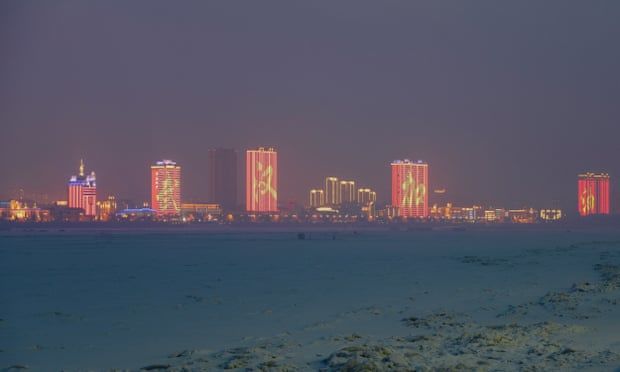 ‘Stay strong, Wuhan!’ The Chinese city of Heihe seen from Blagoveschensk, Russia, across the frozen Amur River, February 2020
The initiative, which has been likened to the Silk Road trade routes of imperial China, was proposed by the current Chinese leader, Xi Jinping, as a blueprint to reposition China in the era of globalisation, and to change the world order in a Chinese way. The thinking behind this $1tn project is ambitious. Such long-term planning, coherent political goals and effective implementation are rare, both in Chinese and in human history. The ruling party in China has laid bare its determination to occupy an important role in the world.
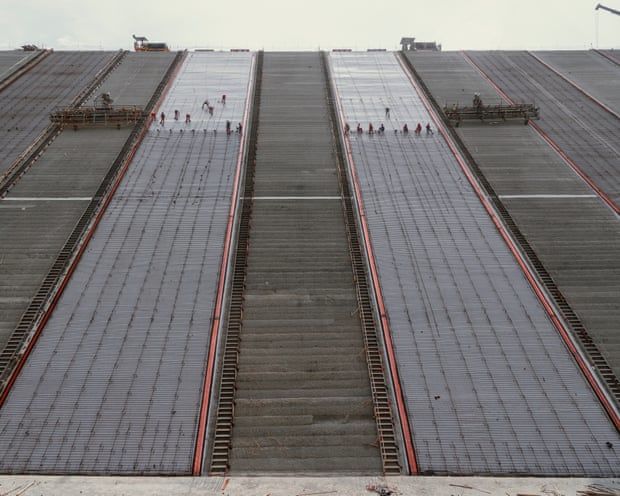
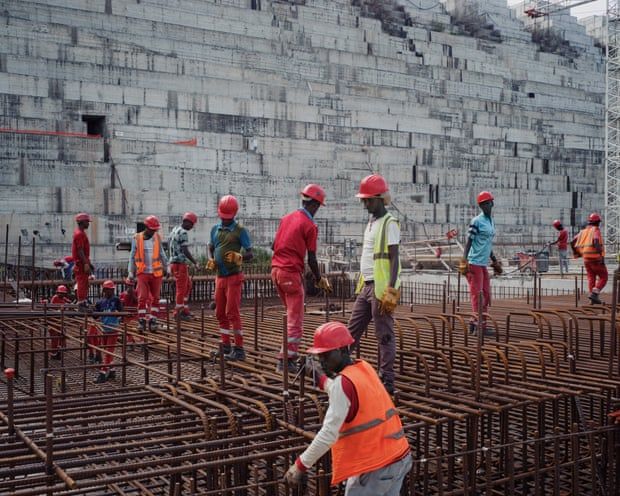 Local people at work on the Great Renaissance
dam, Ethiopia, September 2019. The mammoth project, which began on the
Blue Nile in 2011, is one of the largest hydroelectric power plants in
the world. China has contributed about $1.8bn of the $4.8bn total cost
Local people at work on the Great Renaissance
dam, Ethiopia, September 2019. The mammoth project, which began on the
Blue Nile in 2011, is one of the largest hydroelectric power plants in
the world. China has contributed about $1.8bn of the $4.8bn total cost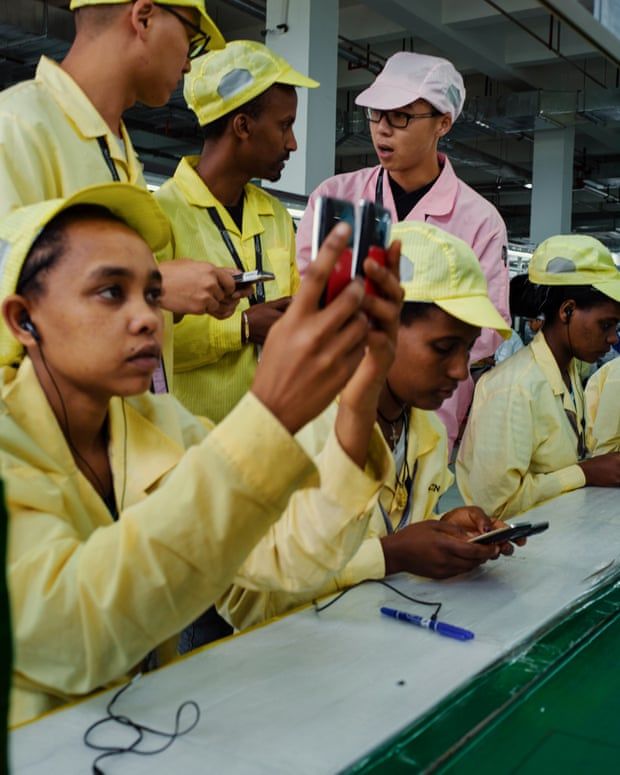 The Tecno Mobile factory in Addis Ababa,
Ethiopia, September 2019. The Chinese phone manufacturer stopped doing
business in Asia in 2008 to focus on the African market. It is now the
second biggest supplier of smartphones on the continent
The Tecno Mobile factory in Addis Ababa,
Ethiopia, September 2019. The Chinese phone manufacturer stopped doing
business in Asia in 2008 to focus on the African market. It is now the
second biggest supplier of smartphones on the continent
The goals of the belt and road initiative are pragmatic, unlike those proposed by the Chinese Communist party in their early days, and embodied in slogans such as “Exceeding the UK, Catching the US” in the 50s and 60s. China, with a huge amount of accumulated wealth and managerial and production experience, has understood that it can fill the gaps in parts of the world that are forgotten and abandoned by the west. These regions thirst for a strong economic entity to piece together fragmented, disorganised territories with longstanding historical differences. This is where China comes in.
About 145 nations have joined the belt and road initiative by signing a memorandum of understanding with China, including countries in Europe, south-east Asia and the Middle East. It is an initiative that mainly focuses on basic infrastructure and engineering projects, such as transportation through rail, road and ports, to facilitate global trade and offer solutions to the problems of developing countries – as the Chinese saying goes, “If you want to be rich, build roads first.” Many people in China, and also in the developing world, feel optimistic about this initiative, and mock Europe and the US for failing to match its vision.
 Aktau, Kazakhstan, October 2017. The city’s
port offers access to the Caspian Sea; from 2016 to 2020, trade between
China and the Caucasus region almost doubled
Aktau, Kazakhstan, October 2017. The city’s
port offers access to the Caspian Sea; from 2016 to 2020, trade between
China and the Caucasus region almost doubled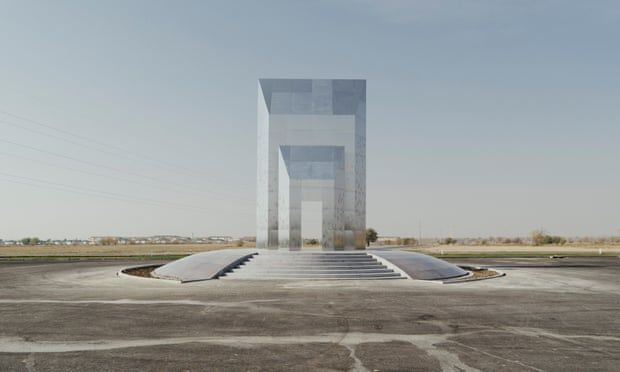 A monument in Nurkent, Kazakhstan, October
2017. The newly built town will accommodate 100,000 workers serving the
nearby Khorgos dry port. A Chinese logistics company has 49% ownership
of the land
A monument in Nurkent, Kazakhstan, October
2017. The newly built town will accommodate 100,000 workers serving the
nearby Khorgos dry port. A Chinese logistics company has 49% ownership
of the land
The belt and road was not a decision taken on a whim. The idea comes from an article by Mao Zedong titled “People of the world, unite and defeat the US aggressors and all their lackeys”, published in 1970 and commonly known as the “520 statement”. In this article, Mao prompted the developing world to be united and fight against western political power led by the US. He stressed the importance of nationalist revolutions, independence and liberation movements as the wave of unstoppable historical change. Mao quoted the Confucian philosopher Mencius – “a just cause attracts much support, an unjust one finds little” – to illustrate his belief that people in the world would triumph over Anglo-American imperialism.
When my generation was growing up, these thoughts permeated the entire country. I belong to the same generation as Xi. We were encouraged to “have the entire motherland in mind and the whole world in view” and to start revolutions everywhere in the world. These arrogant ideas relate to the ideology of that era. Based on these thoughts, the belt and road initiative is a strategic move that corresponds to the country’s rapid development. The question is: will its goals be achieved in a world that is much more complicated than it once was?

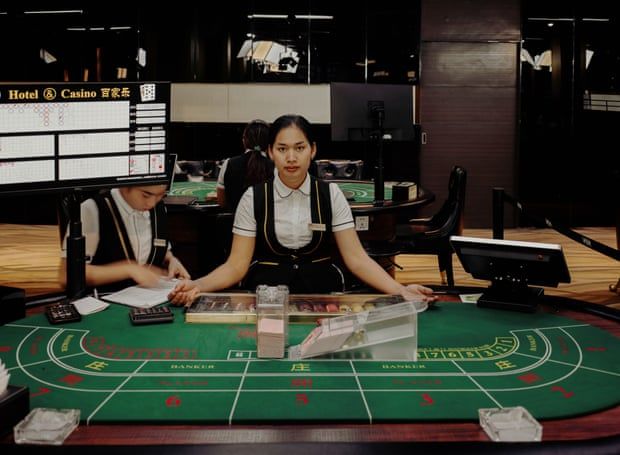 Sihanoukville, Cambodia, December 2019. The
once quiet tourist town on the coast has been transformed, its skyline
dominated by casinos built to accommodate those seeking to avoid the ban
on gambling in mainland China. More than 90% of businesses are
Chinese-owned and locals complain the newcomers are turning the city
into a de facto colony, forcing up rents and making them second-class
citizens in their homeland
Sihanoukville, Cambodia, December 2019. The
once quiet tourist town on the coast has been transformed, its skyline
dominated by casinos built to accommodate those seeking to avoid the ban
on gambling in mainland China. More than 90% of businesses are
Chinese-owned and locals complain the newcomers are turning the city
into a de facto colony, forcing up rents and making them second-class
citizens in their homeland
Monteleone’s photographs are broad in scope and encompass many stories and strange landscapes. The Italian photographer began his project in Russia in 2014 before visiting vast rail and road projects across Asia; container ports; factories; casinos; and the Grand Renaissance dam in Ethiopia. The images clearly depict China’s strategic ambitions, very different from the original Silk Road, which operated from around 130BC until the mid-15th century. The Silk Road was a network of trade routes, whereas the belt and road initiative embeds a political ambition beyond commerce. The issue in question here is: who will be the centre of the world? Who will rise to world power?
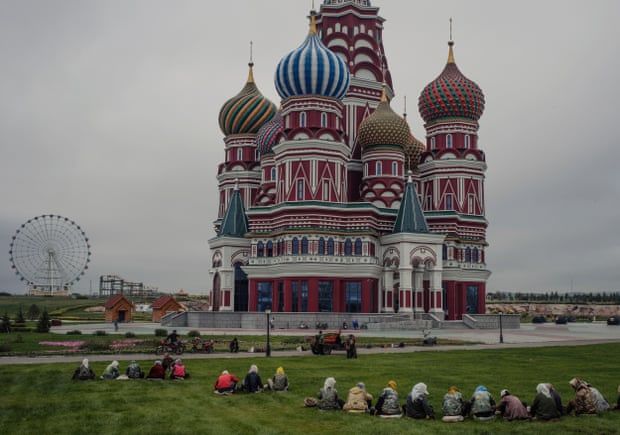 A copy of Moscow’s St Basil’s Cathedral in
Manzhouli, China, August 2015. The small city on the Russian border is
one of China’s biggest trade hubs. The Ukrainian crisis has given fresh
impetus to Chinese efforts to forge a closer relationship between the
two nations, as Russia faces sanctions from the west
A copy of Moscow’s St Basil’s Cathedral in
Manzhouli, China, August 2015. The small city on the Russian border is
one of China’s biggest trade hubs. The Ukrainian crisis has given fresh
impetus to Chinese efforts to forge a closer relationship between the
two nations, as Russia faces sanctions from the west
From my perspective, China refuses to waver in its policies, no matter what setbacks it encounters. The belt and road initiative is its counterattack in a global game of chess. The democracies of Europe and the US are very different from China.

Under pressure to solve short-term problems during their terms of office in order to get re-elected, western governments concentrate their efforts on capital projects and economic competition. The corporatocratic west, primarily measuring political success according to economic profitability, has lost its vision of pursuing mutual benefit and the wellbeing of humankind.
This, however, is not to say that China is necessarily bringing real benefits to the developing world. The belt and road initiative, launched to benefit China, is tinted with colonialism.
It leads this ancient country of 1.4 billion people to a swamp of pragmatism and egoism. While China is pumped up with ambition, it also sinks into contradiction and confusion, because of its lack of self-awareness. The ideological superstructure and economic base will be at odds with each other for a long time.