

Capitalism is killing the planet – it’s time to stop buying into our own destruction
There is a myth about human beings that withstands all evidence. It’s that we always put our survival first. This is true of other species. When confronted by an impending threat, such as winter, they invest great resources into avoiding or withstanding it: migrating or hibernating, for example. Humans are a different matter.
When faced with an impending or chronic threat, such as climate or ecological breakdown, we seem to go out of our way to compromise our survival. We convince ourselves that it’s not so serious, or even that it isn’t happening. We double down on destruction, swapping our ordinary cars for SUVs, jetting to Oblivia on a long-haul flight, burning it all up in a final frenzy. In the back of our minds, there’s a voice whispering, “If it were really so serious, someone would stop us.” If we attend to these issues at all, we do so in ways that are petty, tokenistic, comically ill-matched to the scale of our predicament. It is impossible to discern, in our response to what we know, the primacy of our survival instinct.
Here is what we know. We know that our lives are entirely dependent on complex natural systems: the atmosphere, ocean currents, the soil, the planet’s webs of life. People who study complex systems have discovered that they behave in consistent ways. It doesn’t matter whether the system is a banking network, a nation state, a rainforest or an Antarctic ice shelf; its behaviour follows certain mathematical rules. In normal conditions, the system regulates itself, maintaining a state of equilibrium. It can absorb stress up to a certain point. But then it suddenly flips. It passes a tipping point, then falls into a new state of equilibrium, which is often impossible to reverse.
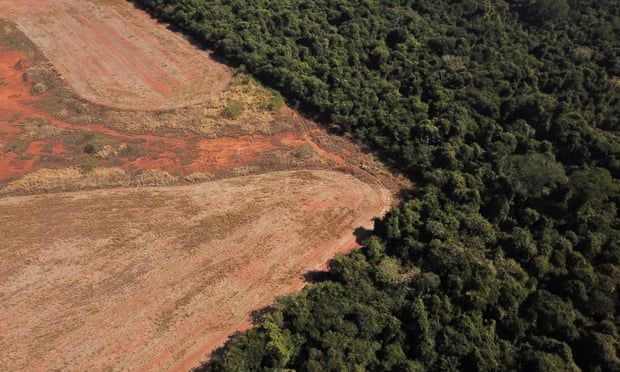 Deforestation in Brazil’s Cerrado: ‘If one
system crashes, it is likely to drag others down, triggering a cascade
of chaos known as systemic environmental collapse.’
Deforestation in Brazil’s Cerrado: ‘If one
system crashes, it is likely to drag others down, triggering a cascade
of chaos known as systemic environmental collapse.’
Human civilisation relies on current equilibrium states. But, all over the world, crucial systems appear to be approaching their tipping points. If one system crashes, it is likely to drag others down, triggering a cascade of chaos known as systemic environmental collapse. This is what happened during previous mass extinctions.
Here’s one of the many ways in which it could occur. A belt of savannah, known as the Cerrado, covers central Brazil. Its vegetation depends on dew forming, which depends in turn on deep-rooted trees drawing up groundwater, then releasing it into the air through their leaves. But over the past few years, vast tracts of the Cerrado have been cleared to plant crops – mostly soya to feed the world’s chickens and pigs. As the trees are felled, the air becomes drier. This means smaller plants die, ensuring that even less water is circulated. In combination with global heating, some scientists warn, this vicious cycle could – soon and suddenly – flip the entire system into desert.
The Cerrado is the source of some of South America’s great rivers, including those flowing north into the Amazon basin. As less water feeds the rivers, this could exacerbate the stress afflicting the rainforests. They are being hammered by a deadly combination of clearing, burning and heating, and are already threatened with possible systemic collapse. The Cerrado and the rainforest both create “rivers in the sky” – streams of wet air – that distribute rainfall around the world and help to drive global circulation: the movement of air and ocean currents.
"The ocean current that brings heat from the tropics is weakening. Without it, the UK would have a climate like Siberia’s
Global circulation is already looking vulnerable. For example, the Atlantic meridional overturning circulation (AMOC), which delivers heat from the tropics towards the poles, is being disrupted by the melting of Arctic ice, and has begun to weaken. Without it, the UK would have a climate similar to Siberia’s.
AMOC has two equilibrium states: on and off. It has been on for almost 12,000 years, following a devastating, thousand-year off state called the Younger Dryas (12,900 to 11,700 years ago), which caused a global spiral of environmental change. Everything we know and love depends on AMOC remaining in the on state.
Regardless of which complex system is being studied, there’s a way of telling whether it is approaching a tipping point. Its outputs begin to flicker. The closer to its critical threshold it comes, the wilder the fluctuations. What we’ve seen this year is a great global flickering, as Earth systems begin to break down. The heat domes over the western seaboard of North America; the massive fires there, in Siberia and around the Mediterranean; the lethal floods in Germany, Belgium, China, Sierra Leone – these are the signals that, in climatic morse code, spell “mayday”.
You might expect an intelligent species to respond to these signals swiftly and conclusively, by radically altering its relationship with the living world. But this is not how we function. Our great intelligence, our highly evolved consciousness that once took us so far, now works against us.
An analysis by the media sustainability group Albert found that “cake” was mentioned 10 times as often as “climate change” on UK TV programmes in 2020. “Scotch egg” received double the mentions of “biodiversity”. “Banana bread” beat “wind power” and “solar power” put together.
I recognise that the media are not society, and that television stations have an interest in promoting banana bread and circuses. We could argue about the extent to which the media are either reflecting or generating an appetite for cake over climate. But I suspect that, of all the ways in which we might measure our progress on preventing systemic environmental collapse, the cake-to-climate ratio is the decisive index.
The current ratio reflects a determined commitment to irrelevance in the face of global catastrophe. Tune in to almost any radio station, at any time, and you can hear the frenetic distraction at work. While around the world wildfires rage, floods sweep cars from the streets and crops shrivel, you will hear a debate about whether to sit down or stand up while pulling on your socks, or a discussion about charcuterie boards for dogs. I’m not making up these examples: I stumbled across them while flicking between channels on days of climate disaster. If an asteroid were heading towards Earth, and we turned on the radio, we’d probably hear: “So the hot topic today is – what’s the funniest thing that’s ever happened to you while eating a kebab?” This is the way the world ends, not with a bang but with banter.
"Most political news is gossip: who’s in, who’s out, who said what. It avoids what lies beneath: the dark money, the corruption …
Faced with crises on an unprecedented scale, our heads are filled with insistent babble. The trivialisation of public life creates a loop: it becomes socially impossible to talk about anything else. I’m not suggesting that we should discuss only the impending catastrophe. I’m not against bants. What I’m against is nothing but bants.
It’s not just on the music and entertainment channels that this deadly flippancy prevails. Most political news is nothing but court gossip: who’s in, who’s out, who said what to whom. It studiously avoids what lies beneath: the dark money, the corruption, the shift of power away from the democratic sphere, the gathering environmental collapse that makes a nonsense of its obsessions.
I’m sure it’s not deliberate. I don’t think anyone, faced with the prospect of systemic environmental collapse, is telling themselves: “Quick, let’s change the subject to charcuterie boards for dogs.” It works at a deeper level than this. It’s a subconscious reflex that tells us more about ourselves than our conscious actions do. The chatter on the radio sounds like the distant signals from a dying star.
There are some species of caddisfly whose survival depends on breaking the surface film of the water in a river. The female pushes through it – no mean feat for such a small and delicate creature – then swims down the water column to lay her eggs on the riverbed. If she cannot puncture the surface, she cannot close the circle of life, and her progeny die with her.
This is also the human story. If we cannot pierce the glassy surface of distraction, and engage with what lies beneath, we will not secure the survival of our children or, perhaps, our species. But we seem unable or unwilling to break the surface film. I think of this strange state as our “surface tension”. It’s the tension between what we know about the crisis we face, and the frivolity with which we distance ourselves from it.
Surface tension dominates even when we claim to be addressing the destruction of our life-support systems. We focus on what I call micro-consumerist bollocks (MCB): tiny issues such as plastic straws and coffee cups, rather than the huge structural forces driving us towards catastrophe. We are obsessed with plastic bags. We believe we’re doing the world a favour by buying tote bags instead, though, on one estimate, the environmental impact of producing an organic cotton tote bag is equivalent to that of 20,000 plastic ones.
"Rich people can persuade themselves they’ve gone green because they recycle, while forgetting they have a second home
We are rightly horrified by the image of a seahorse with its tail wrapped around a cotton bud, but apparently unconcerned about the elimination of entire marine ecosystems by the fishing industry. We tut and shake our heads, and keep eating our way through the life of the sea.
A company called Soletair Power receives wide media coverage for its claim to be “fighting climate change” by catching the carbon dioxide exhaled by office workers. But its carbon-sucking unit – an environmentally costly tower of steel and electronics – extracts just 1kg of carbon dioxide every eight hours. Humanity produces, mostly by burning fossil fuels, roughly 32bn kg of CO2 in the same period.
I don’t believe our focus on microscopic solutions is accidental, even if it is unconscious. All of us are expert at using the good things we do to blot out the bad things. Rich people can persuade themselves they’ve gone green because they recycle, while forgetting that they have a second home (arguably the most extravagant of all their assaults on the living world, as another house has to be built to accommodate the family they’ve displaced). And I suspect that, in some deep, unlit recess of the mind, we assure ourselves that if our solutions are so small, the problem can’t be so big.
I’m not saying the small things don’t matter. I’m saying they should not matter to the exclusion of things that matter more. Every little counts. But not for very much.
Our focus on MCB aligns with the corporate agenda. The deliberate effort to stop us seeing the bigger picture began in 1953 with a campaign called Keep America Beautiful. It was founded by packaging manufacturers, motivated by the profits they could make by replacing reusable containers with disposable plastic. Above all, they wanted to sink state laws insisting that glass bottles were returned and reused. Keep America Beautiful shifted the blame for the tsunami of plastic trash the manufacturers caused on to “litter bugs”, a term it invented.
The “Love Where You Live” campaign, launched in the UK in 2011 by Keep Britain Tidy, Imperial Tobacco, McDonald’s and the sweet manufacturer Wrigley, seemed to me to play a similar role. It had the added bonus – as it featured strongly in classrooms – of granting Imperial Tobacco exposure to schoolchildren.
The corporate focus on litter, amplified by the media, distorts our view of all environmental issues. For example, a recent survey of public beliefs about river pollution found that “litter and plastic” was by far the biggest cause people named. In reality, the biggest source of water pollution is farming, followed by sewage. Litter is way down the list. It’s not that plastic is unimportant. The problem is that it’s almost the only story we know.
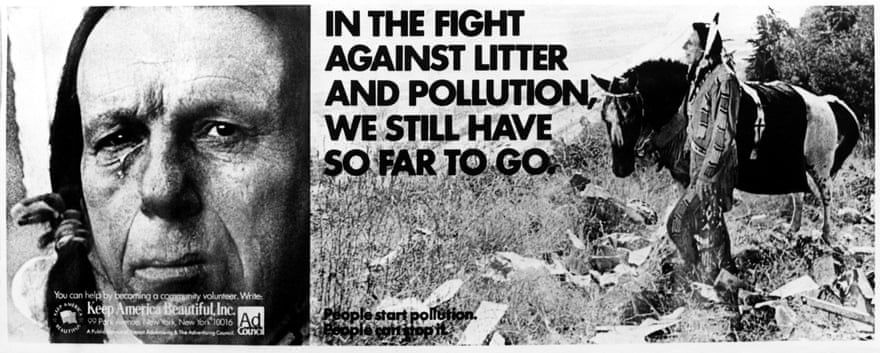 Like Keep Britain Tidy, the Keep America Beautiful ad campaign shifted responsibility away from big corporations.
In 2004, the advertising company Ogilvy & Mather, working for the oil giant BP, took this blame-shifting a step further by inventing the personal carbon footprint. It was a useful innovation, but it also had the effect of diverting political pressure from the producers of fossil fuels to consumers. The oil companies didn’t stop there. The most extreme example I’ve seen was a 2019 speech by the chief executive of the oil company Shell, Ben van Beurden. He instructed us to “eat seasonally and recycle more”, and publicly berated his chauffeur for buying a punnet of strawberries in January.
The great political transition of the past 50 years, driven by corporate marketing, has been a shift from addressing our problems collectively to addressing them individually. In other words, it has turned us from citizens into consumers. It’s not hard to see why we have been herded down this path. As citizens, joining together to demand political change, we are powerful. As consumers, we are almost powerless.
In his book Life and Fate, Vasily Grossman notes that, when Stalin and Hitler were in power, “one of the most astonishing human traits that came to light at this time was obedience”. The instinct to obey, he observed, was stronger than the instinct to survive. Acting alone, seeing ourselves as consumers, fixating on MCB and mind-numbing trivia, even as systemic environmental collapse looms: these are forms of obedience. We would rather face civilisational death than the social embarrassment caused by raising awkward subjects, and the political trouble involved in resisting powerful forces. The obedience reflex is our greatest flaw, the kink in the human brain that threatens our lives.
What do we see if we break the surface tension? The first thing we encounter, looming out of the depths, should scare us almost out of our wits. It’s called growth. Economic growth is universally hailed as a good thing. Governments measure their success on their ability to deliver it. But think for a moment about what it means. Say we achieve the modest aim, promoted by bodies like the IMF and the World Bank, of 3% global growth a year. This means that all the economic activity you see today – and most of the environmental impacts it causes – doubles in 24 years; in other words, by 2045. Then it doubles again by 2069. Then again by 2093. It’s like the Gemino curse in Harry Potter and the Deathly Hallows, which multiplies the treasure in the Lestrange vault until it threatens to crush Harry and his friends to death. All the crises we seek to avert today become twice as hard to address as global economic activity doubles, then twice again, then twice again.
Have we reached the bottom yet? By no means. The Gemino curse is just one outcome of a thing we scarcely dare mention. Just as it was once blasphemous to use the name of God, even the word appears, in polite society, to be taboo: capitalism.
"The main cause of your environmental impact is your money. You persuade yourself you’re a green mega-consumer, but you’re just a mega-consumer
Most people struggle to define the system that dominates our lives. But if you press them, they’re likely to mumble something about hard work and enterprise, buying and selling. This is how the beneficiaries of the system want it to be understood. In reality, the great fortunes amassed under capitalism are not obtained this way, but through looting, monopoly and rent grabbing, followed by inheritance.
One estimate suggests that, over the course of 200 years, the British extracted from India, at current prices, $45tn. They used this money to fund industrialisation at home and the colonisation of other nations, whose wealth was then looted in turn.
The looting takes place not just across geography, but also across time. The apparent health of our economies today depends on seizing natural wealth from future generations. This is what the oil companies, seeking to distract us with MCB and carbon footprints, are doing. Such theft from the future is the motor of economic growth. Capitalism, which sounds so reasonable when explained by a mainstream economist, is in ecological terms nothing but a pyramid scheme.
Is this the riverbed? No. Capitalism is just a means by which something even bigger is pursued. Wealth.
It scarcely matters how green you think you are. The main cause of your environmental impact isn’t your attitude. It isn’t your mode of consumption. It isn’t the choices you make. It’s your money. If you have surplus money, you spend it. While you might persuade yourself that you are a green mega-consumer, in reality you are just a mega-consumer. This is why the environmental impacts of the very rich, however right-on they may be, are massively greater than those of everyone else.
Preventing more than 1.5C of global heating means that our average emissions should be no greater than two tonnes of carbon dioxide per person per year. But the richest 1% of the world’s people produce an average of more than 70 tonnes. Bill Gates, according to one estimate, emits almost 7,500 tonnes of CO2, mostly from flying in his private jets. Roman Abramovich, the same figures suggest, produces almost 34,000 tonnes, largely by running his gigantic yacht.
The multiple homes that ultra-rich people own might be fitted with solar panels, their supercars might be electric, their private planes might run on biokerosene, but these tweaks make little difference to the overall impact of their consumption. In some cases, they increase it. The switch to biofuels favoured by Bill Gates is now among the greatest causes of habitat destruction, as forests are felled to produce wood pellets and liquid fuels, and soils are trashed to make biomethane.
"There is a poverty line below which no one should fall, and a wealth line above which no one should rise. We need wealth taxes, not carbon taxes
But more important than the direct impacts of the ultra-wealthy is the political and cultural power with which they block effective change. Their cultural power relies on a hypnotising fairytale. Capitalism persuades us that we are all temporarily embarrassed millionaires. This is why we tolerate it. In reality, some people are extremely rich because others are extremely poor: massive wealth depends on exploitation. And if we did all become millionaires, we would cook the planet in no time at all. But the fairytale of universal wealth, one day, secures our obedience.
The difficult truth is that, to prevent climate and ecological catastrophe, we need to level down. We need to pursue what the Belgian philosopher Ingrid Robeyns calls limitarianism. Just as there is a poverty line below which no one should fall, there is a wealth line above which no one should rise. What we need are not carbon taxes, but wealth taxes. It shouldn’t surprise us that ExxonMobil favours a carbon tax. It’s a form of MCB. It addresses only one aspect of the many-headed environmental crisis, while transferring responsibility from the major culprits to everyone. It can be highly regressive, which means that the poor pay more than the rich.
But wealth taxes strike at the heart of the issue. They should be high enough to break the spiral of accumulation and redistribute the riches accumulated by a few. They could be used to put us on an entirely different track, one that I call “private sufficiency, public luxury”. While there is not enough ecological or even physical space on Earth for everyone to enjoy private luxury, there is enough to provide everyone with public luxury: magnificent parks, hospitals, swimming pools, art galleries, tennis courts and transport systems, playgrounds and community centres. We should each have our own small domains – private sufficiency – but when we want to spread our wings, we could do so without seizing resources from other people.
In consenting to the continued destruction of our life-support systems, we accommodate the desires of the ultra-rich and the powerful corporations they control. By remaining trapped in the surface film, absorbed in frivolity and MCB, we grant them a social licence to operate.
We will endure only if we cease to consent. The 19th-century democracy campaigners knew this, the suffragettes knew it, Gandhi knew it, Martin Luther King knew it. The environmental protesters who demand systemic change have also grasped this fundamental truth. In Fridays for Future, Green New Deal Rising, Extinction Rebellion and the other global uprisings against systemic environmental collapse, we see people, mostly young people, refusing to consent. What they understand is history’s most important lesson. Our survival depends on disobedience.