

Cosmic colonialism: the race to mine space
When conspiracy theorists examine the first moon landing with a sceptical eye, they look at the flag and note that it appears to be flapping in the wind. “Ah ha!” they squawk. “But there is no wind on the moon, therefore the whole thing was a fake and was being filmed on a Hollywood set somewhere, presumably equipped with a wind machine.”
But, of course, the flag is behaving as all flags do, on the moon or anywhere else, when they are being manoeuvred into position. And the crucial point that the conspiracy theorists miss, which is staring them in the face, is that this is an American flag.
Neil Armstrong and Buzz Aldrin were doing exactly what Captain Cook did in Botany Bay and Christopher Columbus did before him: sticking a flag in the earth and thereby – implicitly in the case of Apollo 11 – laying claim to ownership of territory.
Except that in this case it wasn’t Earth. The scramble for outer space had begun. And it continues apace. It’s not Star Wars – not yet. But the carve-up of great chunks of extraterrestrial real estate is taking place right now.
Philosopher Jean-Jacques Rousseau noted that inequality originated the day someone drew a line around a patch of earth and said: “This is mine!” Now those lines are being drawn on other planets, and moons and asteroids. Dmitry Rogozin, head of the Russian space corporation Roscosmos, recently asserted: “Venus is a Russian planet.” Meanwhile, the United States is determined to brand its name into everything spinning around the solar system.
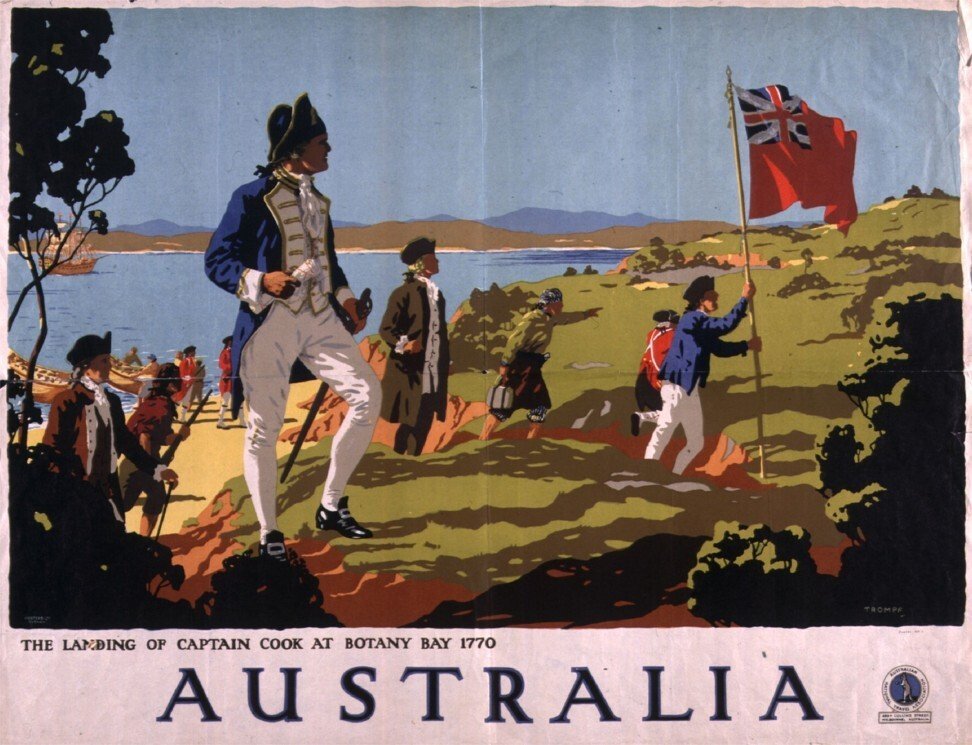
There is a fundamental principle at work here, best summed up in the infantile expression, “bags I!” If we can get our hands – or even remotely controlled robots – on it first, then it’s ours. The Latin version is: terra nullius – it’s nobody’s land. No one lives there. Which was the lie perpetrated about Australia and recycled again and again by rampant imperialists the world over.
In this case, there really is no one out there, unless you count bacteria. But soon there will be. And the squabbling over who owns what has already begun. The answer would appear to be quite simple: “We do!”
Nationalism is not only international but interplanetary. Colonialism never went away, it has simply got rockets attached and boldly gone where no one has gone before. And the great motivation, as ever, is that there’s gold in them thar hills, even if they are millions of miles away. El Dorado may yet be found, possibly on the moons of Mars or Saturn.
An article published last month in Science magazine, “US policy puts the safe development of space at risk”, argues that the US is blasting its America First policy into outer space.
“Science is the highly respected, peer-reviewed journal of the American Association for the Advancement of Science and publishes not only scientific research but also opinion on science-related policy.
The measured but hard-hitting article was written by two co-authors: one an astronomer, Aaron Boley, and the other a political scientist, Michael Byers, both at the University of British Columbia, in Vancouver, Canada.
In August, they were behind the “International Open Letter on Space Mining” that gained more than 100 signatories, including three Nobel laureates, and called on the United Nations to establish a multilateral framework for space mining.
“Powerful countries have always sought to shape the international system in their favour,” Byers tells me, ahead of the November 3 US election.
“The US was once a founding member of the UN. The current US administration [under Donald Trump] has decided that it doesn’t want to subscribe to the multilateral approach.” Whether on this planet or any other.
In April, Trump signed an executive order legitimising commercial space mining. In September, US space agency Nasa announced that it is putting out to tender a plan to mine “regolith”, the moon’s heterogeneous surface layer. There is talk of mining lunar Helium-3, which could be the solution to nuclear fusion, and hydrogen and oxygen, useful for concocting water.
But whether or not moon dust turns out to have value, a precedent will be established: if we have the ability to extract pieces of extraterrestrial territory, then we will, regardless of anyone else.
America is attempting to impose the so-called Artemis Accords on other nations, which would allow commercial space mining subject only to national – not multinational – regulation. “Negotiations” are under way, but the reality is that those who don’t sign up to the Artemis Accords will not be participating in any of the space programmes controlled by Nasa.
“It’s an interpretation of law,” says Byers. “But it is a power play.” If the US “interpretation” is accepted, then the US will become, as Byers and Boley argue in their article, “the de facto gatekeeper to the moon, asteroids and other celestial bodies”.
They point out that since acquiescence is often treated as consent under international law, then other nations need to make a stand, before the US plants stars and stripes on all the stars in heaven. Their article is a call to revolt, before it’s too late – or, as Byers puts it, “an awareness-raising exercise: other countries need to speak up”.

US law is already asserting its jurisdiction over space. In 2015, the Commercial Space Launch Competitiveness Act allowed American citizens to own and sell portions of other celestial bodies – under US law. No matter what Martians or Venusians or, for that matter, other Earthlings might have to say on the subject.
Luxembourg followed suit. And, as far as we know, it doesn’t even own a rocket. It is part of what Byers and Boley call, paradoxically enough, a “race to the bottom”, blowing a spaceship-sized hole through any notion of all-inclusive rules and regulations. Soon we are all going to be jumping on the warp-speed bandwagon, asserting our rights in law well in advance of any objective reality.
It will surprise no one that Trump’s executive order explicitly dismisses the 1979 UN Moon Agreement as irrelevant and rejects the idea of a “global commons” according to which space is declared the “common heritage of mankind”.
Article II of the 1967 Outer Space Treaty states that “outer space, including the moon and other celestial bodies, is not subject to national appropriation by claim of sovereignty, by means of use or occupation, or by any other means”.
Nasa says that it is operating in accordance with the Outer Space Treaty. But any notion of a multilateral, collaborative approach to space mining is unilaterally incinerated on the launch pad.
America First, on this or any other planet. One small step for a man, one giant leap for homo Americanus. Nasa and the Elon Musk SpaceX private initiative (soon to be joined by Jeff Bezos’ Blue Origin) look like the spearhead for a new Galactic Empire.
Russia, in particular, has denounced the Artemis Accords as a US conspiracy to pervert space law. Nasa administrator Jim Bridenstine draws an analogy between space and fishing on the high seas, beyond any national jurisdiction.
A fish cannot be owned so long as it remains safely in the sea: but if someone should happen to hook the fish, then the fisherman owns the fish. Space mining is angling on an interplanetary scale. And as Byers and Boley note, “fishing without science-based regulation often leads to overexploitation and even destruction of stocks”.
Part of the danger is ecological. We are talking about pollution and health and safety in this and other worlds. Mining has never been without risk. A list of great mining disasters would be as long as this article. And the names of the dead sacrificed in the cause of extracting lumps of coal and other valuable mineral deposits would stretch from here to the moon and back.
Now consider what it will be like in space. Safer? That’s not likely. Moons but especially asteroids have low or almost zero gravity. Anything that gets blasted out of the ground will keep on moving.
Space is going to be littered with debris. Some is going to shoot back towards Earth. What goes up will eventually come down. And we – the people left in sublunary space – will be right in the firing line.
If an asteroid does eventually hit the Earth, as in our most apocalyptic nightmares, it may well be because we aimed it in this direction and lost control, thereby creating what Byers and Boley call an “anthropogenic meteoroid”. What court could possibly prosecute the mad mining magnates of Jupiter? None at all, if the US has its way.
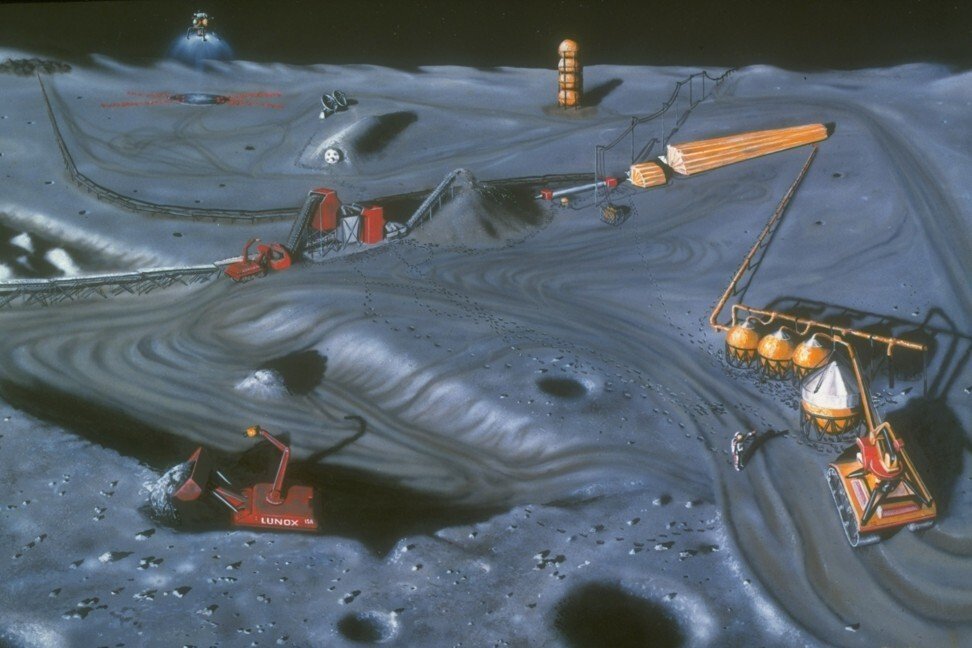
The solar system is going to look like the Wild West, or possibly Alaska in the days of the Gold Rush, even if the new Regolith Rush will mostly be carried on by remote control. The same spirit of reckless and potentially lethal aggression will prevail. With the strong likelihood of ecocide.
SpaceX already has a Tesla electric car zooming through space in the direction of Mars. Israel has smashed a robotic lander into the moon, bearing thousands of semi-indestructible “tardigrades”, micro-animals, now presumably swarming across the Sea of Tranquillity. Ultimately, there will be lawyers in space, arguing over who owns what.
Meanwhile, we already have space lawyers right here on Earth. Christopher Newman is a professor of space law and policy at Northumbria University, in Britain, and has published widely on the subject. I fully expect Prime Minister Boris Johnson to announce that Britain is “world-beating” in the realm of space law.
Newman points out that there is ambiguity built into space law. “It’s true that Article II of the Outer Space Treaty prohibits national appropriation. But Article I says that states are free to use space and explore and investigate without restriction.”
In other words, all celestial bodies should, in principle, remain res communis omnium, or “the province of all mankind”; but in practice that word “use” is a broad term.
It could be said that by mining a planet you are appropriating it. But commercial entities will argue they are only looking to exploit the extraterrestrial environment and extract minerals and other natural resources.
They are not making claims of ownership. Newman says that, by the same token, when the Americans landed the first men on the moon and planted the flag, “they stressed that they were not making territorial claims: they were only saying, we’re Americans and we’re happy to be here”.

Newman is more sympathetic to the Artemis Accords than Byers and Boley. “A lot of what it’s saying makes sense. To do with sharing data and taking care of debris and creating a zone of safety,” he says. “A lot of existing space law is there. And anything that brings clarity to space is to be lauded.”
The Moon Agreement of 1979 makes it clear that “any mining that occurred on the moon and other celestial bodies should be administered by an international regime”.
But, as Newman points out, the reality is that none of the major players in space – the US, Russia, China, Japan – have signed up to the treaty. “Indeed, America has explicitly repudiated it – and hopes that the Artemis Accords will become the established way of doing business on the moon.”
The US is heavily invested in the tagline of the 1979 movie Alien: In space, no one can hear you scream. Or protest about infringements of the law or getting clobbered by flying space junk.
The post-truth is out there. Britain’s Astronomer Royal, Martin Rees, says that we need to get “internationally agreed” rules for mining in space nailed down now because “it will be far harder when commercial pressures have really built up”.
In their article for Science, Byers and Boley urge the US to join in talks with the UN Committee on the Peaceful Uses of Outer Space, the body that drafted the original Outer Space treaties. But unless there is a 180-degree rotation towards a more multinational – genuinely terrestrial – approach to the universe, you might as well wish for the moon.