Arab Press

بالشعب و للشعب
Monday, Jan 05, 2026

EU signs US gas deal to curb reliance on Russia

EU signs US gas deal to curb reliance on Russia

The US and the EU have announced a major deal on liquified natural gas, in an attempt to reduce Europe's reliance on Russian energy.

The agreement will see the US provide the EU with extra gas, equivalent to around 10% of the gas it currently gets from Russia, by the end of the year.

The bloc has already said it will cut Russian gas use in response to Russia's invasion of Ukraine.

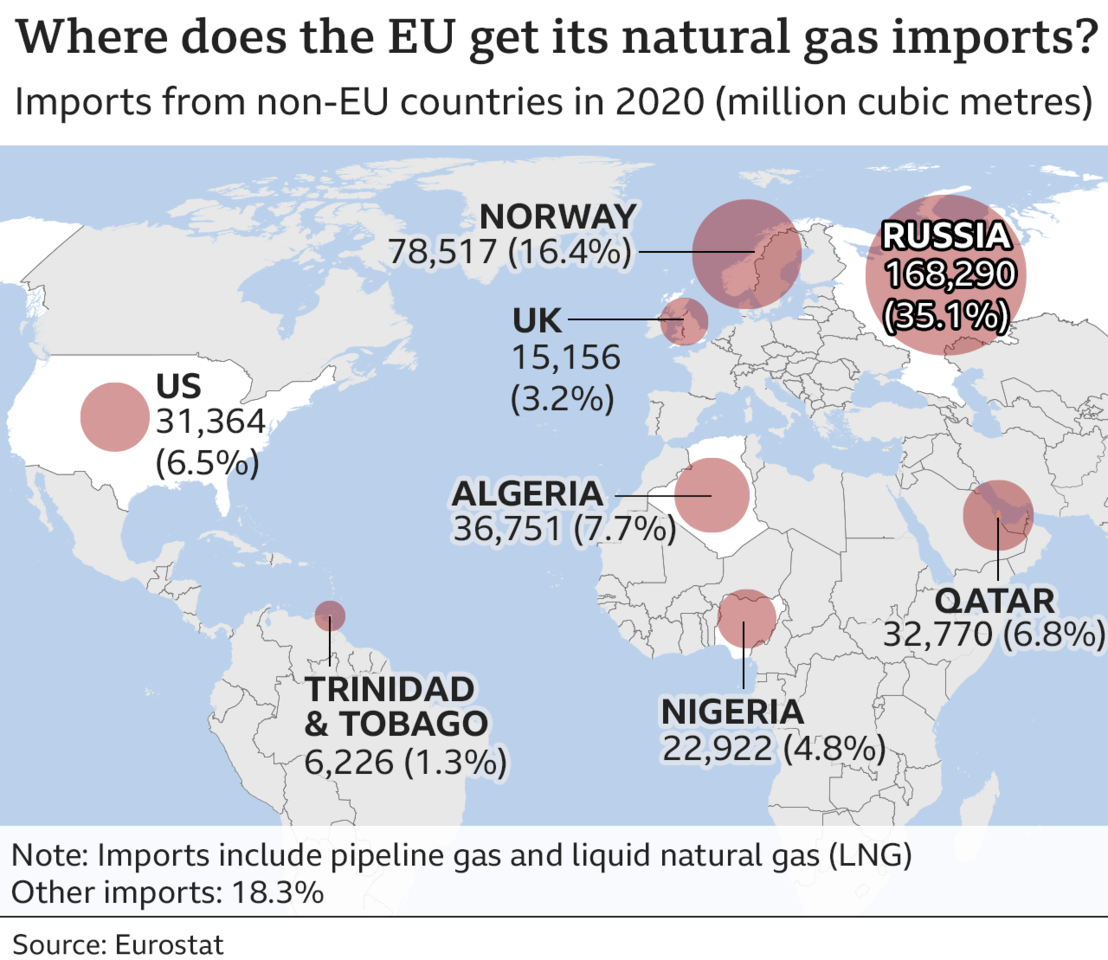
Russia currently supplies about 40% of the EU's gas needs.

The new deal will involve the US and other countries supplying an extra 15 billion cubic metres of gas on top of last year's 22 billion cubic metres.

The new total will represent around 24% of the gas currently imported from Russia.

The eventual aim is for the US and international partners to provide about 50 billion cubic metres per year to the EU.

Cutting reliance on Russia will mean generating more renewable energy and improving energy efficiency as well as increasing imports.

The deal was announced on Friday during a three-day visit by US President Joe Biden to Brussels.

Mr Biden and European Commission President Ursula von der Leyen discussed Russia's invasion of Ukraine and offered fresh support to Kyiv.

"Putin is using Russia's energy resources to coerce and manipulate its neighbours," Mr Biden told reporters in Brussels. "He's used the profits to drive his war machine."

He said the long term benefits of the deal would outweigh the short term pain that reducing Russian gas supplies would cause.

"I know that eliminating Russian gas will have costs for Europe, but it's not only the right thing to do from a moral standpoint, it's going to put us on a much stronger strategic footing."

President von der Leyen said: "We want, as Europeans, to diversify away from Russia towards suppliers that we trust that are friends and that are reliable."

She pointed out that the target 50 billion cubic metres per year "is replacing one-third already of the Russian gas going to Europe today. So we are right on track now to diversify away from Russian gas."


The EU gets 40% of its gas from Russia. If it's to wean itself off that dependency, it needs to get its energy elsewhere.

The question is, where from?

Gas is already piped from Norway - but those pipelines are already operating at maximum capacity. The EU gets relatively little from the North Sea.

New supplies will have to come from further afield, in the form of LNG - gas that's been chilled and liquified.

But there's already intense competition for LNG supplies from countries such as Algeria and Qatar, and that's been pushing up prices.

The 50 billion cubic metres of gas a year from the US - more than double the current quantity - would certainly be welcome.

But it still wouldn't fill the gap if Russian supplies were removed.

There are also question marks over how much gas the US can supply, how quickly it can increase exports to the EU - and how much those shipments will cost.

The EU has been enjoying cheap gas for many years - but now it seems to have accepted that era is coming to an end.

Russia's war with Ukraine has helped push energy prices to record highs.

Energy prices were already rising before the invasion as economies started to recover from the Covid crisis.

The Ukraine invasion prompted the EU to pledge to cut Russian gas use by two-thirds this year by hiking imports from other countries and boosting renewable energy.

The White House said that greater energy efficiency can be immediately achieved through increasing the use of smart thermostats and heat pumps.

The EU said that reductions through energy savings in homes can replace 15.5 billion cubic metres this year and that accelerating wind and solar deployment can replace 20 billion cubic metres.

The EU's goal is to save 170 billion cubic metres by 2030 through energy efficiency and by using renewable energy.

That 170 billion on top of the planned 50 billion of additional gas from the US and other countries means Europe's reliance on Russian gas could be replaced by 2030.

Russia sanctions


In response to Russia's invasion of Ukraine, the US is banning all Russian oil and gas imports and the UK will phase out Russian oil imports by the end of 2022.

The EU has said it will switch to alternative supplies and make Europe independent from Russian energy "well before 2030".

Germany has put on hold permission for the Nord Stream 2 gas pipeline from Russia to open.

Meanwhile in the UK petrol prices have hit record highs as oil and gas costs soar.

Oil jumped to $139 a barrel at one point earlier this month, the highest level for almost 14 years, while wholesale gas prices for next-day delivery more than doubled.

Newsletter

Related Articles

Arab Press
0:00
0:00
Close
CNN’s Ranking of Israel’s Women’s Rights Sparks Debate After Misleading Global Index Comparison
Saudi Arabia’s Shifting Regional Alignment Raises Strategic Concerns in Jerusalem
OPEC+ Holds Oil Output Steady Amid Member Tensions and Market Oversupply
Iranian Protests Intensify as Another Revolutionary Guard Member Is Killed and Khamenei Blames the West
President Trump Says United States Will Administer Venezuela Until a Secure Leadership Transition
Delta Force Identified as Unit Behind U.S. Operation That Captured Venezuela’s President
Saudi-UAE Rift Adds Complexity to Middle East Diplomacy as Trump Signals Firm Leadership
OPEC+ to Keep Oil Output Policy Unchanged Despite Saudi-UAE Tensions Over Yemen
Saudi Arabia and UAE at Odds in Yemen Conflict as Southern Offensive Deepens Gulf Rift
Abu Dhabi ‘Capital of Capital’: How Abu Dhabi Rose as a Sovereign Wealth Power
Diamonds Are Powering a New Quantum Revolution
Trump Threatens Strikes Against Iran if Nuclear Programme Is Restarted
Why Saudi Arabia May Recalibrate Its US Spending Commitments Amid Rising China–America Rivalry
Riyadh Air’s First Boeing 787-9 Dreamliner Completes Initial Test Flight, Advancing Saudi Carrier’s Launch
Saudi Arabia’s 2025: A Pivotal Year of Global Engagement and Domestic Transformation
Saudi Arabia to Introduce Sugar-Content Based Tax on Sweetened Drinks from January 2026
Saudi Hotels Prepare for New Hospitality Roles as Alcohol Curbs Ease
Global Airports Forum Highlights Saudi Arabia’s Emergence as a Leading Aviation Powerhouse
Saudi Arabia Weighs Strategic Choice on Iran Amid Regional Turbulence
Saudi Arabia Condemns Sydney Bondi Beach Shooting and Expresses Solidarity with Australia
Washington Watches Beijing–Riyadh Rapprochement as Strategic Balance Shifts
Saudi Arabia’s Vision 2030 Drives Measurable Lift in Global Reputation and Influence
Alcohol Policies Vary Widely Across Muslim-Majority Countries, With Many Permitting Consumption Under Specific Rules
Saudi Arabia Clarifies No Formal Ban on Photography at Holy Mosques for Hajj 2026
Libya and Saudi Arabia Sign Strategic MoU to Boost Telecommunications Cooperation
Elon Musk’s xAI Announces Landmark 500-Megawatt AI Data Center in Saudi Arabia
Israel Moves to Safeguard Regional Stability as F-35 Sales Debate Intensifies
Cardi B to Make Historic Saudi Arabia Debut at Soundstorm 2025 Festival
U.S. Democratic Lawmakers Raise National Security and Influence Concerns Over Paramount’s Hostile Bid for Warner Bros. Discovery
Hackers Are Hiding Malware in Open-Source Tools and IDE Extensions
Traveling to USA? Homeland Security moving toward requiring foreign travelers to share social media history
Wall Street Analysts Clash With Riyadh Over Saudi Arabia’s Deficit Outlook
Trump and Saudi Crown Prince Cement $1 Trillion-Plus Deals in High-Profile White House Summit
Saudi Arabia Opens Alcohol Sales to Wealthy Non-Muslim Residents Under New Access Rules
U.S.–Saudi Rethink Deepens — Washington Moves Ahead Without Linking Riyadh to Israel Normalisation
Saudi Arabia and Israel Deprioritise Diplomacy: Normalisation No Longer a Middle-East Priority
As Trump Deepens Ties with Saudi Arabia, Push for Israel Normalization Takes a Back Seat
Thai Food Village Debuts at Saudi Feast Food Festival 2025 Under Thai Commerce Minister Suphajee’s Lead
Saudi Arabia Sharpens Its Strategic Vision as Economic Transformation Enters New Phase
Saudi Arabia Projects $44 Billion Budget Shortfall in 2026 as Economy Rebalances
OPEC+ Unveils New Capacity-Based System to Anchor Future Oil Output Levels
Hong Kong Residents Mourn Victims as 1,500 People Relocated After Devastating Tower Fire
Saudi Arabia’s SAMAI Initiative Surpasses One-Million-Citizen Milestone in National AI Upskilling Drive
Saudi Arabia’s Specialty Coffee Market Set to Surge as Demand Soars and New Exhibition Drops in December
Saudi Arabia Moves to Open Two New Alcohol Stores for Foreigners Under Vision 2030 Reform
Saudi Arabia’s AI Ambitions Gain Momentum — but Water, Talent and Infrastructure Pose Major Hurdles
Tensions Surface in Trump-MBS Talks as Saudi Pushes Back on Israel Normalisation
Saudi Arabia Signals Major Maritime Crack-Down on Houthi Routes in Red Sea
Italy and Saudi Arabia Seal Over 20 Strategic Deals at Business Forum in Riyadh
COP30 Ends Without Fossil Fuel Phase-Out as US, Saudi Arabia and Russia Align in Obstruction Role
×