

Gun crime victims are holding the firearms industry accountable – by taking them to court
With each slaughter of innocents, the gun industry offers its sympathy, argues that even more weapons will make America safer, and gives thanks for a two-decade-old law shielding the firearms makers from legal action by the victims.
Mike Fifer, the chief executive of one of the US’s leading handgun manufacturers, Sturm Ruger, once described the 2005 Protection of Lawful Commerce in Arms Act (PLCAA) as having saved the firearms industry because it stopped in its tracks a wave of lawsuits over the reckless marketing and sale of guns.
But now victims of gun crime are following an alternative path forged by legal actions against cigarette makers, prescription opioid manufacturers and big oil in an attempt to work around PLCAA – and the lack of political will to act on gun control – to hold the firearms industry accountable for the bloody toll of its products.
On Tuesday, Ilene Steur, who was badly injured when a man fired 33 shots on the New York subway in April wounding 10 people, filed a lawsuit accusing the manufacturer of the semi-automatic pistol used in the attack, Glock, of breaching “public nuisance” laws.
Steur’s lawsuit contends that Glock endangered public health and safety in breach of New York state law with an irresponsible marketing campaign to push its gun’s “high capacity and ease of concealment” in an “appeal to prospective purchasers with criminal intent”.
It also accuses Glock of giving significant discounts to American police departments on weapons purchases to “give the gun credibility” in the larger and more lucrative civilian market.
“Gun manufacturers do not live in a bubble,” said Mark Shirian, Steur’s lawyer. “They are aware that their marketing strategies are empowering purchasers with ill intent and endangering the lives of innocent people. This lawsuit seeks to hold the gun industry accountable.”
The public nuisance strategy has been used against the tobacco industry for lying about the link between cigarettes and lung cancer, and with mixed success against pharmaceutical companies for creating the US opioid epidemic by recklessly pushing prescription opioids.
Public nuisance claims are also at the heart of a series of lawsuits by states and municipalities accusing oil firms of covering up and lying about the part fossil fuels play in driving the climate crisis.
Until recently, the gun industry thought PLCAA provided a shield from similar actions. The National Rifle Association persuaded a Republican-controlled Congress to pass the law after the families of people shot by the sniper who terrorised the Washington DC area for three weeks in 2002, killing 10 people, won a total of $2.5m from the gun manufacturer, Bushmaster, and the store that sold the weapon.
But a lawsuit by the families of 20 young children and six staff murdered in the 2012 Sandy Hook elementary school massacre sought to exploit an exception in PLCAA if a firearm is sold in violation of “applicable” state or federal law, in this case public nuisance and consumer protection legislation.
The Connecticut supreme court upheld the argument that PLCAA did not prevent the gun maker being sued for breach of state laws for irresponsibly militaristic marketing campaigns for its semi-automatic rifles aimed at young men. Remington appealed to the US supreme court which declined to take the case while it was still in litigation. In February, Remington settled for $73m.
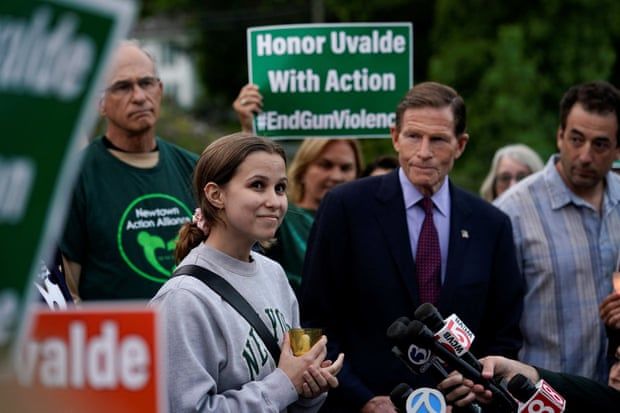 Jordan Gomes, a survivor of the shooting at
Sandy Hook elementary school, stands next to Senator Richard Blumenthal
during a rally for the Uvalde, Texas, community after a mass shooting at
Robb elementary school.
Jordan Gomes, a survivor of the shooting at
Sandy Hook elementary school, stands next to Senator Richard Blumenthal
during a rally for the Uvalde, Texas, community after a mass shooting at
Robb elementary school.
At about the time the Connecticut supreme court ruled in favour of the Sandy Hook families, New York introduced the law Steur is relying on that expands public nuisance legislation to cover gun crimes. On Wednesday, a federal district judge in New York dismissed an attempt by the gun industry to quash the law on the grounds that it pre-empted PLCAA.
Timothy Lytton, a specialist in gun litigation at Georgia State University college of law and author of Suing the Gun Industry, expects the validity of the New York law, and the claim that public nuisance legislation is an exception to the protection given to the gun industry, to be appealed all the way to the US supreme court.
“The most important thing that the supreme court needs to decide with regard to firearms litigation is probably the scope of the federal immunity law and whether or not the exception that was relied upon by the Sandy Hook plaintiffs is a viable legal theory. If it’s a viable legal theory, then I think you’re likely to see an upsurge in litigation,” he said.
But, Lytton said, legal actions against the gun industry face an additional challenge because of the supreme court’s interpretation of the second amendment and the rights it gives to gun owners, a legal area that has also yet to be more widely tested.
“There are limits on the ability to sue a newspaper for libel because of the first amendment. It may be the case that the second amendment has similar restrictions on the ability of individuals to hold the firearms manufacturer liable. But we don’t know what those restrictions might be because we have very little indication from the supreme court about what the second amendment actually protects other than a basic right for an individual to own a firearm that they can use for ordinary purposes,” he said.
Still, as litigation against the tobacco, opioid and oil industries demonstrates, the point of lawsuits is not only to win in court. After each massacre, the gun industry usually seeks to blame the individual shooter and the failure of systems, such as mental health services. Lytton said lawsuits put the focus back on the actions of the firearms makers and forces public discussion of how they sell weapons.
“The impact of litigation is not just about who wins and who loses. It’s about the framing, information disclosure and agenda-setting effects that the litigation process creates even if the plaintiffs lose. A great example of that is clergy sexual abuse.
“Almost none of those suits have been won and almost none of them in front of a jury. But they’ve revolutionised the global church because of these three effects of the litigation,” he said.
Two decades of litigation over the US opioid epidemic that has claimed more than 1 million lives has shifted the focus away from the drug industry’s attempt to blame the victims for their addiction to the big pharma’s responsibility for pushing the wide use of prescription narcotics despite the dangers. Highly embarrassing revelations in several court cases about the drug companies’ cynical marketing techniques helped pressure opioid makers and distributors into settling thousands of lawsuits over the opioid epidemic.
Similarly, states and cities suing the oil industry for lying about the climate crisis hope that public disclosure of what fossil fuel companies knew and when they knew it will add to pressure on big oil to reach settlements.
But Lytton warned that strategy may not have the same impact on the gunmakers.
“There’s something very different about firearms. When it comes to tobacco or opioids or pretty much any other area of public policy in the United States, people tend to reconsider their views and start to rethink the problem,” he said.
“The only place in American public policy where this is not true is in firearms violence. No matter how terrible the tragedy is, people tend to get even more committed to the views that they already have.”