

How the Ukraine conflict could redraw the world air map
All this could have significant consequences for passengers, airlines and the cost of flying if Europe and Russia revive the Cold War era, when sky routes were diverted around an Iron Curtain that extended into the sky.
So far, the United Kingdom and Russia have banned each other's aircraft from overflying or landing on their territories. Other bans have begun to follow, with Poland and the Czech Republic both restricting access to Russian aircraft on Friday.
Apart from punching a significant hole in the aviation traffic map of Eastern Europe, disruption of long-haul traffic is minimal so far. Even Russian aircraft using international airspace over the Atlantic are unaffected, despite the area being managed by air traffic services based in the UK.
During the frostiest days of the Cold War, avoiding the Soviet Bloc meant flying north around Greenland to Alaska, refueling in Anchorage, and then around the Bering Straits to reach Japan. China-bound flights skirted the Black Sea and Caucasus, avoiding Afghanistan and entering China across Central Asia.
We're not there yet. And perhaps thanks to the range of modern aircraft, such steps won't be needed.
The effects on already Covid-impacted commercial airlines and their passengers will at this point be relatively limited if the bans stay between Russia on one side and the UK, Poland and Czech Republic on the other. Equally, the situation could easily escalate.
Shadow of Covid
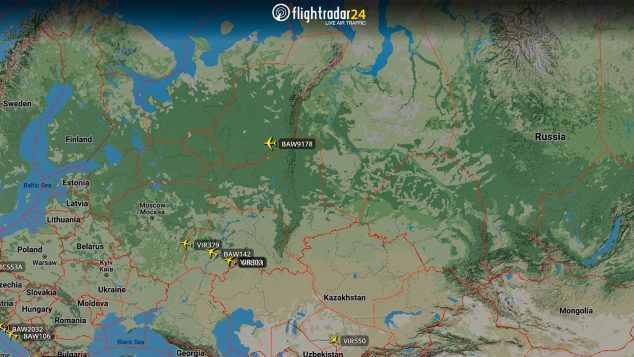 On February 4, multiple UK-registered aircraft were transiting Russian airspace.
"Because of Russia's geographic scale, overflights from airlines all over the world pass through Russian airspace each day," Mikael Robertsson, co-founder of aircraft tracking service Flightradar24, tells CNN. "From the UK, normally about a dozen flights each day pass through Russia en route to places like Hong Kong and India.
"From the EU, hundreds of flights each transit through Russia en route to destinations in Asia. And from the US, most cargo traffic between the US and Asia passes through at least a small portion of Russian airspace. Pre-Covid, the numbers were even greater, especially from the UK, but long-haul passenger flights have yet to really recover."
In terms of flight services, the only Russian passenger airline serving the UK is Aeroflot. The UK's largest carrier, British Airways, served Moscow before the war. BA's parent company, International Airlines Group, has announced that its airlines will not be overflying Russian airspace.
At the beginning of the conflict, the US Federal Aviation Administration issued NOTAM (Notice To Air Missions) instructions to US carriers to avoid operations in areas that include all of Ukraine, Belarus and western parts of Russia. Few US passenger airlines overfly Russia, with nonstop flights to India slow to restart after aviation's Covid shutdowns.
British Airways' and Virgin Atlantic's Asian networks, meanwhile, have largely not been restored after being suspended because of the Covid-19 pandemic. The relatively closed borders of Japan, China and other countries to international arrivals for public health reasons mean that passenger services by UK airlines remain limited.
Already stretched by the online shopping boom since the pandemic began, as well as the requirements driven by pandemic response, cargo carriers such as FedEx, UPS, Atlas, Kalitta, Western Global and others may see further effects.
These airlines do regularly overfly Russia, but the way their route networks are structured is different to passenger airlines. There are shorter flights to save fuel and enable the use of older or lower-range aircraft such as the Boeing 767, McDonnell-Douglas MD-11 and Boeing 747-400.
North-south diversions
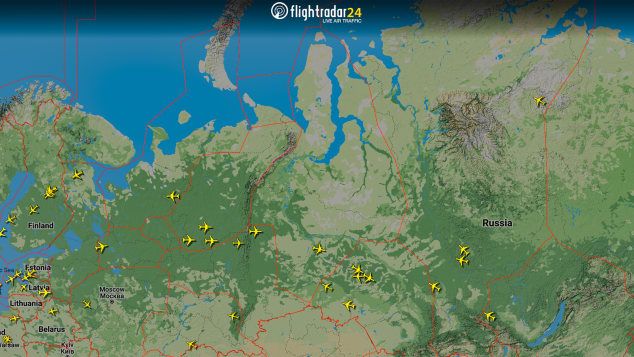 Flights from Amsterdam, Paris and Frankfurt were also transiting Russian airspace on February 4.
Most passenger flights between Europe and Eastern or Southeastern Asia overfly Russia as a simple function of geography.
The first option for airlines avoiding Russia is flying south, skirting the Black Sea and the Caucasus before flying over central Asia. This would be a slightly modified, post-Soviet version of the London-India-Hong Kong routes flown during the Cold War.
Depending on how far south of the Black Sea aircraft would need to fly, this would add roughly two to three hours to the nonstop London-Tokyo timing, but be slightly less than an hour shorter than the second option over Alaska.
The second option is to fly north, over Greenland and far northern Canada to Alaska and the Bering Strait, avoiding eastern Russia. This was the default situation for UK-Japan flights for much of the Cold War, when many airlines added a refuelling stop in Anchorage, Alaska, for flights between Europe and east Asia.
Distance vs. time
In modern-day terms, this Alaska route would add some 1,500 to 2,000 nautical miles to the shortest Great Circle route between London and Tokyo, or roughly three to four hours.
But modern aircraft might not even need to stop in Anchorage. A relatively generous routing from London to Tokyo over northern Alaska, the Aleutian Islands and around the Kuril Islands works out at between 6,500 to 7,000 nautical miles.
This is well within the range of modern aircraft, with roughly 20 air routes prior to and after Covid-19 longer than that, including Dubai to Houston, San Francisco, Los Angeles and Auckland or Hong Kong to Boston and New York.
These flights are, or were, regularly flown by aircraft such as the Airbus A380 or Boeing 777-300ER, which date back some 20 years in terms of technology. Aircraft more than a decade newer, such as the Boeing 787 and Airbus A350 or A330neo, all now in widespread operation, would be even more capable of flying these routes.
Notably, it's unlikely that this stopping route would encounter issues around ETOPS, the set of rules where twin-engined aircraft must remain within a certain time of potential diversion airports. Modern jets are certified for this time limit to be over six hours, and airports in Greenland, northern Canada, Alaska and Japan are more than within range.
Escalations could include other European countries joining the UK in banning Russian airlines and overflights. If this action was at NATO level, it would include Norway (which is a NATO member) but not Sweden and Finland. If it were at EU level, the reverse might be true: Sweden and Finland are EU members but Norway is not, although it has joined the EU in some of the existing sanctions on Russia.
In the event of any action, Russia would then likely retaliate, meaning more detours either north or south. Russia might also ban overflights destined for any sanctioned country, though this would seem less likely.
A spoiler to the whole question, however, is China and the extent to which it objects to economically important traffic between it and key international markets being made more expensive and complicated. While Chinese airlines would be able to fly unless Russia banned overflights based on destination country, the cargo question is a particularly complicated one in this case.
Financial impacts
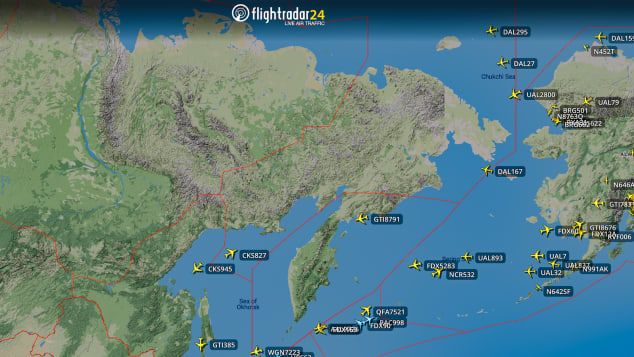 US-registered aircraft also transit Russia, particularly cargo aircraft
on the country's Pacific side, as seen here on February 4.
US-registered aircraft also transit Russia, particularly cargo aircraft
on the country's Pacific side, as seen here on February 4.
The ban will have financial impact for the airlines, but also for Russia, which charges international airlines hundreds of millions of dollars every year for overflight rights.
"There are dozens of flights from the EU to Asia that transit Russian airspace daily," explains Addison Schonland, partner at consultancy AirInsight Group. "All of these are twin-aisle passenger aircraft or large freighters. That means they generate decent daily revenue for Russia even as they are the economically efficient routes between the origin and destinations."
In the event of diversions, Schonland says, "Operators will incur more costs by flying less economically efficient routes and, consequently, may also pay more overflight fees. Passengers and freight forwarders can expect surcharges to be coming soon."
As Schonland points out, the MH17 disaster of 2014, in which a Malaysia Air passenger plane was shot down during fighting in eastern Ukraine, "nobody wants to be anywhere near the conflict zone."
"I expect most flights will start off flying south and go the long way, but it would not be a surprise to see operators consider going the 'back way' over Alaska," Schonland notes. "We have access to much better weather reports now, and it could be that when there's a good tailwind, flying east works best: for example, taking the southerly route from the EU to Asia, then going east over Alaska from Asia to the EU."
Notably, as analyst Madhu Unnikrishnan in Airline Weekly highlights, these transactions are handled via the International Air Transport Association, an industry body representing the world's airline IATA outside of the scope of the interbank payment network SWIFT, which could be used against Russia in future sanctions.
It remains to be seen whether Europe could also specifically ban overflight payments, either alongside or instead of action on SWIFT.
Whatever the next developments in the impacts of this war on commercial aviation -- and it's a safe bet that there will be more overflight bans at the very least -- they may well end up changing the way we fly.