

Lebanon: US dollar savers fear they’ll foot crisis bill
Members of professional syndicates and anti-establishment political parties gathered outside the Beirut headquarters of Lebanon’s commercial banks’ lobby last month to take a stand against a policy that has haunted savers in the country since it plunged into a financial and economic crisis over two years ago – lirafication.
“Lirafication” describes a policy that would allow commercial banks to return depositors’ funds currently locked in United States dollar savings accounts in Lebanese pounds, also known here as lira. Depositors now fear that Lebanon will incorporate lirafication into its economic recovery plan with the International Monetary Fund to bail out the country’s insolvent banks.
“This will take us to hyperinflation,” said Hassan Moughnieh, who leads the Association of Depositors in Lebanon. “This is very bad for the Lebanese economy.”
Such concerns may be well-founded. Lebanon plans on returning less than a quarter of some $109bn in trapped US dollar deposits in its recovery plan, according to a Reuters News Agency report. Several officials involved in drafting the plan have declined to comment about the matter to Al Jazeera.
Ad hoc lirafication has been happening since the country first started sliding into crisis in August 2019, when Lebanon’s banks began to withhold deposits in US dollar accounts.
Currently, depositors can withdraw from their dollar accounts in Lebanese pounds – but at an unfavourable exchange rate that wipes out 70 percent of the market value of those dollar savings, while helping banks trim their losses and expenses.
In the absence of official capital controls, banks have implemented their own withdrawal limits, making life extremely difficult for millions of Lebanese buckling under soaring inflation and rampant unemployment.
Dashed hopes
When people across Lebanon protested against the country’s political and financial leadership in late 2019, they hoped for an equitable economic recovery and a rare joyful chapter in the country’s troubled history.
More than 24 months later, those hopes are dashed and many, including professional syndicates representing pools of professionals, just want their hard-earned dollars savings back.
“The banks are also withholding professional syndicates’ money. The engineering syndicate has 62,000 engineers, with their families harmed,” Aline Fleihan, an architect in the engineers’ syndicate and member of political organisation Li Haqqi said. “We’re unable to secure healthcare or anything for 62,000 engineers and their families.”
Though Lebanon resumed talks last week with the IMF for a rescue programme, many fear that the government will protect the interests of banks over mom-and-pop depositors.
“We are concerned that the government, backed by the financial leadership, will try to mostly distribute losses through lirafication, which is extremely regressive and extremely unfair especially to the smallest depositors,” Diana Menhem, managing director of advocacy organisation Kullana Irada, told Al Jazeera.
The government estimates that losses in Lebanon’s insolvent banks since the onset of the currency crisis fall somewhere in the neighbourhood of $69bn.
For years, Lebanon’s central bank bolstered its foreign currency reserves by paying out exorbitant interest rates to entice commercial banks to lend it US dollars. The arrangement allowed the government to spend well beyond its means and fattened the bottom lines of commercial banks which lured a steady stream of dollar deposits by offering ever-higher interest rates.
Critics have likened the arrangement to a Ponzi scheme.
Today, Lebanon’s economy is crippled, and investor confidence is low. The pound has lost around 90 percent of its value, inflation is among the highest worldwide, and thousands of businesses continue to fail as they try to keep the lights on and pay rent. The United Nations estimates that over three-quarters of Lebanon’s population lives in poverty.
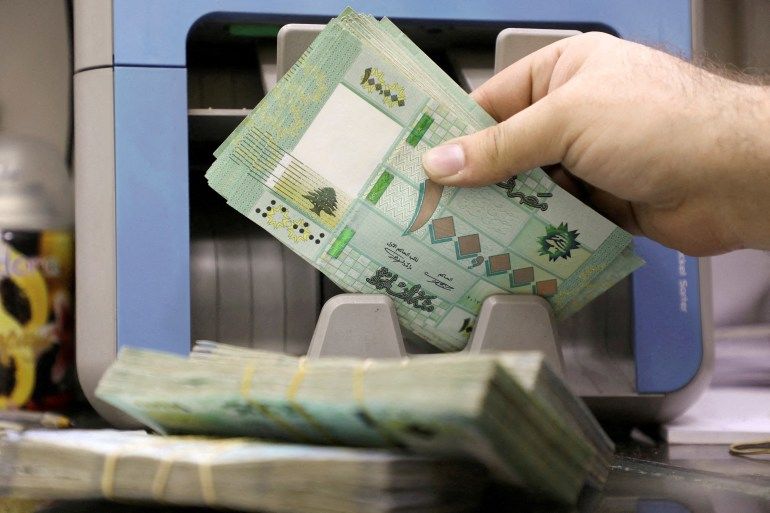 A man counts Lebanese pound banknotes at a currency exchange shop in Beirut, Lebanon
Menhem and others fear that commercial banks will not pay for their role in driving the economy to ruin, and that the government will instead try to fund the financial sector’s rehabilitation by selling state assets that belong to the Lebanese people.
“It’s basically some kind of bailout,” she said. “Whatever resources we have left should be used as reserves strategically to reignite the economy and should in no way be used to cover the losses in the financial sector.”
Lirafication is not out of the question, MP Ali Darwish, who is also an adviser of Prime Minister Najib Mikati, told Al Jazeera. But it’s still unclear what the exchange would be.
“Lirafication is one of the things that is mentioned from now and then,” said Darwish. “As far as I know Prime Minister Mikati is doing his best to receive back their deposits.”
Meanwhile, Lebanon’s commercial banks and central bank continue to pin the crisis on the government, which they’ve accused of gross mismanagement and enabling rampant corruption.
Central bank Governor Riad Salameh – who many hold responsible for Lebanon’s financial collapse, and who is under investigation in Lebanon, France, Switzerland, and other European countries for alleged misconduct – has repeatedly denied any wrongdoing.
And the head of the commercial banks’ lobby, Salim Sfeir, even said in a recent interview that the country’s banks are the “only hope” for restoring Lebanon’s prosperity.
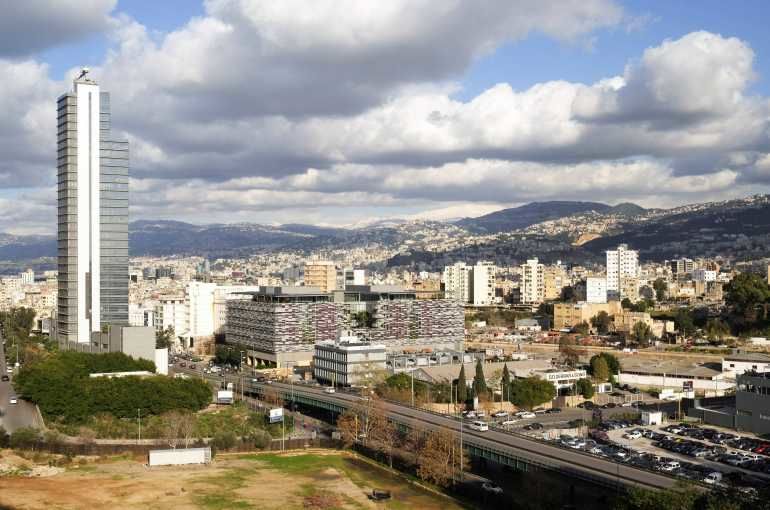 Residential buildings in Beirut, Lebanon
But domestically and internationally, many associate Lebanon’s commercial banks with the country’s ruling parties because many politicians own shares and hold high positions in the country’s financial institutions.
UN Special Rapporteur on Extreme Poverty Olivier De Schutter slammed Salameh and the banks over Lebanon’s economic collapse, describing their roles as “very problematic”.
De Schutter told Al Jazeera after a visit to Lebanon last year that Salameh should have been “more alert” about his unsustainable financial wizardry, and slammed the banks for cancelling a meeting after days of negotiations. “I think ABL [the Association of Banks in Lebanon] is now realising they cannot continue to drive the country to the ground,” he said.
The IMF and international community are demanding that Lebanon implement economic and accountability reforms to become viable again and unlock billions in economic aid and loans. But the government’s financial audit of the central bank has stalled, along with efforts to pass a capital controls law, and restructure the country’s politicised judiciary.
Mohamad Faour, professor of finance at the American University of Beirut, said that the banking sector will have a free pass, as long as Lebanon’s traditional parties are in power.
“The banking system, the central bank and the Lebanese state were literally in bed together. It’s as simple as that,” Faour told Al Jazeera. “None of this would have happened if the political class was not enabling them to do so. In normal circumstances, the banks would be forced to take their share of the losses.”