

People are ‘robbing’ banks in Lebanon – to take their own money
Bank heists in Lebanon have become a growing trend – but these armed “robbers” storming into banks are not stealing anyone else’s money. They are just demanding access to their own savings.
And instead of being prosecuted, the perpetrators have largely been allowed to remain free and have become folk heroes.
The incidents have become increasingly common as Lebanon’s economic crisis continues. The local currency, the Lebanese pound, has depreciated by more than 90 percent against the United States dollar on the black market, while the government’s restrictions on how much money people can withdraw from their own bank accounts have also exacerbated the situation.
So what is behind these bank heists?
* Lebanon has been reeling from a worsening economic meltdown since 2019, plunging 80 percent of its population – about three million people – below the poverty line, according to the United Nations.
* Poverty and unemployment have soared, and savings-account values have evaporated, along with the country’s middle class.
* Since 2019, Lebanese banks gradually imposed draconian controls on deposits, effectively locking millions of customers out of their foreign currency savings.
* “Every time you want to withdraw money, it would be at a rate much lower than the market value,” said Al Jazeera’s Zeina Khodr. “For example, if you want to withdraw $700, they gave you $200. So that’s a de facto haircut.”
* A haircut in economic terms means a reduction applied to the value of an asset. In this case, it refers to the banks’ absurdly unfavourable exchange rate in Lebanese pound when people try to withdraw cash.
How many ‘bank robberies’ have there been so far?
* The first-known case of someone forcibly getting their funds back was reported in January when a man held dozens of people hostage in eastern Lebanon after he was told he could not withdraw his foreign currency savings.
* Local media reported that the customer was eventually given some of his savings and surrendered to security forces.
* In August, an armed man also held employees and customers hostage at a Beirut bank after he was told he could not withdraw $200,000 from his account for his sick father’s treatment. The man was cheered on by a crowd outside the bank.
* On Wednesday, another armed man entered a branch of BankMed in Lebanon’s mountain city of Aley and attempted to retrieve his savings.
* On the same day, a woman called Sali Hafiz entered a BLOM Bank branch in Beirut with what she later said was a toy gun, along with other activists, in order to retrieve money from her own account to fund hospital treatment for her cancer-stricken sister. She poured gasoline inside the branch and threatened to set it on fire if she did not receive her savings.
* She managed to get $13,000 from her deposits, out of a total of $20,000.
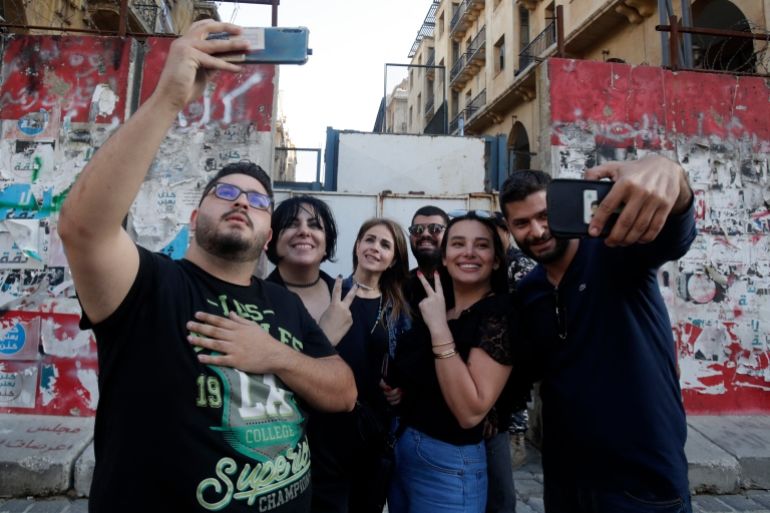 Sali Hafiz (second from right), a young Lebanese activist, held up a
Beirut bank and walked out with thousands of dollars to pay for
treatment for her ill sister on September 14, 2022.
Sali Hafiz (second from right), a young Lebanese activist, held up a
Beirut bank and walked out with thousands of dollars to pay for
treatment for her ill sister on September 14, 2022. Are these lone-wolf acts or part of an organised movement?
* Hafiz and the man who held up the bank in Aley are part of a group called Depositors’ Outcry.
* Its founder, Alaa Khorchid, said that desperate times have left people with no choice but to “take matters into their own hands”.
* “These people worked for decades, but not for the rulers to build palaces while they can’t afford a bottle of medicine,” he said. “There is no government, no economic recovery plan, and little reserves left.”
How bad is Lebanon’s economic crisis?
* The government estimates that losses in the lethargic financial sector since the onset of the currency crisis fall somewhere between $68bn and $69bn.
* The World Bank has warned that the economic calamity could rank as one of the three most severe the world has seen since the mid-19th century.
What can be done to alleviate the crisis?
* The international community has repeatedly urged Lebanon to reform its economy, notably by ending wasteful spending and corruption and restructuring its ineffective energy sector. They have also called for a forensic audit of the central bank.
* Amin Salam, Lebanon’s minister of Economy and Trade, told Al Jazeera: “Lebanon is in need of a bailout and the International Monetary Fund wants reforms done before that happens.”
* However, successive governments have failed to deliver a credible economic reform plan that is a prerequisite for unlocking billions of dollars in desperately needed financial aid.