

Robert Harris: There are times when I think the Labour party’s had it
I’ll be the first to die if civilisation collapses, believe me,” says Robert Harris. “I don’t know how to fix anything”. We are talking about how we would cope if predictions of a winter of discontent come true. Harris is an expert in societal breakdown. All of his 14 bestselling novels are, he says, “in a way about how thin the crust of civilisation is” and he is “haunted by the idea that what we take for granted could so easily fall apart”. At least he has a wood-burning stove, which he bought when a no-deal Brexit looked like it would hit supply chains. “You can roast a chicken on it,” he tells me. “It’s very effective”.
Harris is at home in Berkshire, where he lives with his wife, writer Gill Hornby (sister of Nick), in a red-brick vicarage overflowing with books. Two of their four grown-up children spent lockdown here with them, and his dog Maisie is lying asleep at his feet (“Golden Retrievers don’t let you out of their sight”). We acknowledge that even talking about prepping for disaster is surreal. But then, living in this country right now feels, says Harris, paraphrasing George Orwell, “like being in a family but with the wrong people in charge”.
Harris, 64, has seen the machinations of power first-hand. Before he was one of our most successful novelists, he was the Observer’s political editor and a columnist at the Sunday Times and the Daily Telegraph. He spotted the potential of Tony Blair and became a close ally of his, standing next to him in 1997 when the exit polls came in and getting “a political education that has stood me in good stead ever since”. They fell out when Blair sacked Peter Mandelson, who is godfather to Harris’s daughter. Blair’s trajectory is “rather sad”, says Harris. “He could have had a much longer political career but he went off to make money and I don’t think there is any coming back from that. I almost think that the money-making aspect has been more damaging than Iraq. He is immensely gifted, but he walked away and if you do that you are never really forgiven. I did think at one point he could come back he would just have to fight some hopeless byelection, stand on a soapbox and be prepared to be humiliated in the rain in some town square but you have to be seen to be fighting to get back.”
For Harris, the ultimate leader is Cicero, “the first modern politician, who came from nowhere with no money and survived by the quickness of his wits”. Harris’s trilogy of books about the Roman statesman has just been published as one beautiful volume, “with maps and a ribbon to mark where you are”. “It is what I always wanted,” says Harris. “Like Lord of the Rings without the furry feet. But it looks so huge I wonder how on earth I ever found the time or stamina to write it!”
"Keir Starmer has brought a bow and arrow to a gun fight. But if the Left are going to break through, they need someone with imagination."
One of Harris’s admirers is Boris Johnson, who reviewed Lustrum, the second in the trilogy, and went to see it twice when it was adapted by the Royal Shakespeare Company. Harris has been interviewed by Johnson too, in 1999, which was “perfectly nice” until Johnson said in the article that Harris’s friends call him “moneybags”. “It turned out the quote was from someone I’d never met, the editor of the Telegraph’s secretary. It is a small illustration but it shows the way the truth is endlessly elastic in his hands.”
Johnson is like Cicero “in the sense that he regards it as no disgrace to change position as events change”. “People respond to his natural bounce and optimism. It doesn’t matter if tens of thousands of people die unnecessarily in the pandemic, people sense that on the whole he is with them in believing you have got to try and look on the bright side.” Even Johnson’s personal life “speaks to a lot of people having complicated private lives — as long as you don’t tell people to do one thing and do something different yourself.” Like Matt Hancock? “He will find it difficult to return. Hypocrisy is like salt on a slug in politics.”
Harris attempts to be fair about the new Culture Secretary, Nadine Dorries, but can’t manage it. “Part of me thinks it is good that someone like that gets to the top, and another part of me thinks it’s the decline of the West really. Some of the things she has said in particular about gay marriage are shocking; if you are capable of making those misjudgements then aren’t you likely to be making them again? [Her appointment] is a massive f*** you to the whole western canon.”
The constant whipping-up of culture wars is “depressing”. “A lot of us have been on the receiving end of it now year after year, constantly beleaguered and attacked for being a remoaner or whatever it may be. I have sympathy for Keir Starmer. He has taken a bow and arrow to a gunfight. But a great politician is creative like an artist, you can’t just go on preparing detailed Commons speeches. If the Left are going to break through they need someone with imagination.”
“There are times where I think the Labour Party’s had it. It grew up in response to a certain set of economic conditions that have gone. I don’t see its working- class base coming back. The alliance of intellectuals and workers is gone.” It sounds like a bleak outlook. But Harris has learned from writing about history that nothing is forever. “There is always a great collapse,” he says cheerfully. “It will be a surprise if Boris Johnson doesn’t come a pretty spectacular cropper in the end. There will be some new force out there that will suddenly make sense to liberals in the North and South. It is no accident that the most effective political party recently has been the England football team. They have put the government on the back foot, appealed to the people and made people like Boris Johnson and Priti Patel look out of touch.” He also predicts that the Tories will implode. “If you look at Labour, it wasn’t that the Tories won, it was that Blair and Brown destroyed one another. This will happen with the Conservatives, they will turn on each other…. All bets are off in politics, the Tories are becoming a nationalist party. Nationalist socialist, what could go wrong? There is a Chinese proverb about how if you sit on the riverbank for long enough, sooner or later the body of your enemy will float by, which is very true in politics I think.”
Could Extinction Rebellion be a credible new force? “I am wary of zealots on any side, who don’t believe in a pragmatic middle course. The M25 protestors impeding people trying to go about their daily lives when they’ve got problems, trying to maybe go to hospital, it’s crazy.”
The sense of impending calamity that XR capture is a theme of the upcoming Netflix adaptation of Harris’s novel Munich, about Neville Chamberlain’s last attempt at negotiations with Hitler on the eve of the Second World War. The director, Christian Schwochow, decided to focus on the three young characters because he felt that spoke to young people today. “They feel trapped, knowing this terrible thing is happening but struggling in the face of it — whether that is the rise of Right-wing nationalism or climate change.”
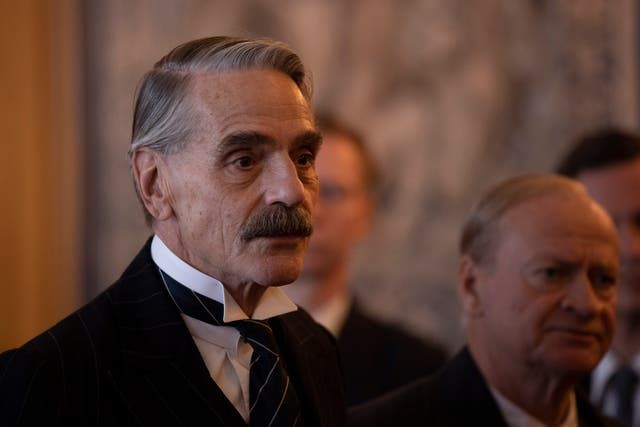 Jeremy Irons as Neville Chamberlain in Munich
Harris’ main role in the adaptation was casting Jeremy Irons as Neville Chamberlain. They met for lunch years ago to talk Irons playing a Cardinal in an adaptation of Conclave and discussed the former Prime Minster. “Jeremy Irons said he was interested in Chamberlain so I sent him a copy of Munich and we kept in touch and I told Netflix he was interested in playing him.” Chamberlain has been misrepresented on screen, says Harris. “He is always played in movies like The Darkest Hour by some feeble actor who looks hopeless but he was an incredibly dominating figure in his day and tripped Hitler up at Munich. The fact that this glamorous figure like Jeremy Irons is playing him gives you a sense of what a dynamic figure he was.”
Harris has always been fascinated by politics. When he was six, growing up in a council house in Nottingham, the son of a printer, he wrote an essay entitled “Why me and my dad don’t like Sir Alec Douglas-Home”. After attending the local comprehensive, he read English at Cambridge and has joked about being a fully paid-up member of the metropolitan elite ever since. But he is still aware of money — for years, every time he finished a novel, he would make a major purchase, like a car, to have something to work for. That’s now changed and his open-topped Aston Martin DB7 has gone: “it looked like a mid-life crisis”.
He sees himself as a journalist and commentator and has never given any money to a political party. “I support the people whose views I think are worth supporting.” One of his friends is Andrew Neil, who gave him his column at The Sunday Times. “He was very good to me,” says Harris. “He has a terrific mind and takes no prisoners. He is always interesting and worth talking to. His obviously right of centre but above all he is a journalist; he likes making trouble.”
That certainly happened with GB news. For Harris, writing historical fiction makes Harris immune to an extent from discussions about cancel culture that Neil has waded in to, and ones in his own industry, with writers saying that the climate feels increasingly constricted and JK Rowling lambasted for her views on gender. “I’m on safe ground with Cicero, no one cares what you write about him. I would be hesitant to try to capture modern morals. My children would cringe… I hope JK Rowling is not too bothered by it all. It’s only a problem in so far as she lets it be. She was the most successful children’s writer of all time and that can never be taken away from her. All our children were obsessive JK Rowling readers and we used to buy several copies so they could read them at the same time and there wasn't an argument. They were enraptured by them. She created a magic for children and that can never be forgotten whatever the current storm is.”
His colleagues in publishing are mainly women. “I am hesitant to say this but I think fiction is one of the few areas where you can say there is genuine equality,” he says. “Women are if anything more dominant in fiction than men and it is a very nice world to work in. I am not a macho type.”
Still, his wife tells him he doesn’t read enough books by women and he “is trying to correct that”, “picking up the new Sally Rooney” on holiday in Greece last week, even though he ended up reading The Master by Henry James instead. “It sounds pretentious,” he says, but we think Rooney, who likes James too, would approve. “I don’t read much modern fiction and that is a fault,” he adds. “I’ve had a lot of old friends, if you know what I mean, people like Roy Jenkins and John Mortimer, and they were always interested in whatever was new. That seems to be the key to being successfully old.”
His holiday “recharged” him. Lockdown “should have been perfect for writers but you couldn’t switch off and go to the theatre or a party so you were trapped with your working day, which oddly enough made it hard to work.” He was fascinated by the way we kept saying the pandemic would be over in three months, “which you also get every time there is a War. Humans can only take a short view. Everyone is still in denial about the pandemic, which is likely to go on for many years. It is incredibly frustrating. You are able to do things like go on holiday now but there is constant bureaucracy, which is quite intimidating - like what Norman Mailer once wrote, it is like going to a drinks party where the champagne is served in plastic tumblers. It is just not quite the same. Putting aside the terrible bereavement which we mercifully haven’t experienced I think this has been a national trauma and will work its way through in the years and months to come.”
He is now writing a novel set around the English civil war, “when England was a republic a century before the French and the Russians, we had this revolution.” Hopefully it will come out in September next year. Harris’s time as a journalist means he needs a deadline so he tries to start a novel in January and finish by June. It was harder this year, “I found myself getting stale but after going to Greece… I found enthusiasm again.”