

The epic attempts to power planes with hydrogen
Few of the thousands of tourists who visit West Palm Beach, Florida, every year for its beaches notice the abandoned industrial site on the edge of town. A faded sign reading "CAMERAS FIREARMS NOT PERMITTED ON THIS PROPERTY" was attached to a gate blocking a forgotten access road. It was one of the few clues that the Apix Fertilizer factory once hid a secret.
The 10-square-mile (25.9 sq km) site was a clandestine government facility that, in the late 1950s, was at the heart of American efforts to spy on the Soviet nuclear arsenal.
Rather than producing fertiliser for farmers, the site was probably the world’s largest producer of liquid hydrogen, which was needed for one thing: Project Suntan. This was the code name given to the "beyond top-secret" project to build the replacement for the Lockheed U-2 spy plane, which began in 1956.
The Lockheed CL-400 Suntan was more like a space plane, or a Thunderbird, than a spy plane. Led by Lockheed's genius designer and secretive Skunk Works founder Kelly Johnson, the dartlike flying machine was intended to fly at Mach 2.5 at 30,000m (100,000ft) with a skin temperature of 177ºC (350ºF), have a range of 4,800km (3,000 miles) and be powered by liquid hydrogen – that is, hydrogen cooled down to cryogenic temperatures of around -423ºF (-253C). The Skunk Works, based in Burbank California, was a business-within-a-business that was free of the usual corporate oversight.
Engineers believed they were in a "hydrogen race" against the Soviets after U-2 flights over the Soviet Union spotted the construction of liquid hydrogen plants. The Americans became convinced that the Soviets were developing their own space plane/spy plane, or a high-flying, high-speed interceptor to shoot down the U-2. The true Soviet motivation became clear in 1957, when Sputnik was launched on top of a liquid hydrogen-powered rocket.
Even though aspects of the project were a success, the Skunk Works team was unable to solve two problems with hydrogen-powered aircraft which still confront designers today. The first was range. Hydrogen is very light compared to kerosene – traditional aviation fuel – and packs three times as much punch per unit of mass, but it needs four times the volume on an aircraft for the same hit, and storing it is tricky.
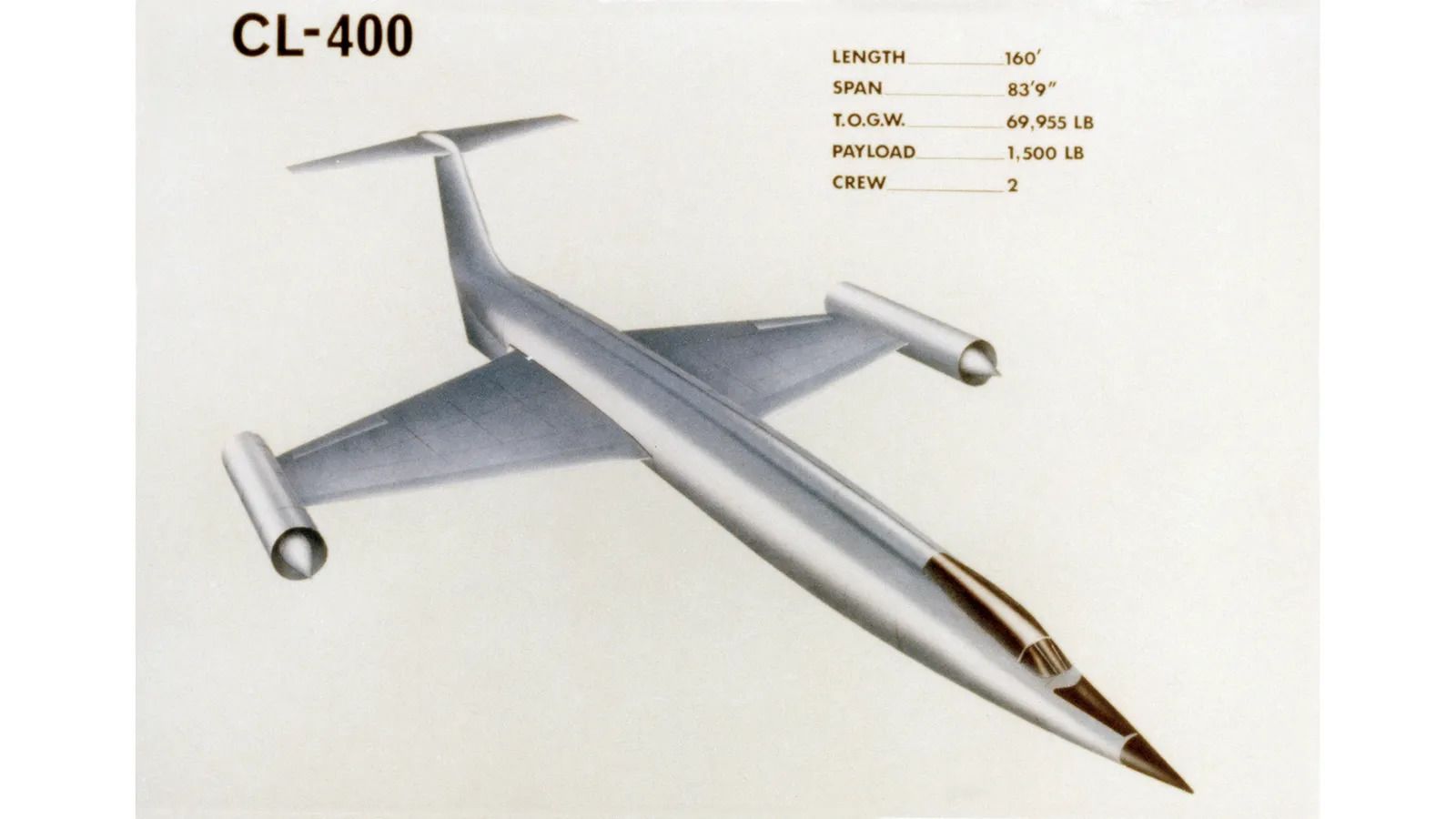 The Lockheed CL-400 was Lockheed's ambitious design from Project Suntan
Liquid hydrogen has advantages over the alternative, pressurised hydrogen gas, which include a higher energy density (vital for longer ranges) and not needing strong, heavy tanks. Nonetheless, while Johnson's design for Project Suntan was as long as a B-52 bomber, it still couldn’t achieve the range Johnson had promised the US Air Force.
The second problem was even greater. While it proved possible to produce enough liquid hydrogen, the infrastructure needed to run a hydrogen-powered plane was a different matter. Kerosene was just too cheap and convenient compared to transporting volatile liquid hydrogen in huge amounts to air bases around the world, storing it, and safely refuelling the aircraft.
When the Lockheed team stored hundreds of gallons of liquid hydrogen at the Skunk Works a visiting scientist warned them "My God … you're going to blow up Burbank." Later, they were reminded of this prophecy when a fire broke out and nearly caused a massive explosion that could have demolished the top-secret facility, the neighbouring airport and Burbank itself.
Now a new generation of engineers is pursuing hydrogen-powered flight with greater urgency, spurred on by its promise of zero carbon emissions
With his famous bluntness, in 1958 Johnson told his paymasters in Washington that he was "building them a dog", and repaid around $90m spent on the project. The hydrogen-powered plane became one of the few failures of his long career. It was easy to think that if Johnson and his Skunkworks couldn’t make the new fuel work, no one could.
Several other aircraft engineers disagreed. On 15 April 1988 the rather mundane-looking Soviet experimental aircraft the Tupolev Tu-155 flew using liquid hydrogen, and the modified airliner went on to fly around 100 flights. The fall of the Soviet Union curtailed the programme, but a handful of hydrogen-powered small planes or UAVs (unmanned aerial vehicles) have flown since then. The prototype of Boeing's Phantom Eye high-altitude, long-endurance, liquid hydrogen-powered drone flew for the first time on 1 June 2012. On the last of its nine flights the Phantom Eye flew for eight to nine hours at 16,500m (54,000ft). A lack of funding eventually grounded the drone.
Now a new generation of engineers is pursuing hydrogen-powered flight with greater urgency, spurred on by its promise of zero carbon emissions. (The aviation industry is currently responsible for around 2.4% of global carbon emissions.)
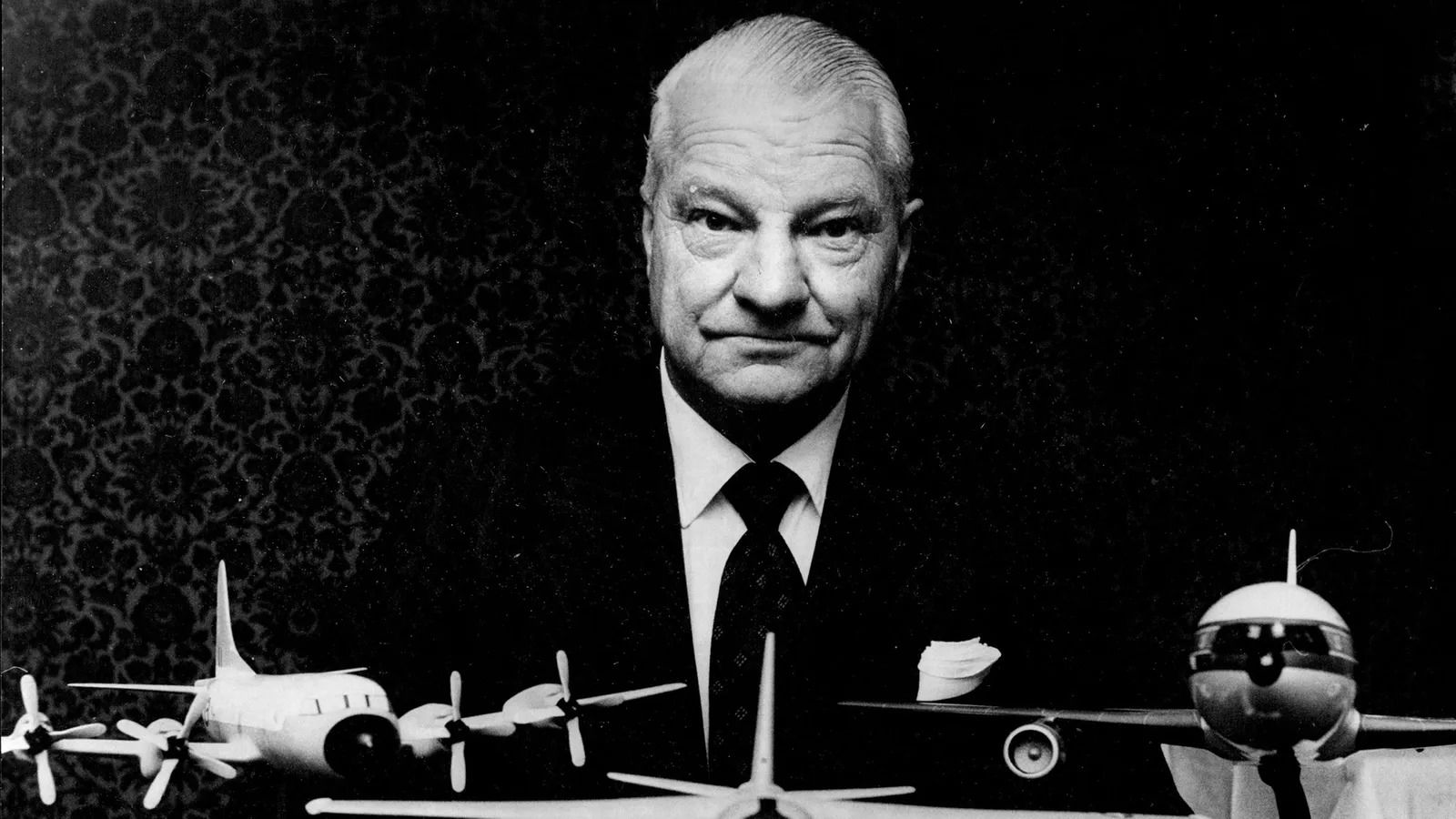 Visionary designer Kelly Johnson looked into hydrogen aircraft designs in the 1960s
Most of these designs generate electricity by either using liquid hydrogen to power a fuel cell or to combust in an engine, or a combination of the two. With hydrogen comes the opportunity to rethink aircraft design, including the wings, because of the need to store liquid hydrogen in relatively heavy, insulated tanks. That might make future aircraft look a lot different, because lighter kerosene can be stored in the wings. It is also a chance to rethink practices that in some case date to the 1950s.
"When a process hasn’t been innovated for a very long time you can end up with malfunctions in the design," says Arlette van der Veer, senior manager radical innovation at KLM Royal Dutch Airlines. "For example, my colleagues from cargo, or ground services, are the last point in the aircraft design process, and that is a huge problem. They are currently lying on their backs in the belly of planes moving luggage because robots can't go into the space, and it is too narrow for other solutions."
Full-sized, the Flying-V would be around the same size as an Airbus A350
In July 2020 a team from Delft University drove across the border from the Netherlands to Fassberg air base in Lower Saxony, Germany, on a mission to test a radical new design of hydrogen-powered commercial aircraft called the Flying-V. In the back of their van was a 3m-wide (10ft) scale model in the distinctive blue-and-white KLM livery. The team – including researchers, engineers, and a drone pilot – had a week to prove that their one-and-a-half years of hard work in the university's aerospace laboratory had not been a waste of time.
Delft is one of the top technical universities in the world and has one of the largest aerospace engineering faculties in northern Europe. The Flying-V was conceived by TU Berlin student Justus Benad, supported by KLM and Airbus. It is a radical new design that is 20% more efficient than a conventional aircraft, with the passenger cabin, cargo hold and fuel tanks integrated into the two arms of its V-shaped structure. Full-sized, the Flying-V would be around the same size as an Airbus A350, carry a similar number of passengers (more than 300) and could use the same departure gates.
 Soviet designers flew a converted Tu-154 airliner with hydrogen fuel in the 1980s
The Flying-V is a type of aircraft called a "blended wing" because the wings and fuselage are smoothly blended, with no clear dividing line. Often called flying wings, they are seen as a natural fit for hydrogen-powered aircraft because they are more efficient than traditional tube-and-wing aircraft and have plenty of space for the hydrogen tanks.
Airbus itself has unveiled three Zeroe concepts for liquid hydrogen-powered aircraft, one of which could enter service by 2035. They are a rather conventional-looking short-haul turboprop and an intercontinental jet airliner, as well as a more radical blended wing that looks more like a space plane.
FlyZero, a British project aiming to realise zero-emissions commercial aviation, assessed 27 different configurations for hydrogen-powered airliners before producing its own. These included planes with two fuselages, one for hydrogen and one for passengers, through to gondola designs, with the tanks above the passengers, and a flying wing. Its own, recently unveiled concept, is for a mid-sized aircraft flying non-stop to San Francisco or Delhi which looks like a bloated version of a conventional airliner with ultra-thin wings.
Aircraft design is a compromise between many things, and you can get into get into a spiral when designing a plane – David Debney
There are many other designs for future hydrogen-powered commercial aircraft. "It is a question of where you can site these hydrogen tanks in an aircraft for the minimum penalty," says David Debney, a chief engineer at FlyZero. "We looked at wacky ideas, for example, where you could put a giant hydrogen tank between the wings and have two cabins, one at the back, one at the front, but they'd be separate. And you couldn't get from one to the other. That's not allowed under the regulations.
"Aircraft design is a compromise between many things, and you can get into get into a spiral when designing a plane. If you make it heavier, then you need more lift, and that means a bigger wing; a bigger wing means more weight, so you need even more lift but a bigger wing weighs more, and so on."
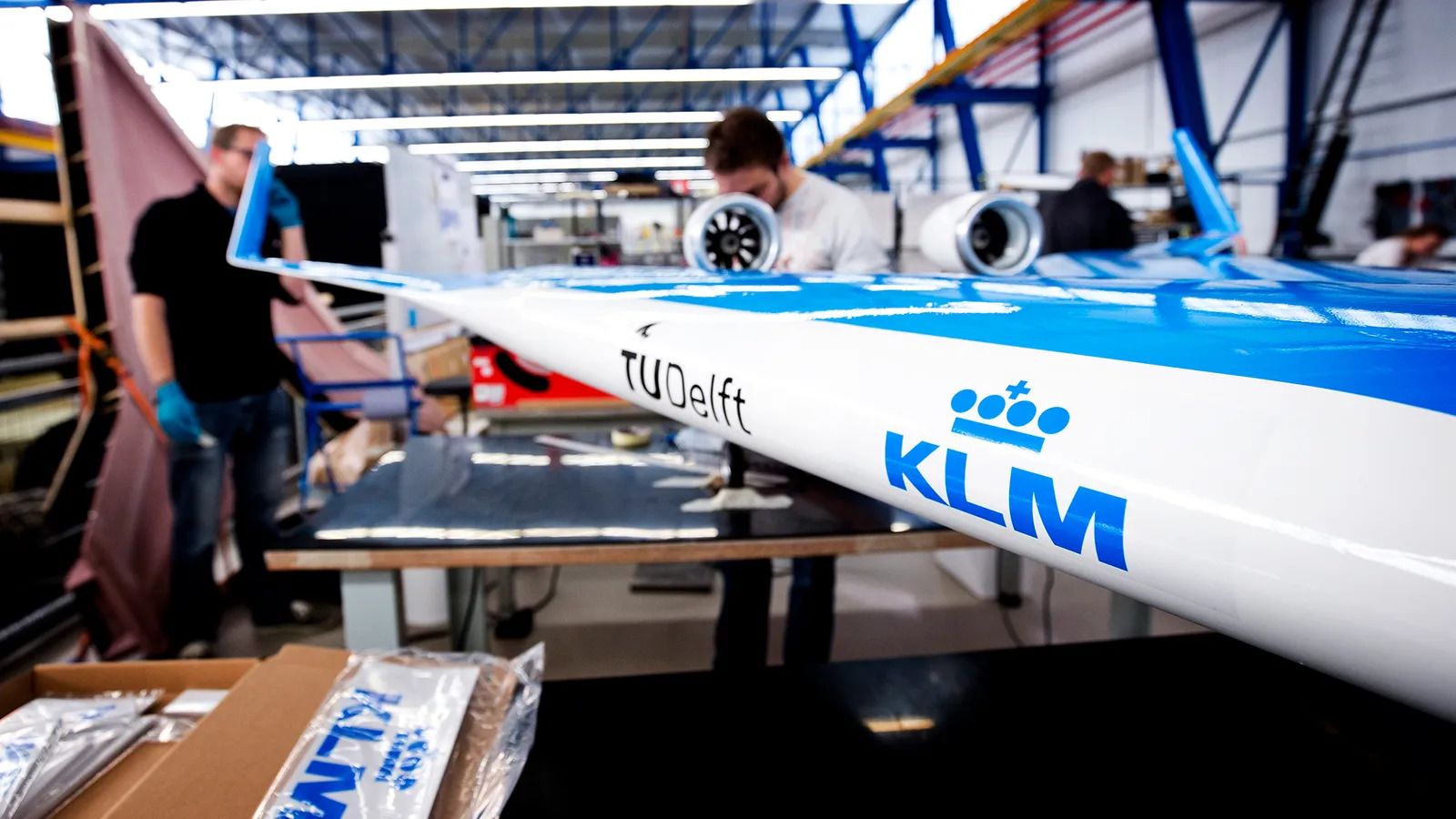 The Flying-V was designed in a completely different way to most aircraft concepts
For the Flying-V, hydrogen means trade-offs that Kelly Johnson would have recognised, and which the kerosene powered version doesn’t need. "We sacrificed two things: the first is about two-thirds of the cargo volume [which will hit profitability]," says Roelof Vos, an assistant professor at the Aerospace Engineering Faculty of Delft University of Technology. He is also technical lead on the project. "We will have sufficient volume for the passengers' luggage, but nothing more. The second is the amount of volume we have available for hydrogen, and how far we can fly on that." While a hydrogen-powered Flying-V could fly from London to Cape Town non-stop, a kerosene-powered version could reach as far as Sydney.
On 16 July 2020 the Delft team’s hard work paid off. The scale model of the Flying-V was carried through the doors of the old wartime hangar onto the concrete apron at Fassberg. A little after 3.30pm, with a whine of its two electric motors, it rose sharply into the air for its successful five-minute-long maiden flight. "The flight of the scale model demonstrates that the Flying-V can be flown controllably with good handling qualities without any problems," says Vos.
"Hydrogen aircraft have flown now, so we know the fundamentals of the fuel, and we know the fundamentals of the aircraft," says Mark Bentall, head of operations for technology at Airbus, "and like we do with a traditionally fuelled aircraft… we will always take the benefit of the latest technologies."
Thanks to computer modelling our level of understanding of combustion is way, way more advanced than in Kelly Johnson’s day – David Debney
Carbon fibre allows engineers to build lighter, stronger structures. Easily overlooked new manufacturing techniques such as friction stir welding (FSW) deliver more accurate high-quality joins. It uses the heat generated by friction from a rotating tool to fuse two different materials together. The Skunk Works team used wooden models and wind tunnels to design Suntan; today computer design and simulation tools help engineers to produce highly accurate designs, quickly and cheaply.
"Thanks to computer modelling our level of understanding of combustion is way, way more advanced than in Kelly Johnson's day, and this has helped kerosene engines, but it will help hydrogen-powered aircraft more," says David Debney. "Greater efficiency of aircraft helps massively with the volume of hydrogen fuel that you need to accommodate, and that’s the big thing that's changed.
"If you were using 1950s aerodynamics and engine technology, for the same missions you’d need a lot more hydrogen, and that's hugely penalising from the volume perspective."
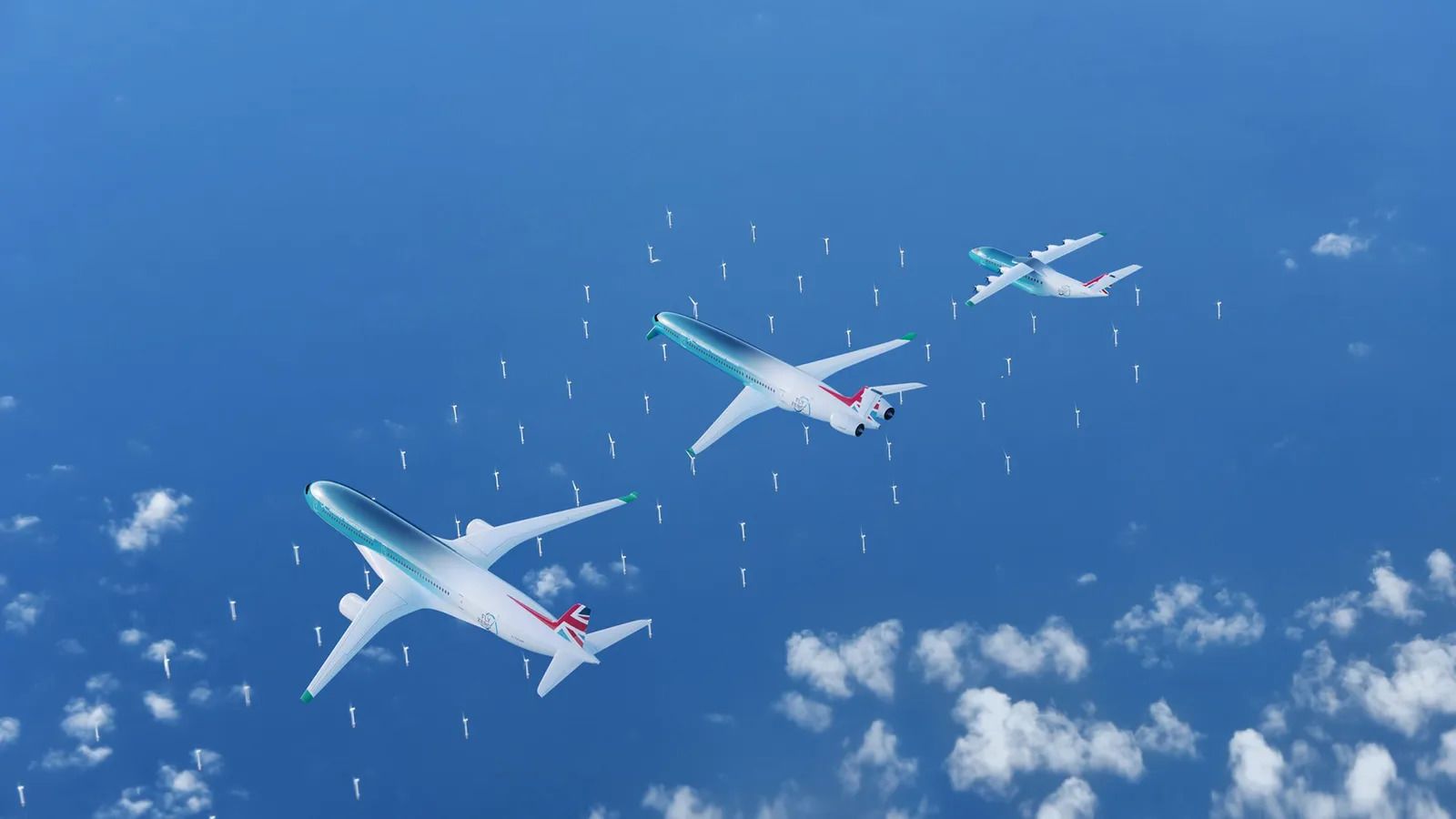 FlyZero has offered three different airliner coincepts, including a smaller model for regional journeys
The innovation continues. Ultima Forma is a British technology company based south of London. Fuel tanks are heavy. Hydrogen causes corrosion embrittlement in metals such as steel, but less so in copper. Ultima Forma is developing ultra-thin liners made from copper for the inside of lightweight carbon-fibre fuel tanks. The same technology could be used in the transportation of hydrogen.
It is in everyone’s interest, as well as the planet's, if the lessons learned by different teams could be shared. "I know for sure that the best design cannot come from one party," says Arlette van der Veer. "What would be really disruptive is an open knowledge-sharing economy to combine the knowledge of different manufacturers to produce the best designs."
Crucially, commercial aviation will have to learn from other industries that work with hydrogen every day
Even though an estimated $500bn (£370bn) is going to be spent globally on hydrogen infrastructure, not every problem that Johnson faced has been solved, and some – including whether the hydrogen is produced locally or centrally, how it is distributed and how it is stored at the airport – are far too big for an aircraft manufacturer or airline to solve on its own.
Then there is the matter of how aircraft will be refuelled with passengers nearby (robotic arms are one idea), and what the safety regulations will be. "That’s a big bit of work," says Captain David Morgan, director of flight operations at budget airline easyJet. "And that's something we’re going to start doing long before the first aeroplane arrives on the scene."
Crucially, commercial aviation will have to learn from other industries that work with hydrogen every day. "One of the reasons why we brought Zeroe to public attention early was because we need to work as an ecosystem to make it happen," says Bentall. Conversations between airports, airlines and manufacturers have started.
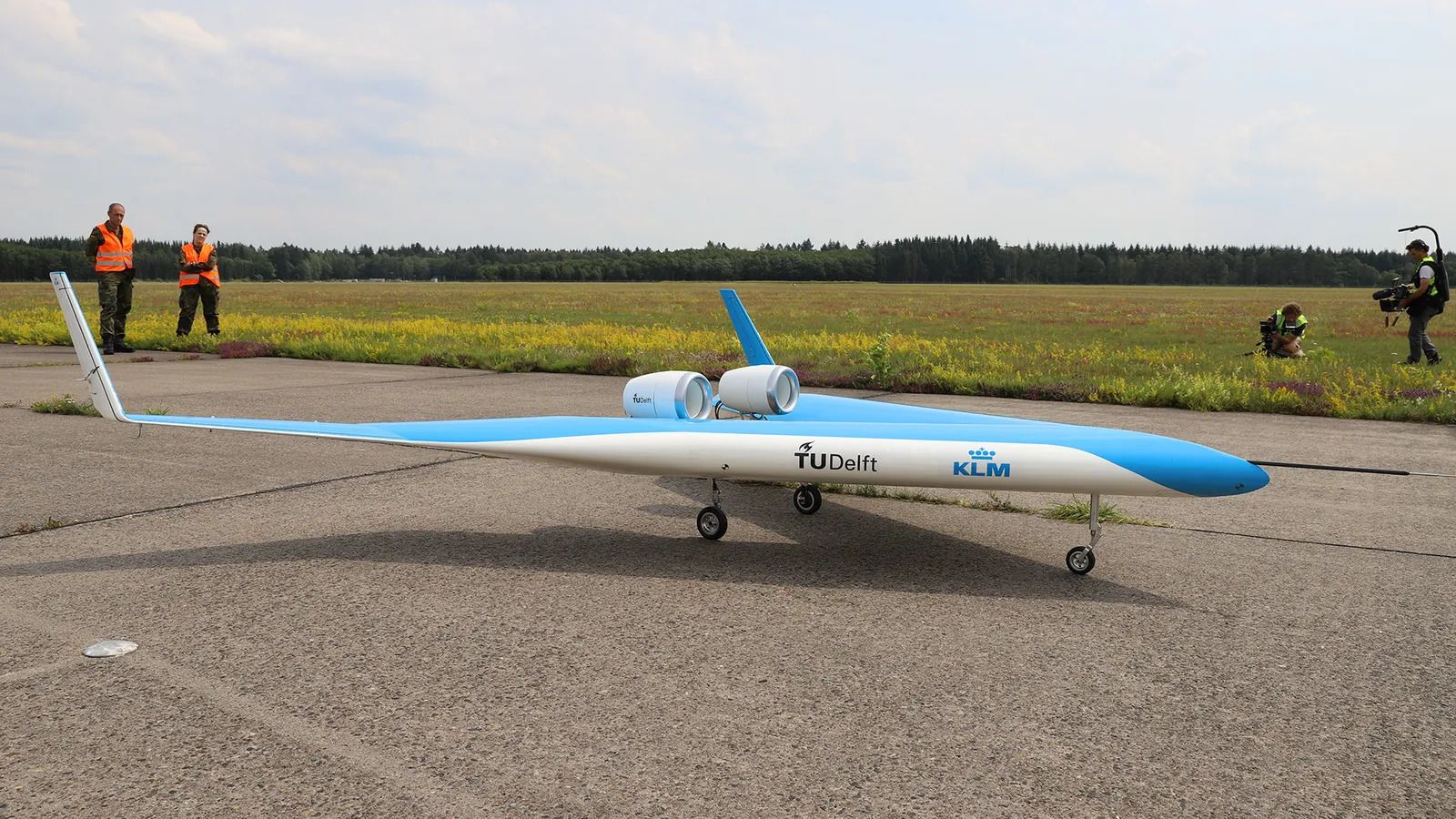 Tests with the model Flying-V showed that it had good handling qualities, Roelof Vos says
There are many reasons why it might not happen, but there are good indications that sometime in the 2030s commercially viable hydrogen-powered aircraft will be in the air, though initially they might look like the planes that line up at airports like Heathrow today.
"There are some really interesting designs, futuristic designs, that would lend themselves to hydrogen," says Morgan. "However, what you don’t want to do when you change over to a hydrogen fleet is to make everything so radical that the changeover becomes a real problem."
"Safety is the sole purpose of everything we do… but what I discovered in my research is that there are some mindsets and approaches from the 1960s or 1970s that still prevail today despite all the new testing methods," says van der Veer. "If I designed the most perfect aircraft…but there is no fuselage, it’s not cylindrical, it would be a case of the computer says 'no'. The certification authorities need to develop certification methods for aircraft designs that they have never seen before."