

We Asked Russia's 1980s Afghan War Vets To Judge The U.S. Exit. Here's What They Said
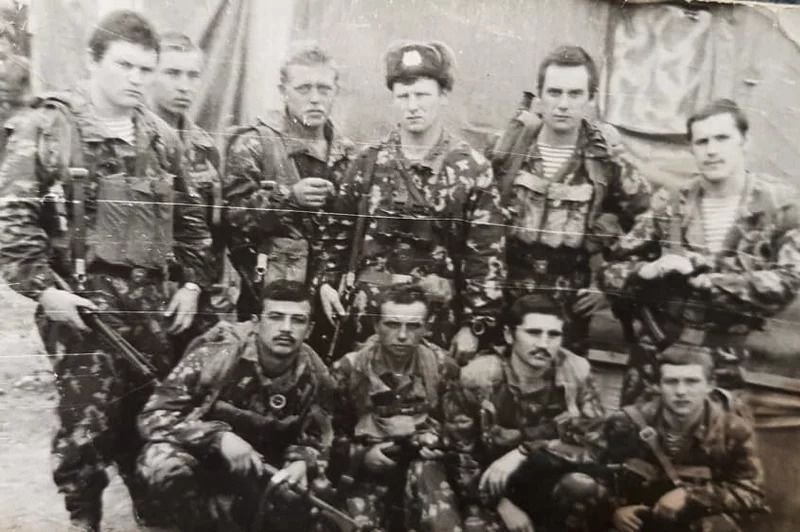 Over half a million Soviet troops served in Afghanistan between 1979 and
1989. Among the first deployed was Rustam Khodzhayev, seen posing here
(front row, first from the left) with his special operations unit in
1981.
Over half a million Soviet troops served in Afghanistan between 1979 and
1989. Among the first deployed was Rustam Khodzhayev, seen posing here
(front row, first from the left) with his special operations unit in
1981.
It's not the defeat that confounds him — he understands that part all too well. Opalev served as a captain in the Soviet army as it was gradually humbled by Afghan mujahedeen fighters during a decade of war in the 1980s.
The problem, he says, is how U.S. forces left.
"It's just a fact that if you want to evacuate a division, you need a week," says Opalev, who was among the last Soviet soldiers to withdraw from Afghanistan. "If you pull out an army of tens of thousands, you need a year."
As the United States grapples with the fallout from its exit from Afghanistan, former soldiers who fought as part of the USSR's own losing military campaign see echoes in their experiences — similar searing loss — but also evidence of American miscalculation that casts the Soviet experience in a more flattering light.
Moreover, perceptions of missteps in the U.S. withdrawal have played into the hands of Russian President Vladimir Putin's wider efforts to rehabilitate aspects of Soviet history.
The Soviets fashioned a made-for-TV exit
Take the final days of the Soviet pullout from Afghanistan in 1989. Once viewed as a moment of national humiliation, Russian veterans say it now looks more impressive and orderly in comparison with America's hurried exit.
Soviet state television coverage of the final day shows popular crooner Iosif Kobzon in the Afghan border town of Hairatan to entertain troops. Soldiers shine their boots in anticipation of reunions with family members.
The footage culminates in this scene: On Feb. 15, 1989, the last tanks and trucks cross a bridge from northern Afghanistan into Uzbekistan, then a Soviet republic. They are followed by a lone figure on foot: Soviet Lt. Gen. Boris Gromov.
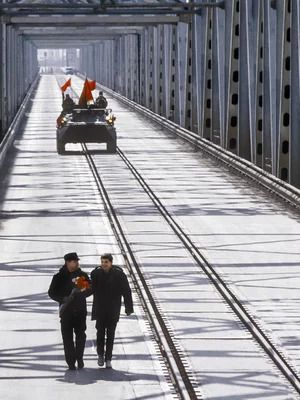 On Feb. 15, 1989, Lt. Gen. Boris Gromov (left), with his son, Maxim,
walks across a bridge over the Amu Darya at Termez, Uzbekistan. When the
Soviet Union completed its military withdrawal from Afghanistan, it was
widely hailed as a much-anticipated end to a bloody quagmire, but
public perceptions have changed.
On Feb. 15, 1989, Lt. Gen. Boris Gromov (left), with his son, Maxim,
walks across a bridge over the Amu Darya at Termez, Uzbekistan. When the
Soviet Union completed its military withdrawal from Afghanistan, it was
widely hailed as a much-anticipated end to a bloody quagmire, but
public perceptions have changed.
"I can say that not one soldier remains behind me," Gromov tells a Soviet reporter on the scene. Soon, the general is joined by his young son, and the two walk arm in arm into Soviet territory.
The event was — of course — staged. Neither were Gromov's words entirely true: Several hundred Soviet troops were still missing in action.
Yet, today, Opalev says he finds it an appropriate end to a decade of war.
"The main thing was that it was organized. From our perspective, the evacuation was done just right," he says. "We left civilian infrastructure but took every tank and machine gun with us."
The Soviet retreat was necessary. It was also methodical. For reasons Opalev still can't understand, the American exit wasn't.
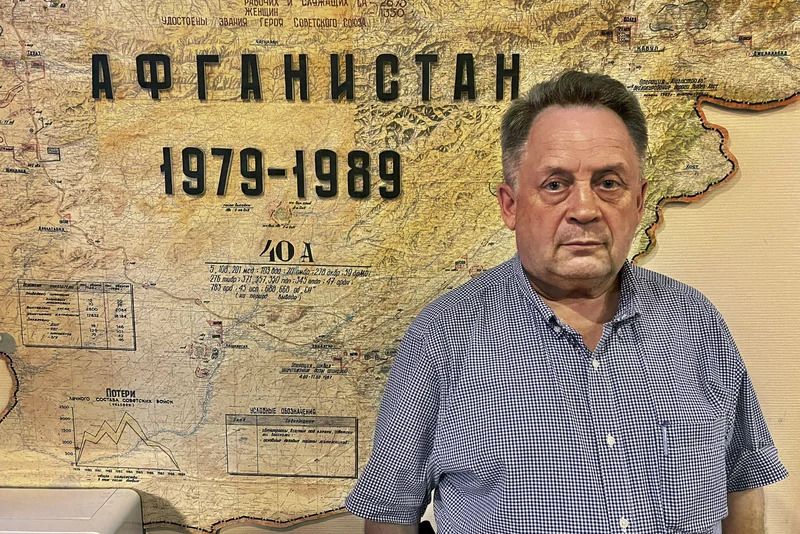 Sergei Opalev poses with a map of Afghanistan at the Union of Veterans
of Afghanistan's office in Moscow. Opalev was among the last Soviet
troops to withdraw in February 1989. "The main thing is that it was
organized," he says.
Sergei Opalev poses with a map of Afghanistan at the Union of Veterans
of Afghanistan's office in Moscow. Opalev was among the last Soviet
troops to withdraw in February 1989. "The main thing is that it was
organized," he says.
The USSR propped up its communist ally in Kabul
Today, Opalev works at the Union of Veterans of Afghanistan's office in central Moscow, where he pulls out the decorated uniform he wears for ceremonies and occasional talks at schools.
Explaining the Soviet military effort to prop up a communist government in Kabul can be a tough sell, he admits.
"If someone thought we came to build socialism — well, yes, that was the political goal at the time and probably not the right one," says Opalev. "Just like the Americans thought 'we'll build a democracy ... in five, 10 or 20 years.' It didn't work."
He much prefers to frame the Afghanistan mission in terms of "fighting the religious extremists of the day" — and what it means to serve.
"In Moscow, there are people who follow politics. They've always respected veterans and understood why we were there and why the war was in the country's interests," says Opalev. "But then there's another generation that thinks that it was completely unimportant."
Opalev says his nearly two years in Afghanistan — on mountain patrol until an injury earned him a desk job — was the first time he felt like he was doing something that mattered.
He was "like a blue-eyed Rambo" when he first arrived, he says. "Now ... ." His eyes drift to his middle-aged paunch. "Still, those were the best days of my life," he says.
Opalev was just one of more than a half-million Soviet soldiers who cycled through Afghanistan over a decade of fighting.
Others' memories are messier. Less happy.
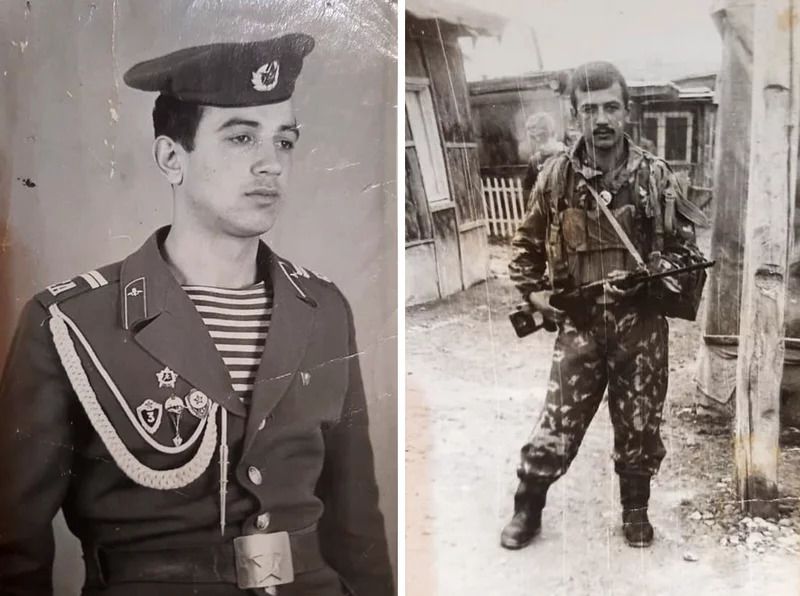 Left: Rustam Khodzhayev, at age 20, poses for a photograph in Dushanbe,
Tajikistan, following two years of fighting in Afghanistan. "We were
just kids when we sent there," he says. Right: Khodzhayev poses before a
special operations mission in Afghanistan in 1981.
Left: Rustam Khodzhayev, at age 20, poses for a photograph in Dushanbe,
Tajikistan, following two years of fighting in Afghanistan. "We were
just kids when we sent there," he says. Right: Khodzhayev poses before a
special operations mission in Afghanistan in 1981.
The war left trauma in its wake
Some 2,300 miles south, in Dushanbe, Tajikistan — now an independent country but back then part of the Soviet Union — Rustam Khodzhayev still struggles with the Afghanistan war.
"It was a hard time for me," he says.
He was 18 in December 1979, when he was conscripted into the Soviet army and deployed at the beginning of the Soviet invasion.
Khodzhayev says Tajiks and other Central Asians formed the majority of initial troop deployments — part of "Muslim battalions" chosen in part for their knowledge of dialects with similarities to those of Afghan speakers of Dari, in particular.
But when he arrived with other new recruits, he felt like he'd landed in a strange land.
"When the cargo doors opened, all we saw was dust," says Khodzhayev. "It was like another planet."
He soon found himself in a special operations unit tasked with tracking the traveling caravans of more experienced Afghan mujahedeen fighters.
"We were all just kids," he says. "I watched friends die, three or four at a time, in province after province. Each one muttered the same word at the end — 'Mama.' "
His wife, Mukhru Khodzhayeva, says Rustam, now 59, still has nightmares from those days. He calls out for dead friends in his sleep — pleading with them to turn back, to run.
She worries he has "Afghanskii syndrome"— the PTSD-like term that Soviets gave to unexplained emotional trauma that lingered from the war.
Meanwhile, Mukhru has her own memories from Afghanistan to confront.
The Soviets also sought to liberate Afghan women
Mukhru served as a Dari interpreter for Russian-speaking Soviet forces beginning in 1987 — "kind words were my weapon," she says.
She also worked in educational and job skills programs for Afghan women — first in Kabul, then elsewhere in the country.
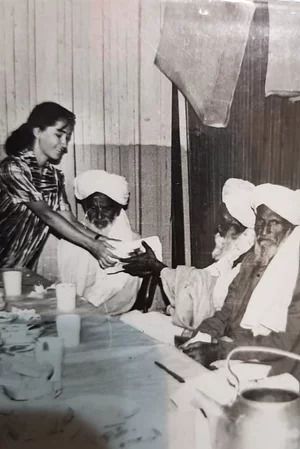 Mukhru Khodzhayeva worked as an interpreter during the Soviet war in
Afghanistan. Here she meets with Afghan village elders in 1989. "We'd
just signed an agreement that they wouldn't fire on Soviet troops," she
says.
Mukhru Khodzhayeva worked as an interpreter during the Soviet war in
Afghanistan. Here she meets with Afghan village elders in 1989. "We'd
just signed an agreement that they wouldn't fire on Soviet troops," she
says.
"They were happy we were there," she recalls. "They weren't as conservative as they are now. They would wear hijabs in public," she says, referring to the traditional head covering, "but when they gathered with other women, they dressed openly."
Still, she found herself omitting phrases or selectively translating if her Soviet Russian comrades said something that might offend the locals.
"I was raised in the east, and there you learn to tread lightly," she says.
But that didn't save her from the war's violence. After viewing soldiers' bodies sheared open from battle wounds, she says she nearly lost her mind.
"I'd grown up being taught that good always won over evil," she says. "Only it turns out, evil was always there beside us. We just hadn't noticed."
For that reason, Mukhru views the Soviet withdrawal — that day on the bridge — as a happy event.
She was a patriot. She'd fulfilled her duty. The violence of the war was finally at an end.
Pundits called it "the Soviet Vietnam"
By the time the Soviet army withdrew, more than 15,000 of its soldiers had been killed and 60,000 wounded, and at least a million Afghans had died in the fighting.
U.S. military aid — in the form of shoulder-fired Stinger missiles supplied by the CIA — had helped the mujahedeen counter Soviet helicopter gunships and inflict damage on the occupying Soviet forces.
But after a decade at war, the Soviet public couldn't understand what the USSR was even doing in Afghanistan. Profound changes were underway at home as Soviet leader Mikhail Gorbachev's policy of perestroika brought increased freedoms — and growing economic turmoil. With no Kremlin victory in sight, pundits increasingly drew comparisons to another draining Cold War quagmire — referring to the Afghanistan war as "the Soviet Vietnam."
Less than three years after the Soviet pullout, the USSR was no more.
"The veterans went from status of being venerated to the condition where they were completely despised, and that was also projected onto the collapse of the Soviet state," says Princeton University professor Serguei Alex Oushakine, author of The Patriotism of Despair: Nation, War, and Loss in Russia. "For the bigger part of this new century, [Soviet] Afghan vets were sort of outcasts."
Rustam Khodzhayev says that's how it felt for him.
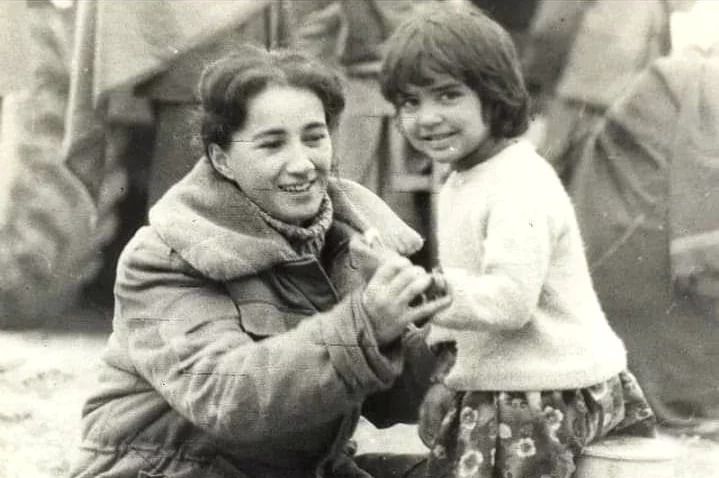 Mukhru Khodzhayeva with an unidentified child in an Afghan village
during a humanitarian mission in 1987. An interpreter for Soviet forces,
she says "kind words were my weapons."
Mukhru Khodzhayeva with an unidentified child in an Afghan village
during a humanitarian mission in 1987. An interpreter for Soviet forces,
she says "kind words were my weapons."
"The USSR was gone and no one wanted to help us anymore," he recalls. "They say, 'Why should we? We didn't send you there.'"
Better days after the war
Yet good things also came out of the war.
Rustam and Mukhru first met at a reunion for Afghan vets in Dushanbe shortly after the war. "Rustam came up to me and introduced himself. Of course, I smiled," says Mukhru.
The couple have been married now for over 30 years, with children and grandchildren.
Both remain active in veterans' affairs — gathering with fellow Afghan war vets and laying flowers at the graves of those they lost.
In Moscow, Opalev, the former Russian captain, says the Soviet mission may have been misguided, but more Russians have come to understand the sacrifice and selflessness of the soldiers involved in the Afghan war all those years ago.
"I didn't take part in the decision to send in the troops or take them out," he says. "We did what we were ordered to do. And I think we did that with honor. From a military point of view, it was a success."
Views change about the war
In Putin's Russia, that's a message that increasingly resonates as the late stages of Soviet power have come to be seen through the lens of failed Kremlin leadership — not a failed military.
Today's Kremlin has also sought to cross-pollinate widespread reverence for the Soviet victory over Nazi Germany in World War II with Russia's more recent — and controversial — proxy wars in east Ukraine, Georgia and Syria.
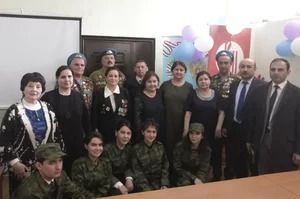 Rustam Khodzhayev (in back row with mustache) and Mukhru Khodzhayeva (in
front of him with white collar) pose with young army cadets in
Dushanbe, Tajikistan, in 2019. The couple is still active in veterans'
affairs.
Rustam Khodzhayev (in back row with mustache) and Mukhru Khodzhayeva (in
front of him with white collar) pose with young army cadets in
Dushanbe, Tajikistan, in 2019. The couple is still active in veterans'
affairs.
Soviet Afghan veterans, too, have found themselves part of that grander version of the Soviet past — within limits.
"The government hasn't forgotten about us, they invite us to events, but it's not the same as with the World War II veterans," says Opalev.
"After all, they were defending the Fatherland. We were defending the interests of the Fatherland."
Russian films like The 9th Company — a 2005 domestic blockbuster that tells the story of Soviet soldiers who heroically fought and died in one of the last battles of the Afghan occupation — have also helped to rehabilitate the image of Afghanistan vets in the eyes of the Russian public.
"The message is extremely patriotic," says Princeton's Oushakine. "It has this very Hollywood-like message — 'The war may have been lost, but we won our personal battles.'"
Soviet Afghan war vets can point to this victory as well: In 2010, the Kremlin officially named Feb. 15 — the official date of the Soviet pullout from Afghanistan — a state holiday: "A Day of Remembrance of the Russians Who Fulfilled Their Service Duty beyond the Limits of the Fatherland."
Opalev says in that path of redemption lies advice for American veterans as they restart their own lives — and journeys — post-Afghanistan.
"Help one another," he says. "Reach out to those who've been injured, and to the families of the dead."
Meanwhile, Mukhru Khodzhayeva, the interpreter, recalls the Soviets' efforts to promote Afghan women's rights all those years ago. She says her thoughts now lie primarily with the fate of women under the Taliban. Since taking power in August, the new rulers have already rolled back many of the rights women gained under the previous government, including work and education.
"How can the Taliban expect to build a society without women?" she asks.
And her husband Rustam, still living with his nightmares, warns that for all those touched by the war, the struggle will never truly be over.
"It's only the beginning of the beginning," he says.
Witnessing two of the world's most powerful armies humbled in the Afghan deserts in one lifetime has revealed the simplest of truths: there are always more battles to come.