

Why Political Leaders Are Never to Blame
At first glance, Margaret Thatcher and Barack Obama share little in common, whether in their politics or their legacies. Thatcher remains a figure of extraordinary divisiveness: a heroine to some, a caricatural witch to others. Though Obama’s time in office was marked by vitriol, his popularity afterwards has been durable, and right-wing hatred now seems concentrated elsewhere.
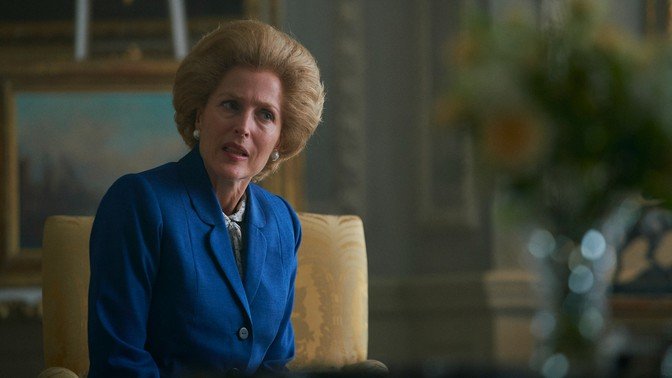
But as I watched the latest season of The Crown, in which Thatcher is portrayed by Gillian Anderson, and consumed excerpts of A Promised Land, the first volume of Obama’s memoirs, I noticed a thread that unites them. Thatcher and Obama are symbols for causes bigger than themselves, icons to venerate, characters to mourn—ambassadors from a lost age.
At the heart of Obama’s memoirs and Thatcher’s depiction in The Crown are profiles of leadership. The qualities Obama champions are moral as much as anything—decency, optimism, hope—whereas for Thatcher, they are fortitude, consistency, seriousness. In both narratives, these strengths are portrayed as obviously lacking today.
Dig deeper, and a more profound vision of leadership emerges that binds the two leaders: They are, in effect, prophets who came to embody their countries’ stories and, crucially, changed those stories. They are the chosen people who bent history to their will by holding up their visions of the future.
The problem is that both are exercises in mythology.
In The Crown, we are told Thatcher is “a conviction politician” who believes that Britain needs to be reformed from top to bottom. We watch as she battles her cabinet, the Argentinians, even her own emotions, to make good on her promise. In one early scene, she faces a ministerial revolt over spending cuts, as her colleagues accuse her of undermining everything the party stands for. “Oh, and what is that?” Anderson’s Thatcher asks. The scene is fictional but based on reality: While arguing with her ministers, according to Charles Moore’s multivolume biography, Thatcher would sometimes produce Friedrich Hayek’s libertarian work The Constitution of Liberty and declare, “This is what we believe.”
Could Boris Johnson, or indeed any of Thatcher’s other successors, replicate that moment? The Crown’s portrayal of Thatcher evokes a form of nostalgia for the certainty of the past that she has come to represent. With the benefit of hindsight, we can see that on some big calls, she was right: on remaking Britain’s moribund economy, for example, and retaking the Falkland Islands. We tend not to linger on areas where her record does not quite fit the narrative we have constructed, where she compromised or made errors of judgment she later came to regret.
Today we see her as a leader who saw what needed to be done to get to where she wanted to go. And in one sense that designation is evidently true. Thatcher was a political titan of iron will and intellectual vigor who did change Britain—for good or ill, depending on your view.
But did she really remake it top to bottom, as The Crown implies, and all sides of the political spectrum accept today? Thatcher lost many battles, including the one over European integration, which she could neither forestall nor stop Britain from taking part in. Indeed, as the historian of modern Britain Dominic Sandbrook has argued, Thatcher probably didn’t change Britain as fundamentally as we believe. Had she not been prime minister, would tens of thousands of miners really still be digging coal out of the ground in northern England, Sandbrook recently asked on a podcast? Wouldn’t the country, like so many of its neighbors, have eventually grasped its way to some kind of economic reform and ended up, roughly, where it is today?
In 1979, when Thatcher entered Downing Street, public spending as a percentage of the total economy stood at 41 percent, according to official figures. It did not fall below 40 percent until 1986, and a sustained economic boom was necessary for it to fall to 35 percent by the time she left office in 1990. Similarly, tax receipts as a percentage of the economy stood at 37 percent when she became prime minister, and 11 years later, they stood at 34 percent. A significant change, but hardly radical. On both scores, the Labour government that came into power in 1997 returned the size of the state to 1979 levels before the 2008 economic crash. In the grand scheme of things, Britain has chugged along relatively undisturbed by the political fighting over its captaincy.
Does the story we tell about Thatcher, then, not reveal more about us than it does about her? Is the point, in fact, that we need the myth of Thatcher—the visionary and transformational leader—to affirm to ourselves that we too can make a difference and change the world? Otherwise, what is the point?
Obama’s memoir seems to grapple with this inconvenient problem, but the former president cannot stop believing in his own myth. How does he explain Donald Trump’s election, for example? In his interview with The Atlantic’s Jeffrey Goldberg, Obama says Trump’s rise is partly a reaction to his own success, and partly the consequence of a changing media landscape.
In other words, Trump’s election does not undermine Obama’s victories or vision, because circumstances beyond his control subsequently changed for the worse. It was not, fundamentally, because of anything Obama had done wrong, or any of his own character flaws. Crucially, it was also not because his promise of a better America was wrong.
In my time covering politics, I have heard a very similar explanation from almost every losing candidate I have come across: Gordon Brown and Hillary Clinton told a comparable story; Jeremy Corbyn constructed the same defense. The Remain campaign in the Brexit referendum continues to criticize the publicly funded, legally impartial BBC for failing to expose pro-Brexit “lies,” which the campaign argues may have cost Britain its place in the EU.
Each of these narratives makes the age-old attempt to weave conflicting facts into some form of harmony. For Obama, the question he must wrestle with is how can the same electorate that showed its goodness and wisdom by electing him subsequently have chosen Trump?
And for Trump, if his success in 2016 made him great, is he now a loser? In Britain, the same confounding problem presents itself for Tony Blair and David Cameron: How can the same voters who made them successful have become, in their view, so populist and gullible?
Rare are the political leaders who blame themselves for the political landscape that follows their departure. Thatcher’s liberal economic revolution brought about a liberal social revolution, one in which she never felt comfortable. Similarly, the international and European Britain that Blair thought he had created brought about the Brexit Britain of today.
In the U.S., could there have been a President Trump without Bill Clinton’s NAFTA, or a President Obama without George W. Bush’s Iraq War? John Major continues to fight the same battles over European integration that he fought in the early 1990s, still as sure as ever that he’s been right all along; Cameron argues that holding a Brexit referendum was the right decision, even though he believes that its outcome is disastrous for the U.K.
The argument that policy failures, character flaws, personal weakness, or legitimate public distaste was the real reason leaders or their philosophies were rejected is rarely countenanced. The closest example of a genuinely remorseful political figure was Robert McNamara, who admitted that he was catastrophically wrong about Vietnam, but, of course, McNamara never held the top job.
In fact, it is possible to discern something of an iron rule for former political leaders: Nothing can ever happen after power has been relinquished that in any fundamental way proves their central political analysis wrong. Admissions can be made on the margins, even confessions offered for minor sins, self-deprecating reflections draped over the whole proceeding, but one cannot ever admit elemental failures of foresight or character.
Politicians have long understood that their ability to forecast the future—to be on the right side of history—is central to their legitimacy as decision makers. The 18th-century philosopher-politician Edmund Burke argued that statesmanship required deciding a course of action by assessing the probable course of events that would unfold. Burke believed that judgments about the future involve “an account of how the present had been conditioned by the past,” the historian Richard Bourke wrote. In other words, a leader leads by anticipating the future using their understanding of how the past led to the present.
For any statesman to admit that he failed to foresee the future is to admit that he failed as a statesman. It is for this reason that none ever does. Instead, new narratives are created recasting the present as confirmation of what a leader has always predicted, even though it appears to flatly contradict everything they said before.
In the extract of A Promised Land published by The Atlantic, Obama makes what he says is a confession: “There have been times during the course of writing my book, as I’ve reflected on my presidency and all that’s happened since, when I’ve had to ask myself whether I was too tempered in speaking the truth as I saw it, too cautious in either word or deed, convinced as I was that by appealing to what Lincoln called the better angels of our nature I stood a greater chance of leading us in the direction of the America we’ve been promised.” Reading this section, I couldn’t help but think of the job applicant who, asked for their biggest weakness, replies that they care too much and try too hard.
Obama—like almost all political leaders—feels vindicated by events, even as they drift further and further away from the path he foresaw. “I’m convinced that the pandemic we’re currently living through is both a manifestation of and a mere interruption in the relentless march toward an interconnected world,” he writes, for instance, although another conclusion one might reasonably draw from the pandemic is that those countries that closed their borders quickly and tightly in the hope of temporarily reducing their interconnectivity with the world were able to stop the virus’s spread more effectively.
For political leaders, questioning their own record and judgment is difficult, because it challenges their very purpose, the status they enjoy, and the place in history that they crave. That introspection would implicitly go against the very things we demand of our leaders: power, wisdom, foresight, and control—that they be on the right side of history.
If leaders were to candidly admit after leaving office that they achieved little of lasting value, that whatever they did achieve has since been undone, then implicitly go against the very things that have been their life’s work—they would be admitting that they were not especially consequential. Instead they must persist in arguing that however far from the path the world has veered since their departure, the destination remains the same: that the arc bends just as they prophesied.
Ultimately, though, the problem lies as much with us as with them. It lies with what we expect of leaders and what leaders, in turn, expect of themselves. We need to believe that Thatcher changed Britain through personal courage, determination, and vision, that Obama redeemed America and made it listen to its better angels, because if we are all just froth on the wave of history, then what is the point? If even Thatcher and Obama are ultimately powerless, then what are we, and what of the whole political process we treasure? Our leaders must project perfection and certainty. We need them to in order to make us relevant.