

Why the EU's consensus on Syria could be slowly unravelling
Syria’s nearly 11-year-conflict remains a divisive subject in Europe and contributes to wider security and migration concerns across the continent.
Although for years European Union (EU) member states have been largely aligned in their position regarding the Syrian regime’s illegitimacy, the bloc’s unity behind this stance has gradually weakened in recent years.
The situation in Afghanistan, alongside many other factors, could accelerate the erosion of this once strong consensus against the Damascus regime.
Recent events have revived fears of a renewed migrant surge. These are the same fears which followed the 2015-2016 “migrant crisis” that catalysed the renewal of the far right across Europe and anti-immigration political discourse.
This “crisis”, in which 1.3 million refugees migrated to Europe for asylum, was exploited by right-wing parties and effectively built the base of support for leaders who would re-engage Damascus, particularly in eastern and southern Europe.
"Although for years EU member states have been largely aligned in their position regarding the Syrian regime's illegitimacy, the bloc's unity behind this stance has gradually weakened in recent years"
Hungary’s Viktor Orban is arguably the leader of Europe’s anti-immigrant and far-right bloc. Since rumours of the populist prime minister’s plans to normalise with Assad first surfaced in 2019, Budapest has actively implemented concrete actions outlined in the document, such as sending a chargé d’affaires to Damascus in 2020.
Serbia, Cyprus, and Greece have recently renormalised their formal relationships with Syria’s government while Bulgaria and the Czech Republic never severed diplomatic relations with Damascus.
Additionally, Poland’s nationalist government may re-formalise diplomatic relations with Damascus as well, especially considering its traditionally hardline stance on migration and recent border issues with Belarus. Perhaps Austria, whose then-foreign minister said six years ago that “in this fight [against Islamic State] we are on the same side [as Assad]”, may move in this direction too.
This stems from individual state interests overtaking wider European unity. “If we look at some of the EU member states that have restored or currently maintain some sort of diplomatic presence in Damascus, it's not unsurprising,” said Samy Akil, a visiting fellow at the Australian National University’s College of Arts and Sciences and a non-resident fellow at the Operations & Policy Center (OPC), in an interview with The New Arab.
“Many of these states don't have much political leverage regarding the Syrian conflict, and their policies of normalisation are largely self-driven and not in the line with the EU's official stance towards Syria. However, their actions are of significant value to the regime.”
Thus, it is fair to say that the Syrian regime is not absolutely rejected within the EU, although western European countries such as France, Italy, and Germany are, at least for now, fully committed to opposing the Assad regime.
As Berlin, Paris, Rome, and others in Europe believe, any renormalisation of relations with Damascus would require a new head of state and significant government reforms, not limited to the Syrian constitution. Akil argues that this dynamic represents a split across Europe.
“While some EU states are slowly but surely 'moonwalking' away on their policies hoping that it would look like a forward motion in order to save face, I highly doubt that states like Germany and France will be following suit in the short-term.”
Considering this, much of the EU continues to reject Assad’s rule in Syria in recognition of United Nations Security Council Resolution 2254 and a political transition in Syria. European powers have imposed many sanctions on Syria’s regime and those affiliated with its atrocities in support of this position.
Additionally, Europe continues to be a leading funder and host of Syrian human rights organisations and humanitarian efforts in opposition-held areas.
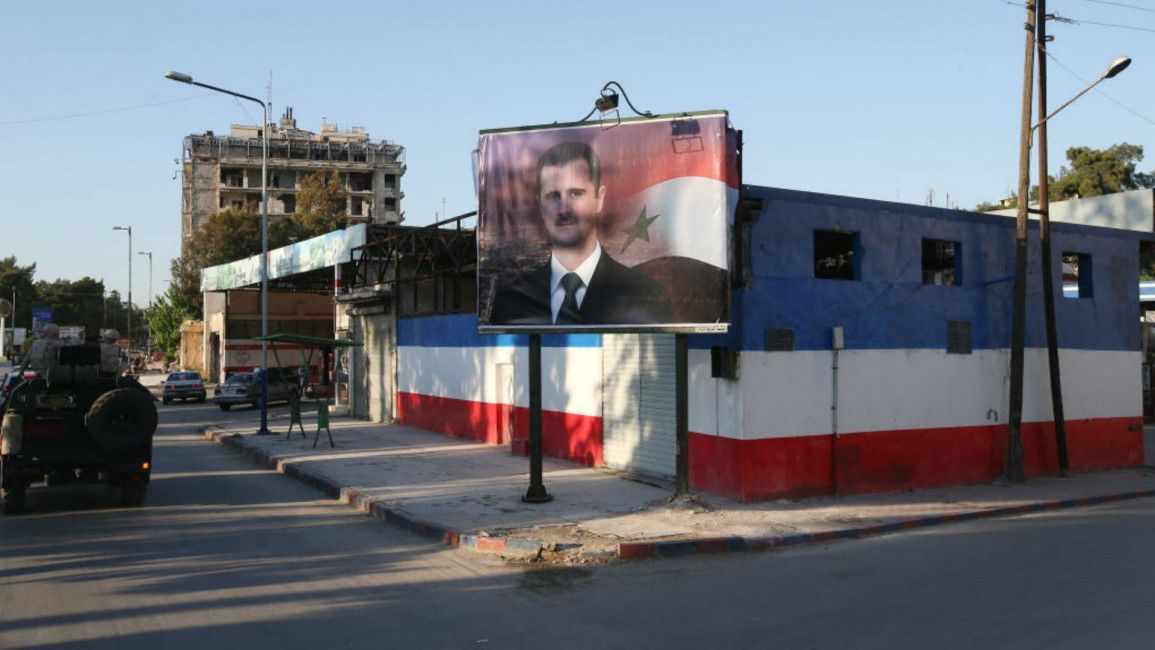 Much of the EU continues to reject Assad's rule in Syria in recognition
of United Nations Security Council Resolution 2254 and a political
transition.
Much of the EU continues to reject Assad's rule in Syria in recognition
of United Nations Security Council Resolution 2254 and a political
transition.
Yet, even with Europe’s most powerful states and the EU as a multilateral body pushing for continued uniformity against Damascus, perceptions of Assad are shifting as EU members reassess their positions and alternatives to a stagnant status quo in Syria.
Such considerations are driven by two core European interests perceived to be related to the Syrian conflict: migration and violent extremism.
Migration and Syria
First and foremost, Europe is focused on preventing a renewed surge of migrants to Europe from the southeast. This is best personified by its response to the recent collapse of the Afghan government, which has been largely disjointed.
While some European powers - namely Germany and France - have called for mechanisms to resettle Afghan refugees, others have openly rejected any renewed flow of Afghans into their countries.
This includes Slovenia and Austria, both of which released statements refusing to accept additional refugees. The Slovenian Prime Minister Janez Jansa went so far as to tweet that the “EU will not open any European ‘humanitarian’ or migration corridors for Afghanistan,” reflecting the sentiments of mostly central and eastern European states with highly xenophobic, Islamophobic, and ultra-nationalist leaders that are highly opposed to migration.
"I do think that those [eastern and southern European] countries take this [pro-normalisation] position because they necessarily take an anti-liberal view on foreign and security policy. They don't problematise the human rights abuses, war crimes, and everything else"
Dr Andreas Krieg, an Associate Professor at King's College London, told The New Arab that these European states have many reasons for feeling less connected to their western counterparts on such issues, partially due to an illiberal foreign policy approach that does not take issue with Assad’s crimes.
“I do think that those [eastern and southern European] countries take this [pro-normalisation] position because they necessarily take an anti-liberal view on foreign and security policy. They don’t problematise the human rights abuses, war crimes, and everything else the Assad regime has committed. In that respect, they view the entire [Syrian] scenario entirely differently than western European countries.”
Such sentiments are intricately related to the wider issue of migration and prove that many parts of Europe do not currently hold a values-based stance on the issue of the displaced, which has deep implications for Syria.
Today, Turkey hosts roughly 3.6 million Syrian refugees, as well as 320,000 registered Afghans, Iraqis, and Iranians. The concern among European leaders is Turkey’s capacity to, and interest in, retaining such a massive number of people – an effort that has severely strained the Turkish economy, created serious societal divisions and hate against refugees, and harmed President Recep Tayyip Erdogan’s approval ratings.
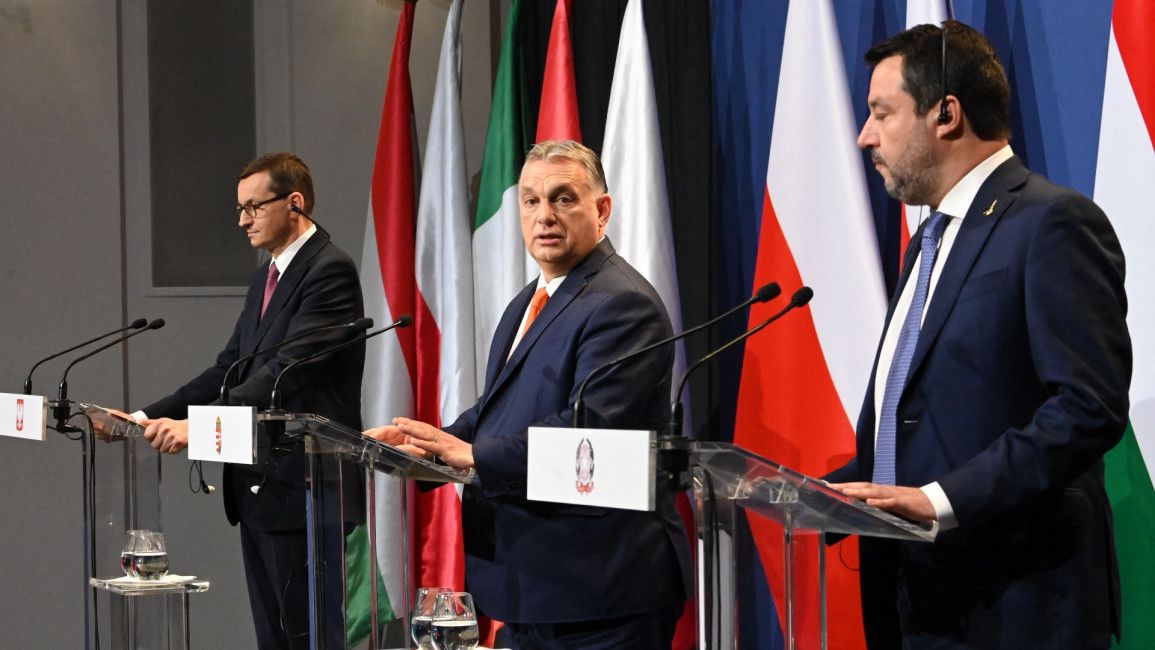 Hungary's Viktor Orban is arguably the leader of Europe's anti-immigrant and far-right bloc.
With this in mind, and from Europe’s viewpoint, the risk of Turkey rejecting its role as the continent’s gatekeeper only increases with more refugees – whether from Syria, Afghanistan, or elsewhere. This makes returning refugees to Syria a priority for those willing to look past Assad’s atrocities and who view him as the victor in his war against the Syrian people.
This stance is hardly philanthropic but very much on point for leaders such as Orban and Poland’s President Andrzej Duda, who ran electoral campaigns that appealed to certain constituents’ fears of increased Muslim immigration and terrorism. Such statesmen have exploited various acts of terrorism in Barcelona, Nice, Madrid, London, Paris, and elsewhere carried out over the past two decades.
The governments in Europe that have formalised relations with Damascus accept this narrative that their choice is between Assad or Islamic extremist groups – much to Assad’s liking and propaganda efforts.
As Italy’s then-Interior Minister Matteo Salvini put it in 2015, “I prefer Assad to ISIS.” For some European leaders, this is exactly the rhetoric that builds political power within their respective countries.
For example, Orban often highlights his role as a “protector” of Europe and Christians. As some violent extremist groups that operate in various parts of Syria, such as the Islamic State (IS), target Christians, Orban and other European statesmen justify their positions in favour of recognising Assad’s legitimacy on religious grounds, citing their faith.
According to such figures, Assad can protect Christians and other minorities while preserving an allegedly stable, secular country in an unstable region, ultimately preventing the overflow of terrorism into Europe.
"The 'migrant crisis' was exploited by right-wing parties and effectively built the base of support for leaders who would re-engage Damascus, particularly in eastern and southern Europe"
The latter point is crucial given fears in Europe and in relation to Afghanistan’s change of government and refugee flows. The memory of deadly IS and al-Qaeda attacks continues to exert political influence in European societies, where increased far-right and nationalist rhetoric has painted instability in Afghanistan and Syria as a direct security threat.
Leaders like Orban or Marie Le Pen of France falsely conflate refugees with terrorism, and, ultimately, Afghanistan has reawakened this conversation, which could have implications for Syria and its conflict.
More of the same for Europe
There is unlikely to be a sudden or sweeping shift by European states in the form of re-normalisation at this juncture. While European leaders may express a vested interest in an end to the war in Syria and their migration woes behind closed doors, in public they still openly reject Assad’s rule in Damascus.
This will probably result in Europe and the West increasingly differing with members of the Arab League - the majority of which support rehabilitating Syria’s regime.
Still, it seems safe to bet that more EU member-states will gradually move toward renormalisation with Damascus. Given sensitivities in Europe on the Syria conflict, reconciliation between western European countries and Assad’s government could take place with low-profile mini steps as opposed to major announcements of full rapprochement, if it all.
This is heavily reliant on both electoral outcomes inside of these western European states and US policy decisions on Syria, especially considering the latter’s impact on European actions through its sweeping sanctions programs such as the Caesar Act.
As Krieg put it, “the overall trend is going towards a degree of normalisation. That doesn’t mean full normalisation in the near future. But obviously if that trend continues, and there is a potential change in the White House in 2024, this might set a new tone when it comes to the sanctions regime against Assad with many things being possible”.
He adds: “I think Washington plays a crucial part. Every single party that is now interested in normalisation or is engaging with Syria is doing so consciously of the Caesar sanctions and wanting to make sure they are not in breach. So, in many ways Washington sets the tone.”
This latter point is significant given the state of the conflict and in relation to European interests. If Damascus does not fall to the opposition, which has been almost certain for years, European countries will have to ask themselves how they can assert influence in the country while not engaging.
Because there is no real answer to that question, more EU members will likely follow in the footsteps of Hungary, Greece, and a few others that chose to restore ties with Assad’s government despite its grave war crimes of the past and present.
“The French might take a different view on Assad eventually,” Dr. Krieg told TNA. “It’s a game of who is there first. If you think that that normalisation is a trend that will eventually leave the international community to accept and allow the Assad regime to re-enter the circle of trust, then you want to make sure that you’re the first to get in there. That’s what the Emiratis are doing”.
"Given sensitivities in Europe on the Syria conflict, reconciliation between western European countries and Assad could take place with low-profile mini steps as opposed to major announcements of full rapprochement, if it all"
Akil agrees. “The lack of political will, coupled with a series of failed policies and limited capabilities to actually resolve the conflict have simply been compensated and shrugged away by simply refusing to normalise relations with Assad without ever challenging the status quo,” he says.
“As was the case in the Arab world in 2020 with regards to Israel, a few EU states have decided to diverge from the official line hoping that this would serve their own national interests after coming to the realisation that Assad was there to stay. In both cases, the actors that normalised relations were not historically significant actors in either conflict, and, thus, were able to get away with it without ever facing actual repercussions.”
Now that the conflict is almost 11 years old and the regime’s survival has not been severely threatened since 2015-2016, desensitisation has taken effect throughout Western countries on Syria’s brutal war.
This effect has gradually helped the Assad regime advance its interests in rehabilitating itself internationally. As a result, it is becoming easier for EU governments to normalise with Assad, especially when considering migration and security concerns.
Such factors could contribute to a very slow but gradual shift in Europe’s thinking, even if limited by outside considerations like US-imposed sanctions.