

Wine crime is soaring but a new generation of tech savvy detectives is on the case
Down in the cool, dark cellar of Berry Bros & Rudd in St James’s, central London, Philip Moulin arranges some of the world’s most valuable wines on a table. This building has been the wine merchant’s HQ since the company was founded in 1698, and we are in the Holy of Holies, a cellar accessible via fingerprint scanner and several locked gates, where the “directors’ stock” is stored. On one rack lie dusty magnums of Mouton Rothschild 1982, on another a pyramid of golden Château d’Yquem Sauternes. The liquid in this room is worth hundreds of thousands of pounds, if not more. Or at least is, if it is what it claims to be.
Moulin, a genial figure who has been into wine since he was a boy, has sometimes been called a “wine detective”. He is the quality and authentication manager at Berry Bros, who in recent years has specialised in helping to check everything the company buys is up to scratch. Berry Bros is the first British merchant to employ an authenticator; recognition that their reputation is based on trust and that fraudulent wine is a serious problem in the trade. Moulin shows me some of the dozens of ways to check a wine is real without actually tasting it: from the weight of the bottle to the level of the wine within, watermarks, paper with a unique weave, ink with special DNA, microchips in the bottle. Using a magnifying glass, he shows me micro-writing hidden within what look like lines. A UV torch reveals hidden flecks of reflective material.
“There are lots of grey areas. We need to make sure that if we have any issues with something, it doesn’t come into the business,” says Moulin. “Questions do arise. There aren’t many people who can deal with it. The police have no interest.”
It may be low priority for the police, but as wine has become more valuable, wine-related crime has been on the rise. Wine tends to be less well guarded than jewellery, yet it can be just as tempting a target. Last October, a bottle of Yquem worth £295,000 was among 45 bottles stolen from a resort in Spain. In 2019, thieves bored a hole into a cellar beneath a Paris restaurant and made off with €600,000 worth of wine. Merchants, châteaux, restaurants and customers are engaged in a constant battle against theft and mis-selling.
While thefts attract headlines, fraud is the more pernicious problem. Wine has been mucked around with for as long as it has been drunk. Pliny the Elder complained of friends claiming to be drinking prized “Falernian wine” when he, an expert on the stuff, knew they were not. In Chaucer’s Canterbury Tales, the Pardoner warns against mixed wines. In the 15th century, taverns poured from the barrel in sight of their customers so they couldn’t be accused of watering it down. In the 1480s, a German vigneron was forced to drink two bottles of his own wine as punishment for adulterating it. He died, which presumably spared him quite a headache. The diethylene glycol scandal of 1985, in which millions of gallons of Austrian wine were found to have been adulterated with an antifreeze component, set that nation’s wine business back a decade.
After the 2004 wine film Sideways popularised pinot noir at the expense of merlot, the American firm E&J Gallo bought 13.5m litres of pinot noir from a collective of French growers in Limoux, in the Languedoc, at a surprisingly good price. Eventually, the French customs office took an interest, noting that the entire Languedoc region only produced around 5m litres of pinot noir per year. The suppliers had been sending merlot and shiraz instead. As the defence lawyers tried to argue, “not a single American consumer complained”.
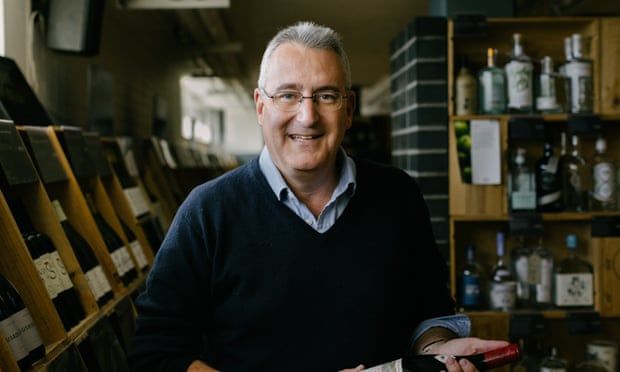 ‘We need to make sure that if we have any
issues with something, that it doesn’t come into the business,’ says
Philip Moulin of Berry Bros & Rudd.
‘We need to make sure that if we have any
issues with something, that it doesn’t come into the business,’ says
Philip Moulin of Berry Bros & Rudd.
Today, it has been estimated that as much as 25% of all the wine in the world is not as it is described. This covers a spectrum of adulteration to bottle and liquid, from mislabelling, mis-blending and false certification to forgery. Although wine is often compared to art, a painting is either by the artist or it isn’t. But £1,000 bottles of wine might be passed off as £10,000 bottles in auctions; Algerian wine might be passed off as French; God-knows-what might be passed off as off-licence stalwarts. Where the line is drawn between acceptable rule-bending and wanton criminality can depend on who you ask, but everyone agrees the problem is getting worse. The fake wine, beer and spirits sector is estimated to cost the UK more than £600m annually.
If you were trying to think of a trade ripe for fraudsters, you would struggle to come up with one better. A cheap agricultural product becomes a luxury commodity through process, time and labelling. There is no barrier to entry for winemakers or consumers. To trade complicated financial products you need FCA qualifications. Any muggins can go online and buy or sell wine for as much as they like. Only a handful of people on earth have the palate to discern between the very best wines and even they are highly fallible. What’s more, unlike authenticating a painting, the art of testing a wine has mostly involved opening it and therefore removing most of its value. There are ways to test from outside the bottle, but they are costly and complex. The most serious cases have resulted in fines or relatively short jail sentences. Such an attractive combination draws not just opportunistic chancers, but professional criminals who have the resources to keep pace with even sophisticated anti-fraud techniques.
Two high-level cases helped popularise wine fraud in the public imagination. Benjamin Wallis’s 2008 book The Billionaire’s Vinegar documented the case of the Jefferson wines. A German dealer, Hardy Rodenstock, claimed to have found, behind a bricked up-wall in Paris, bottles of 1787 Lafite allegedly intended for Thomas Jefferson, engraved with “Th. J.” Despite doubts about the wines from Jefferson scholars, Christie’s sold them at auction for world-record prices. Another collector, who had bought a bottle privately from Rodenstock before the record sale, grew suspicious and sued him. In court, a piece of evidence was the presence in the wine of high levels of carbon-14 and tritium, two isotopes that became much more prevalent in the atmosphere after the advent of nuclear weapons testing. Scientists concluded that at least some of the Jefferson wine came from 1962 or later. A German court found against Rodenstock; it was settled out of court after he appealed. A film of The Billionaire’s Vinegar is in the works, with Brad Pitt attached.
Then there was the case of Rudy Kurniawan, an enigmatic Indonesian who popped up in the high-end American wine market in the early 2000s with a seemingly bottomless supply of rare wines. In 2009, he was sued by Bill Koch, the billionaire collector who also helped expose Rodenstock. Koch was one of the few collectors wealthy and committed enough to risk devaluing his own collection to reveal the scams at work. When FBI investigators searched Kurniawan’s house in 2012, they found a trove of forger’s gear: corks, stamps, labels and empty bottles. In 2014 he was sentenced to 10 years in prison. He served six years before being released and deported in late 2020. The scandal was the subject of a 2016 Netflix documentary, Sour Grapes.
“Rudy highlighted to the whole fine wine trade that they had been complacent,” says Moulin. “Everyone had to wake up and take fraud more seriously. Now people are asking questions all the time about it: ‘How can we prove this is real?’”
One of the key investigators in the Kurniawan case was Maureen Downey. A charismatic and forthright American, she is the godmother of the wine-authentication business. Working as an auctioneer in the late 90s and early 2000s, she started to notice an alarming number of fakes. Labels would be wrong; vintages impossible; the wines themselves not as described. In 2005, she quit auctions to focus on authentication. She fought an uphill battle. Owners, by and large rich and powerful men, did not want to know. There was little to be gained from being the one holding the fakes when the music stopped. Better to quietly move the wine on and let someone else take the hit.
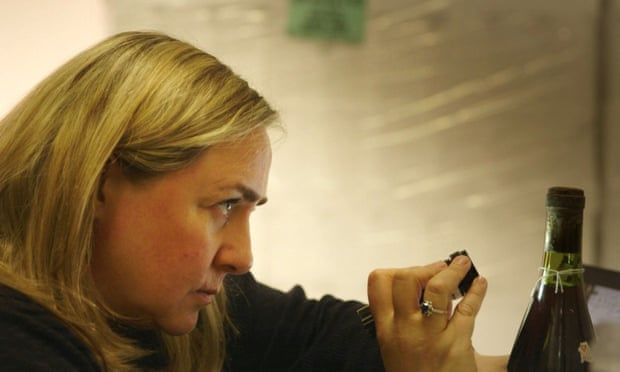 Sniffing out the criminals: Maureen Downey examines a wine bottle
“It was a difficult decade,” says Downey, over the phone from her home in California. “I was a girl pissing on the boys’ campfire. I was out and loud about it and nobody would believe me. I had to take bodyguards to wine tastings, and I’ve been physically assaulted. It’s big money. It’s also about fragile male egos. A lot of these guys were part of a whole ‘my bottle is bigger than yours’ scene, and had been losers before they made money. It was more than they could handle to be told that their bottle was fake.”
Downey agrees that the Kurniawan case changed everything. Since then, her services have been in constant demand from collectors, merchants and auction houses looking to guarantee their stock. She has trained hundreds of other experts, Moulin among them. At times, the world of elite wine crime has some of the qualities of a jewel heist; where it is tempting to root for the devious outsiders defrauding credulous billionaires. Downey has no time for this view.
“As somebody who has been screaming about this for years, I needed to find a way to make people care,” she says. “There are people who think it’s all about stupid white guys. But fraud accounts for billions in lost tax revenue. It’s why schools go underfunded and potholes aren’t filled.”
The scandal brought winemakers up short, too. Fiona Morrison is a Master of Wine and the co-owner, with her husband, Jacques Thienpont, of Bordeaux’s famous Pomerol estate, Le Pin. “It was one of those wine stories that overflows into everyday life,” she says. “It really made people sit up and take notice.” Quality control can be easier in theory than in practice, she says. “Watermarks and other things on the label can make it harder, but tracking the bottles is a thornier issue altogether. Ultimately, it takes a hell of a lot more manpower. The bottom line is that it depends on how many bottles you’re making.” In recent years she says there has been an increase in customers ordering direct from the château, to avoid the uncertainty of middlemen.
While the top-end wines attract the most publicity, fraud is a problem at every level, down to the various local shops around Birmingham that were caught selling fraudulent Yellow Tail last year. (Unlike in California, Trading Standards were tipped off, in at least one case, by a suspicious and evidently discerning member of the public.) If a quarter of all the wine on earth is fraudulent, it’s almost certain you’ve served some at dinner parties.
Joshua Castle is the head sommelier for Noble Rot, a pair of restaurants in London which also has a wine shop, a magazine and a wholesale trade business. They specialise in finding unusual bottles from all over the world, especially France, often from smaller producers. In contrast to the most famous Bordeaux and Burgundies, often little is known about these wines.
“Some of these guys make very little or almost no wine,” Castle says. “They don’t reach many markets. Where is the body of authentic literature or knowledge about what makes those bottles distinctive?” So-called “unicorn” wines, he adds, where there is a hot demand for a little-known wine, which is in limited supply, would be a tempting target for forgers.
“If you put a bottle of this stuff online, it’s going to go for top dollar, and the buyer might even drink it,” Castle says. “There won’t be any comparative analysis. I tasted a bottle in a restaurant the other day and it was so far off how I expected it to taste, it must have been a completely different wine.” All the same, he cautions against placing too much faith on any one tasting. “Human palates are pretty bad,” he says. “We can have strong instincts, but we can’t chemically analyse things on the palate. Ultimately, the weight of provenance relies on the bottle.”
Thanks in part to the pioneering work of Downey and others like her, those in the trade now have a wider range of techniques to deter counterfeiters. As well as microchips and tracking numbers, there’s a system called Bubble Tag that puts an unmistakable pattern of air bubbles in the capsule (the protective sleeve over the cork), which matches to an image kept on stock.
Perhaps most intriguingly, wine is an appealing test case for blockchains, the digital system of recording information in a way that protects it from fraud. Downey has created something called the Chai Vault, which will use the blockchain to authenticate bottles in storage. There are several other start-ups offering a similar service. “Everything has gotten worse since Rudy,” Downey says, “and the forgers have become a lot more sophisticated.”
Downey’s new system can update information as the wines change hands. Provided there is confidence about the original provenance, it ought to help. “Blockchain is part of the solution,” she says. “In 50 years, when someone goes to buy that bottle, they will be able to see exactly what the ownership has been.” Even that doesn’t guarantee the wine, she says, because someone could still put a needle through the top and refill it with inferior liquid, so she also has a system with the capsule that protects the elegance of the bottle.
For all the promise of technology, few think fraud will vanish any time soon. Partly it’s the ingenuity of the counterfeiters, and partly because the consumer is unable, or unwilling, to tell the difference.
Back in the crepuscular glamour of the Berry Bros vaults, one of Moulin’s colleagues arrives to collect a bottle for a lunch upstairs. Amid all the money, theft, technology, rivalry, envy and recrimination of this murky trade, it is almost strange to be reminded of the only quality of wine older than fraud: it is meant to be drunk.