

As Lebanon's Hariri appears to make a comeback, a popular uprising turns into a political front
Pierre Issa arrived at a meeting with French President Emmanuel Macron on August 6 with 10 stitches on his face, two chipped teeth and a few broken bones. "I wasn't sure if I could make it today, so I wrote you an open letter just in case," Issa recalled telling Macron.
Issa -- a bespectacled 63-year-old who is Secretary General of Lebanon's non-sectarian National Bloc party -- was one of thousands of people who were injured in the August 4 explosion at the Beirut port which laid waste to large parts of the capital.
Over 200 others perished and the Lebanese state appeared on the verge of collapse. Two days later, Macron flew into Beirut to cobble together emergency aid, as well as a political resolution. He brought traditional politicians together in an attempt to resolve their disputes, and met with humanitarian workers and civil society actors.
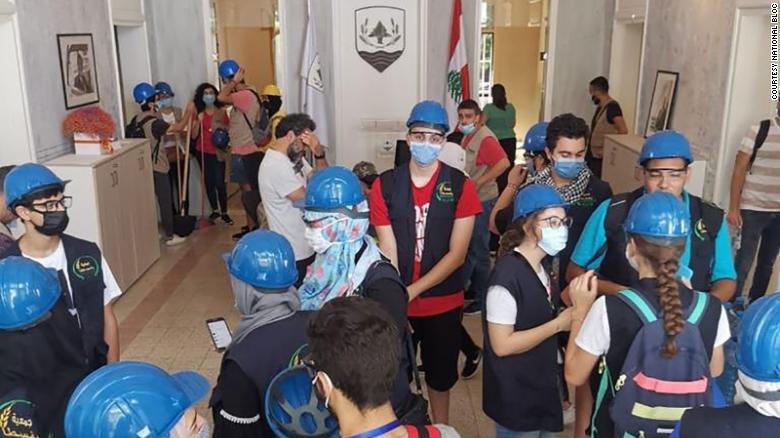
"I thanked him for his humanitarian help, but I thanked him for nothing else," Issa told CNN about his meeting with Macron at the house of the French ambassador, the palatial Residénce des Pins where 100 years ago Lebanon was declared a state.
Issa said he berated Macron for excluding major figures in Lebanon's year-long popular uprising from talks about the crisis-ridden country's immediate political future.
According to Issa, Macron, in turn, told him what he would that evening repeat to members of the Lebanese press: that the political alternative to Lebanon's loathed confessional power-sharing system does not yet exist, and that the country's reform process -- later known as "the French initiative" -- would have to be enacted through traditional sectarian political parties.
The French presidential palace declined to comment on the conversation.
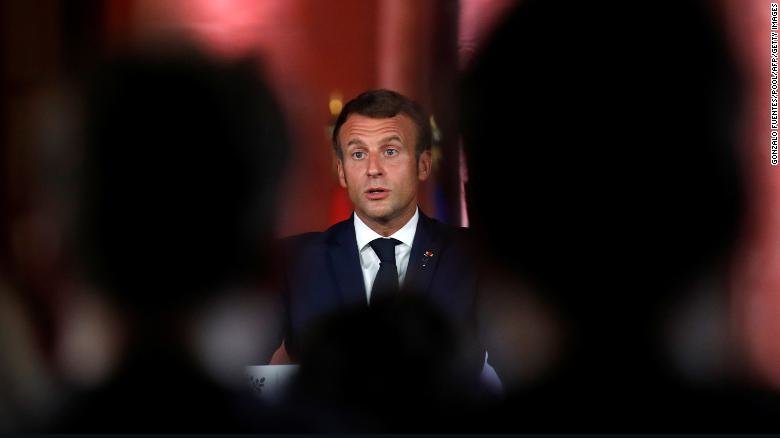
The exchange between Issa and Macron, which occurred during the French president's meeting with civil society actors, was one of the clearest signs that
Lebanon's uprising has been working to chart a new course.
The popular movement which began last October 17 has shied away from political participation, largely refused to negotiate with the country's sectarian leadership, and insisted that it was a "leaderless" grouping expressing widespread disgruntlement with the ruling political elite.
But as an economic meltdown gripped the country, destroying millions of livelihoods and causing poverty levels to soar, the euphoria of the protests gave way to despair. The coronavirus pandemic has also limited people's ability to flock to the streets. Prominent protest figures have disappeared from Lebanese television's prime-time talk shows, and traditional sectarian politicians, who were personae non gratae in the early weeks of the demonstrations, have again taken center stage.
Adding to the sense that Lebanon's political mood is making a 360-degree turn is the apparently imminent return of former Prime Minister Saad al-Hariri as the country's premier. Hariri resigned following huge street protests in October 2019. This Thursday, he is widely expected to be tasked with forming the country's next government during parliamentary consultations.
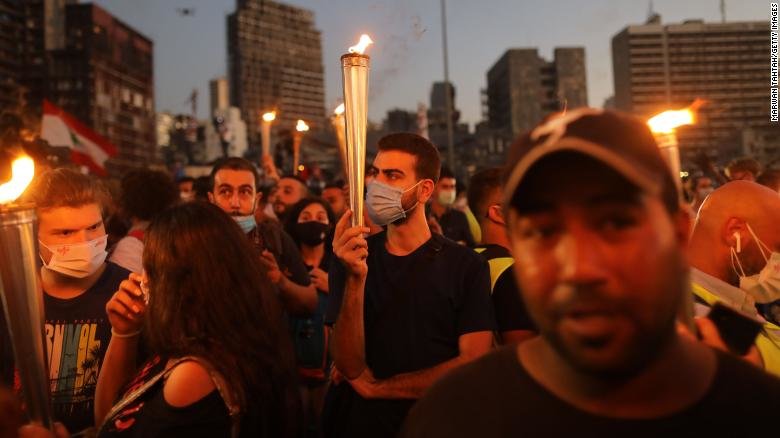
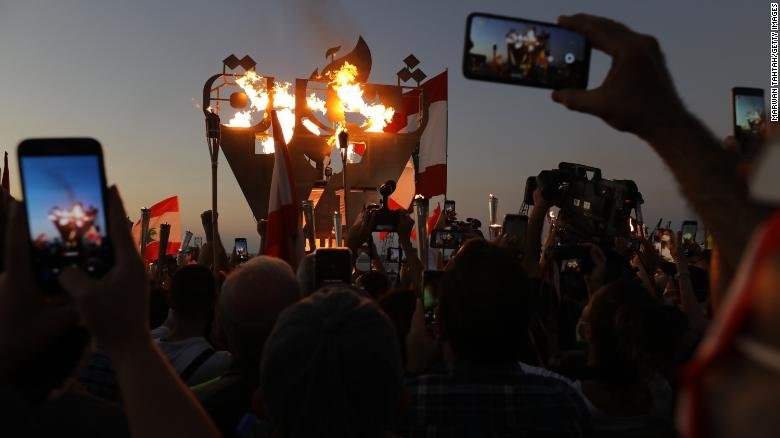
Hariri would take over from caretaker Prime Minister Hassan Diab, a technocrat who was brought to power by a Hezbollah-backed parliamentary coalition majority. Diab stepped down about a week after the August 4 explosion as Beirut's streets roiled with angry demonstrations. The so-called French initiative
which brokered the political process following the blast led to the naming of a Hariri-backed diplomat, Mustapha Adib, for the premiership.
In less than a month, Adib stepped down as PM-designate and Hariri re-emerged as the country's most likely contender for prime minister.
It's a situation that has prompted protesters to take pause, to discuss the shortcomings of what many call "the October revolution." And they say it has also pushed them to shift gears.
A political front composed of non-sectarian opposition groups will be announced in the coming weeks, says Issa. His center-right National Bloc party recently forged an alliance with the non-sectarian, left-leaning Citizens in a State party (Mouwatinoun wa Mouwatinat fi dawla), as part of a bid to build a coalition that seeks to dismantle Lebanon's ruling elite.
Other civil society groups have also morphed into political parties and are coalescing into alliances.
"Practically speaking, people have understood that in order to break the ceiling we must create a political front," said Issa. "Today we are all voices in the desert. We have a common enemy and a common goal. We need to topple the ruling political system."
From street to office
On a quiet side-street in eastern Beirut, a group of activists are concocting tactics to keep demonstrations peaceful during the commemorations of the uprising's anniversary last weekend. This is what Lebanon's popular movement now looks like, they say: activists taking to their laptops and organizing.
"I do believe that we destabilized (the ruling elite's) presence in a way they would have never imagined," said 29-year-old Ziad Nassar, a Doha-based business consultant and Lebanese activist. "There was a Berlin Wall before separating people in this country, between sects, and political parties."
"What happened on October 17 is we broke a wall."
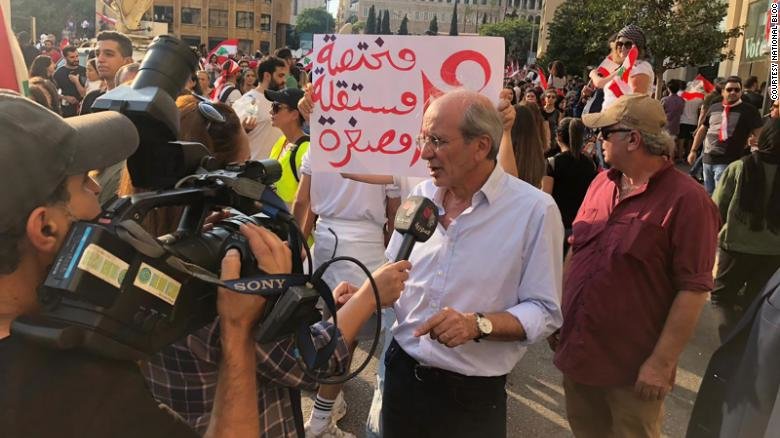

But like many activists in Beirut, they say that the coming together of a population traditionally split between sectarian parties is not enough. They're especially worried about being ill-prepared for parliamentary elections expected to be held in roughly 18 months from now.
"What the revolution should gear to ... is focusing on the elections," said 33-year-old business strategist and activist Sarmad Nabti. "If we don't take advantage of the time we have now to do that, then the hope is gone.
We're definitely going from street to office."
Activists acknowledge Hariri's expected return as a setback. "I won't accept it," said Nabti. "I'll either leave or go back to the streets."
"We will go down to the streets and we will pressure either until he falls or until he proves us wrong," said Nassar.
"Hariri and this regime can't give us our services, because to satisfy their way of politics, they can't form a real government," said 25-year-old activist Tarek Khalil.
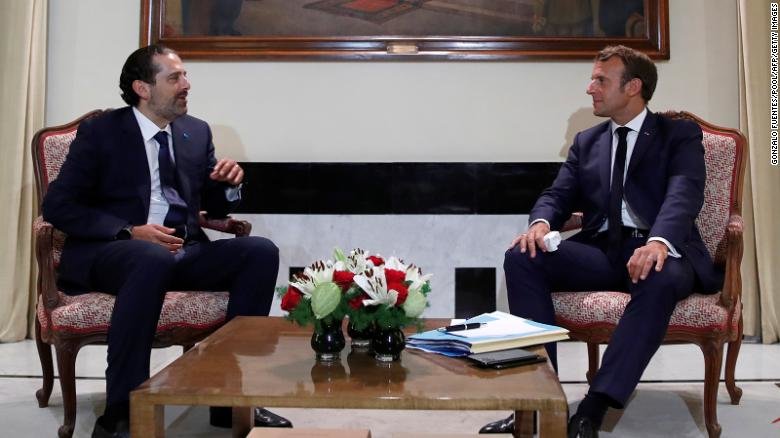
Hariri is part of the ruling elite, and backed by Saudi Arabia. He's also seen as the leader of the country's Sunni community. Lebanon's confessional power-sharing system allots the premiership to a Sunni Muslim.
But many in Lebanon argue that a Hariri government, particularly one that satisfies the demands of the international donor community, is imperative. The three-time prime minister appears to have the backing of the international community. If he manages to form a rescue government, he could unlock over $10 billion in pledged funds, potentially staving off collapse in a country where foreign currency reserves are rapidly drying up.
"Under all this pressure, we are in the emergency room and we need treatment," Yassin Jaber, an independent MP affiliated with Parliament Speaker Nabih Berri's Liberation and Development Bloc, told CNN.
"The doctor needs to be a government that comes in to do the necessary cleaning up, the necessary patching. And then we look at the confessional system, when we are in better health than we are in at the moment."
The parliamentary bloc Jaber is affiliated one of those political groups widely accused of corruption by the popular movement. Jaber insists that not all politicians in the ruling elite are involved in wrongdoing but acknowledges that government corruption is widespread.
Speaking about the protest movement which Jaber says he "saw coming," he argues that the absence of a political structure caused its eventual fizzling out.
"Movements like this need a face. They need leadership and that's what was lacking. You had many people talking here and there but there was no organized leadership," said Jaber.
Back at the Résidence des Pins, Macron made a similar defense for his limited engagement with the protest movement, according to Issa.
"He said 'where are you all? Where is this political alternative? Announce your front so that we can speak to you,'" recalled Issa.
"I said 'can't you see us? In any case, the opposition front is En Marche, Mr. Macron,'" Issa said. It was a play on the name of the French leader's party, and an allusion to the idea that a movement "in progress" could also, one day, be a force to be reckoned with.