

Benjamin Netanyahu, Israel's comeback leader
Mr Netanyahu himself though defiantly promised: "We'll be back!"
As it turned out his departure was but a relative blip, with Mr Netanyahu upending the new political landscape with a convincing election victory just over a year later.
With some irony, the 73-year-old head of the right-wing Likud party toppled his centre-left opponent Yair Lapid, who had engineered his downfall.
His dramatic comeback will seal the belief among his supporters that "King Bibi" is politically invincible.
Israel's longest-serving leader, Mr Netanyahu has won a record five elections to hold office (as expected) six times - more than any other prime minister in the country's 74-year history.
Mr Netanyahu's unrivalled success owes much to the image he has cultivated as the person who can best keep Israel safe from hostile forces in the Middle East.
He has taken a tough line towards the Palestinians, putting security concerns at the top of any talk of peace, and long warned of existential danger to Israel from Iran.
But hanging over his political achievements is the cloud of an ongoing criminal trial for alleged bribery, fraud and breach of trust - charges he fiercely denies. And for a man described by the Times of Israel as "ultra-divisive", his opponents see him as a danger to Israeli democracy itself.
Brother's legacy
Benjamin Netanyahu was born in Tel Aviv in 1949. In 1963, his family moved to the US when his father Benzion, a prominent historian and Zionist activist, was offered an academic post.
At the age of 18, he returned to Israel, where he spent five distinguished years in the army, serving as a captain in an elite commando unit, the Sayeret Matkal. He was wounded in a raid on a Belgian airliner hijacked by Palestinian militants which landed in Israel in 1972, and fought in the 1973 Middle East war.
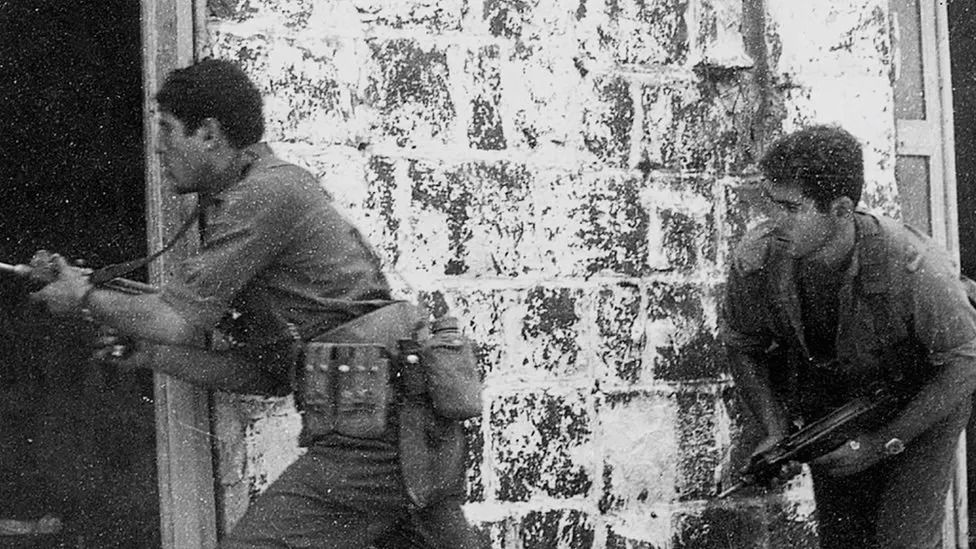 Mr Netanyahu (R) was a captain of the elite Sayeret Matkal commando unit
In 1976, Mr Netanyahu's brother, Jonathan, was killed leading a raid to rescue hostages from a hijacked airliner in Entebbe, Uganda. His death had a profound impact on the Netanyahu family, and his name became legendary in Israel.
Mr Netanyahu set up an anti-terrorism institute in his brother's memory and in 1982 became Israel's deputy chief of mission in Washington.
Overnight, Mr Netanyahu's public life was launched. An articulate English speaker with a distinctive American accent, he became a familiar face on US television and an effective advocate for Israel.
He was appointed Israel's permanent representative at the UN in New York in 1984.
Rise to power
Mr Netanyahu became involved in politics when he returned to Israel in 1988, winning a seat for the Likud party in the Knesset (parliament) and becoming deputy foreign minister.
He later became party chairman, and in 1996, Israel's first directly elected prime minister after an early election following the assassination of Yitzhak Rabin.
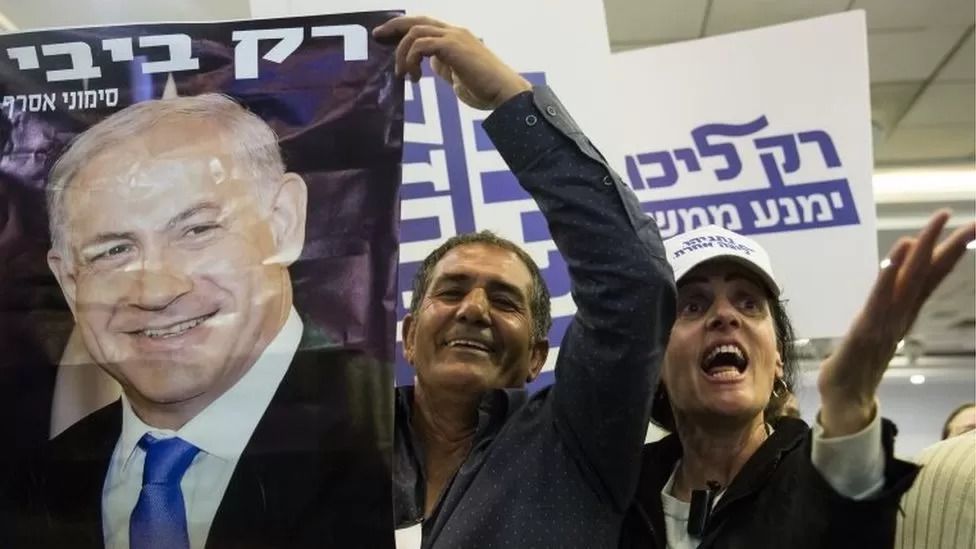 Mr Netanyahu has a loyal political base in the Likud party
Mr Netanyahu was also Israel's youngest leader and the first to be born after the state was founded in 1948.
Despite having fiercely criticised the 1993 Oslo peace accords between Israel and the Palestinians, Mr Netanyahu signed a deal handing over 80% of Hebron to Palestinian Authority control and agreed to further withdrawals from the occupied West Bank, to much opprobrium from the right.
He lost office in 1999 after he called elections 17 months early, defeated by Labour leader Ehud Barak, Mr Netanyahu's former commander.
Political revival
Mr Netanyahu stepped down as Likud leader and was succeeded by Ariel Sharon.
After Mr Sharon was elected prime minister in 2001, Mr Netanyahu returned to government, first as foreign minister and then as finance minister. In 2005, he resigned in protest at the Israeli withdrawal from the occupied Gaza Strip.
His chance came again in 2005, when Mr Sharon - just before a massive stroke that left him in a coma - split from Likud and set up a new centrist party, Kadima.
Mr Netanyahu won the Likud leadership again and was elected prime minister for the second time in March 2009.
He agreed to an unprecedented 10-month freeze on settlement construction in the West Bank, enabling peace talks with Palestinians, but negotiations collapsed in late 2010.
Although in 2009 he had publicly announced his conditional acceptance of a Palestinian state alongside Israel, he later toughened his position. "A Palestinian state will not be created, not like the one people are talking about. It won't happen," he told an Israeli radio station in 2019.
Palestinian attacks and Israeli military action repeatedly brought Israel into confrontation in and around the Gaza Strip before and after Mr Netanyahu returned to office in 2009.
The fourth such conflict in just 12 years erupted in May 2021, putting a temporary halt to efforts by parties opposed to Mr Netanyahu to oust him following a series of inconclusive elections.
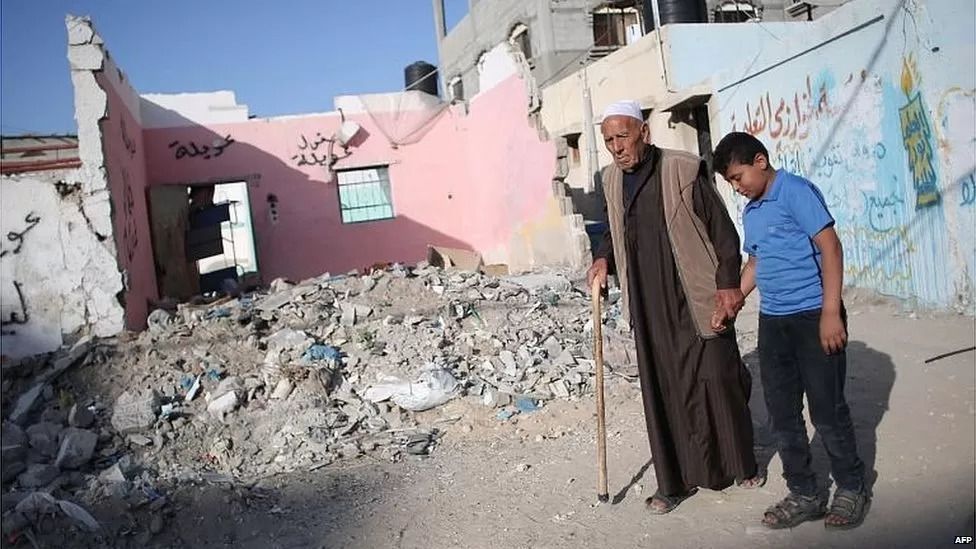 Israel has fought four major conflicts with militants in Gaza
Although during the conflicts Israel had the support of the United States, its closest ally, relations between Mr Netanyahu and President Barack Obama were difficult.
They reached a low point when Mr Netanyahu addressed Congress in March 2015, warning against a "bad deal" arising out of US negotiations with Iran over its nuclear programme. The Obama administration condemned the visit as interfering and damaging.
Trump ties
The advent of Donald Trump's presidency in 2017 led to a closer alignment between US and Israeli government policies, and within a year Mr Trump announced his recognition of Jerusalem as Israel's capital.
The move sparked fury across the Arab world - which supports the Palestinians' claim to the eastern half of Jerusalem occupied by Israel since the 1967 Middle East war - but it handed Mr Netanyahu a major political and diplomatic coup.
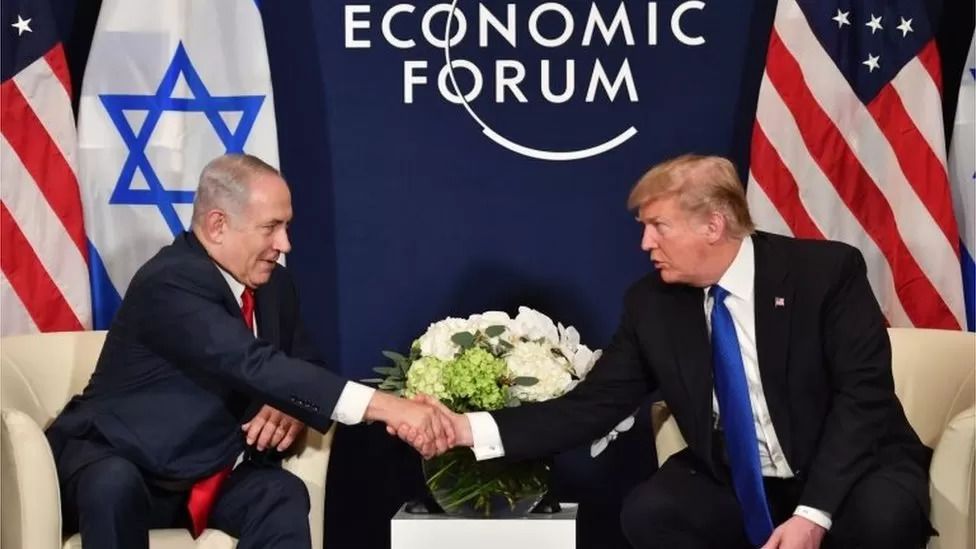 Mr Netanyahu had a close political relationship with Donald Trump
And in January 2020, Mr Netanyahu hailed Mr Trump's blueprint for peace between Israel and the Palestinians as "the opportunity of the century", though it was spurned by Palestinians as one-sided and left on the table.
Mr Netanyahu also saw eye-to-eye with Mr Trump on Iran, welcoming the president's withdrawal in 2018 from the Iran nuclear deal and reinstatement of economic sanctions.
Mr Trump however made stinging remarks about the Israeli leader, accusing him of disloyalty, after he congratulated Joe Biden on winning the presidency in November 2020.
Spectacle of trial
After 2016, Mr Netanyahu was dogged by a corruption investigation, which culminated in him being charged with bribery, fraud and breach of trust in connection with three separate cases in November 2019.
Mr Netanyahu is alleged to have accepted gifts from wealthy businessmen and dispensed favours to try to get more positive press coverage.
He denies wrongdoing and says he is the victim of a politically motivated "witch hunt" engineered by his opponents. He went on trial in May 2020, becoming the first serving prime minister to do so.
The spectacle has not, though, harmed his electability.
"We have won a huge vote of confidence from the people of Israel," he told jubilant supporters after exit polls in the November election showed him on course for victory.
For his political base, Mr Netanyahu's return marks the start of another, new dawn.
After being charged in 2019, Benjamin Netanyahu railed against what he saw as an "attempted coup"