Arab Press

بالشعب و للشعب
Sunday, Apr 26, 2026

Consumer confidence falls to record low in Lebanon as crisis deepens

Consumer confidence falls to record low in Lebanon as crisis deepens

Consumer sentiment retreated significantly in the second quarter of 2020 due to the government's token action to tackle the economic crisis

Consumer confidence in Lebanon has fallen to record low levels in the first half of 2020 as the country's economic crisis deepens.

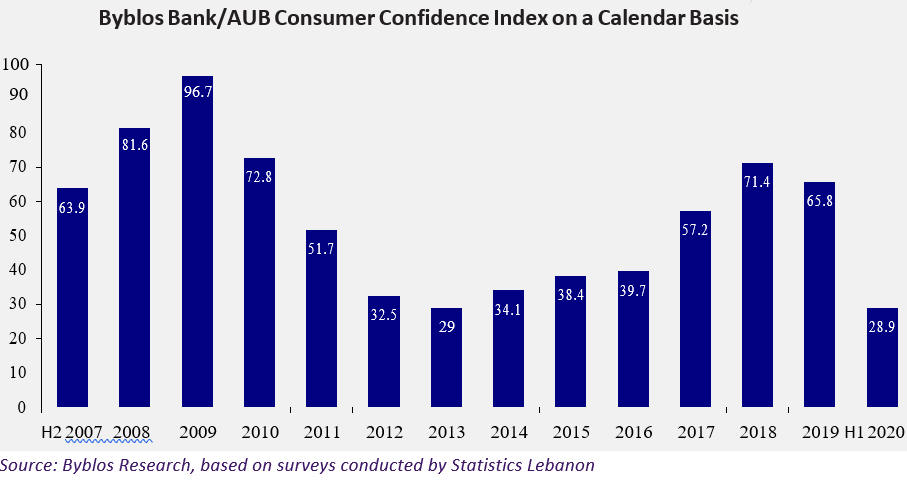
The latest Byblos Bank/AUB Consumer Confidence Index fell to its lowest level since its inception in July 2007, registering 28.9 percent, reflecting the mounting frustrations of Lebanese citizens.

The index was published on the same day that Lebanon’s President tasked former Prime Minister Saad Hariri with forming a new government, bringing back the veteran politician a year after he was toppled amid nationwide protests against widespread corruption and a failing economy.

Hariri now faces a more impoverished Lebanon, devastated by the massive August port explosion, but also a more determined opposition.


The swift formation of an effective and credible government is seen as the first step towards restoring the confidence of households and improving their long-term outlook.

The Byblos Bank/AUB Consumer Confidence Index averaged 38.7 in the first quarter of 2020 and declined by 19 percent from the fourth quarter of 2019. It fell by 50.8 percent to an average of 19 in the second quarter of 2020.

Household sentiment has historically been influenced by political developments in Lebanon. However, this trend changed in the first half of 2020 as consumer confidence was mostly affected by prevailing socio-economic conditions in addition to political uncertainty.

Consumer sentiment retreated significantly in the second quarter due to the government's token action to tackle the economic crisis that was exacerbated by the outbreak of the coronavirus pandemic.

The results for the first half of 2020 reflected the uncertain outlook of Lebanese households about their future as only 1.4 percent of those polled expected their personal financial conditions to improve in the coming six months compared to 7 percent in the second half of 2019.

Eighty-three percent of respondents believed that their financial situation would deteriorate while 14 percent expected their financial conditions to remain the same.


A series of adverse events severely dented household sentiment during the first half of the year, including mounting financial pressures, the weakening of the Lebanese pound's exchange rate in the parallel market and the rising cost of living, the impact of the government's decision to suspend all payments on its outstanding Eurobonds starting in March, as well as the lockdown measures that the government enforced to contain the coronavirus pandemic.

The onset of nationwide protests in October 2019 raised the hopes of citizens for genuine political change and accountability but the sustained failure of political parties in power only dented household confidence further in the first six months of the year.

The Byblos Bank/AUB Consumer Confidence Index showed that only 0.3 percent of Lebanese polled in March considered that their personal financial conditions improved compared to six months earlier, edging up to 0.6 percent in June, while no-one considered that business conditions in Lebanon had improved in the same period (0.1 percent in June).

The shutdown of the economy due to the coronavirus pandemic led many companies to cut salaries or, in some cases, to lay off some of their employees, which further reduced households' income and increased their level of uncertainty in the second quarter of the year. The index dropped in April to its lowest level on record, only to drop further in May.

The results of the index for the first half of 2020 continue to reflect citizens' lost trust and increased scepticism about the ability of politicians to carry out much-needed reforms.

Newsletter

Related Articles

Arab Press
0:00
0:00
Close
News Roundup
Strategic Saudi-Bahrain Causeway Closed Amid Security Concerns as Trump Deadline Approaches
Saudi Arabia Keeps Red Sea Oil Exports Flowing Despite Regional Tensions
Pipeline Attack Cuts Significant Share of Saudi Arabia’s Oil Export Capacity
Saudi Business Leader Abudawood Appointed Chairman of Merit Incentives Group
TotalEnergies Confirms Damage at Saudi Refinery Following Security Incident
Saudi Arabia Launches Early Construction Phase for King Salman Stadium Project
Saudi Shift Away from Longstanding Dollar Oil Framework Gains Attention Amid Iran Conflict
Türkiye and Saudi Arabia Resolve Long-Running Transit Visa Dispute
Saudi Oil Capacity and Pipeline Flows Reduced as Supply Risks Intensify
TotalEnergies Reports Damage to Saudi SATORP Refinery Following Security Incidents
Gulf States Assess Prospects of U.S.-Iran Truce as Regional Stability Efforts Intensify
South Korea Resumes Honey Exports to Saudi Arabia Following Sanitary Approval
Saudi Arabia Carries Out Sentences in Eastern Province Following Security Convictions
Saudi Sovereign Wealth Fund Backs King Street’s Regional Credit Strategy
Saudi Arabia Secures World Cup Return as Egypt Celebrates Landmark Qualification
Iran and Saudi Arabia Intensify Diplomatic Engagement Amid Regional Tensions
Russia and Saudi Arabia Open Visa-Free Travel Corridor for Citizens
Saudi Oil Output Capacity Reduced by 600,000 Barrels Per Day Amid Regional Conflict
Saudi Arabia Suspends Operations at Select Energy Sites as Precautionary Measure
Saudi Arabia Halts Operations at Multiple Energy Facilities Amid Heightened Tensions
Global Markets Jolt as Iran Signals Ceasefire Breakdown and Rising Regional Tensions
King Street Aligns with Saudi Sovereign Wealth Fund to Expand Alternative Investments in Middle East
Attack on Saudi Arabia’s Jubail Petrochemical Hub Raises Global Supply Concerns
Debate Emerges Over Saudi Strategic Decisions as Gulf Cooperation Council Dynamics Come Into Focus
Saudi Arabia Expands Full Workforce Localisation to 69 Professions in Major Labour Reform
Emerging Alliance of Pakistan, Turkey, Egypt and Saudi Arabia Signals New Regional Power Dynamic Amid Iran Conflict
Iran Linked to Strikes Across Gulf States Following Refinery Attack Escalation
Saudi Arabia Voices Concern Over Fragile US–Iran Ceasefire Stability
Starmer Warns Sustained Effort Needed to Ensure US–Iran Ceasefire Holds
Saudi Arabia’s Key East-West Oil Pipeline Targeted Following Ceasefire Announcement
Iran Targets Saudi Arabia’s East-West Oil Pipeline in Escalating Regional Tensions
Trump Warns of Civilizational Stakes as Iran Halts Negotiations
Saudi Companies Expand Remote Work Measures Ahead of Iran-Related Security Concerns
Iran Warns of Strikes on Saudi Energy Infrastructure if US Targets Its Facilities
Iran Urges Civilians to Form Human Shields Around Nuclear Sites as Diplomatic Deadline Approaches
Saudi Arabia Raises Oil Prices to Record Premiums Amid Supply Pressures Linked to Iran Conflict
Key Saudi-Bahrain Causeway Closed Amid Heightened Security Concerns Linked to Iran
Formula One Calendar Gap Explained as Fans Await Next Grand Prix
Growing Strain on the Petrodollar System Comes Into Focus Amid Iran Conflict
Reported Strike on Saudi Arabia’s Jubail Complex Raises Global Energy Supply Concerns
FedEx Introduces New Digital Tool to Streamline Imports into Saudi Arabia
Iran Claims Strike on Saudi Arabia’s Jubail Petrochemical Complex Amid Rising Regional Tensions
Taiwan to Source Oil Shipments from Saudi Arabia’s Red Sea Ports
Saudi Arabia Evacuates Riyadh Financial District as Precaution Amid Regional Tensions
Saudi Arabia Balances Ambitious Economic Vision Amid Regional Tensions and Financial Pressures
Budget Saudi Arabia Reports Strong Full-Year 2025 Financial Performance
Saudi Arabia Expands Investment in Capcom With Stake Reaching Six Percent
Saudi Arabia Assesses Significant Economic Impact From Regional Conflict Involving Iran
US Beef Secures Expanded Market Access in Saudi Arabia
×