Here is What Will Happen on Nov. 3
After 24 years and 1,283 political campaign victories, including three winning U.S. Presidential races, I will break down how I see the race heading into Election Day.
Our partnership with the largest data collection, analytics, and AI company in the United States has given me a behind the scenes look at what’s really going on with American voters. Utilizing our database of 200 million+ Americans, 550 million+ connected devices, tracking 10 billion+ daily online decisions, and over 1 trillion daily searches, and comparing it to all the other outside data and polling, I have a unique perspective on how this election will turn out (and we’ve given this data away for free since March).
Hold on tight. It’s not what you think…
Here’s the thing, 99% of this election is not about persuading undecided voters. There are too few left. I believe this election is about how the candidates and their campaigns motivate their supporters to get out and vote. My breakdown is not close to what you will read in the mainstream media. Let’s dive in.
1. STATE OF THE VOTERS:
Two storylines have emerged in the final weeks. The mainstream and left-wing media outlets have already assumed a Biden victory is in the bag. For example: As of this writing, The Economist gives Biden a 96% to win the election. Their reasoning?
* Almost every public media poll has Biden up big, both nationally and in key electoral states. You can check out how they aggregate the polls here.
* An unprecedented voter turnout that has already occurred can only benefit Joe Biden (with the presumption that it’s a highly motivated anti-Trump vote). Here is one example.
On the other hand, Trump supporters are more confident in a victory than at any point since the pandemic began, due to a few factors:
* Universal distrust in the national media polling (which got it wrong in 2016) and a belief in new voter modeling pointing to Trump momentum in key states heading into Election Day.
* The belief in strong leadership in uncertain times will carry Trump to election victory.
* Optimism with the economic comeback and the promise of a COVID-19 vaccine.
2. TOP MOTIVATIONS DRIVING VOTERS TO THE POLLS:
* Biden Voters. The top issues motivating Biden voters to get out and vote? They deal almost exclusively in non-policy issues, including:
1. Fervently Anti-Trump — A vote against Trump is more important than a vote for Biden.
2. Continued fear around the coronavirus and wanting new leadership to address the pandemic differently.
3. Returning decency to the White House.
* Trump Voters. The top issues motivating Trump’s voters to get out and vote? Much like Biden voters, Trump supporters are motivated to turn out by Trump himself. But they are motivated by specific policy issues, as well:
1. Loyalty to Trumpism and a belief that Trump will continue to be the Molotov cocktail to the entire federal government/mainstream media apparatus.
2. Belief that Trump’s record on the economy will continue to pull us out of the economic calamity.
3. Belief that Trump’s leadership will keep us safe from COVID-19, China, wokeism, lawlessness, liberal policies, and biased news media.
Independent/non-affiliated swing voters that are turning out in large numbers this election are motivated by:
1. Voting for need not want — We’ve seen this in our data since April as the driving force for Americans making political and economic decisions. And I’ve written about this concept here. This pool of Americans are voting based on what they “need” in these uncertain times vs. what they “want” to vote for (“Want” would have been the choice in the pre-coronavirus world when life was blissful and there was more “certainty” in our society).
2. Safety, safety, safety — As we’ve seen for months, voters are motivated by the need for safety above all else, which I’ve written about here and here. They want certainty and want our president to protect and grow the economy, keep our streets safe, and protect us from the virus (by finding a cure).
3. Optimistic leadership — The “doom and gloom” messaging is over for these voters. They want to see optimism and strength from their president.
3. VOTERS ARE BEING MISLED HEADING INTO ELECTION DAY IN THREE WAYS:
Most media polling is not scientific, and “national media polls” are completely useless. If we’ve learned anything since 2016, it’s that public polling is all over the place. The reason being is that Americans have drastically changed their communication habits to take polls (away from relying too heavily on live phone calls to text and social media surveying). I could write an entire post on this one topic, but for brevity’s sake, here are four reasons public polling gets it wrong over and over again.
1. Most public polls rely too heavily on live callers for their methodology.
2. Most public polls sample too many Democratic voters and too few Republican voters.
3. Most public polls rely on surveying “registered voters” (too many unlikely voters in their sample) rather than “likely voters.”
4. Most public polls take too long to conduct and use pre-approved voters that agree to be polled in advance (rather than polling them randomly).
Unfortunately for you, the most accurate polling companies are conducting private polls — which are not released to the public. However, there are outliers — pay attention to the polling firms that have consistently gotten it right in recent elections. For example, The Trafalgar Group is one of the only polling firms that picked Trump to win in 2016. They are also a complete innovator, disruptor, and outlier in polling methodology — and now they are releasing some of their polls publicly (another interesting outlier survey firm to pay attention to right now Invisibly.com).
* Little acknowledgment by the mainstream media and polling companies of the “Social Desirability Bias” and the “Shy Trump Voter.” In today’s cancel culture, a large percentage of voters are falling into these two categories. The “Social Desirability Bias” is when a voter answers a polling operator in a way that makes them look best (in the eyes of the person asking the question).
The voter may say they are voting for Biden or Trump in a poll but take the exact opposite position when voting on election day. The “Shy Trump Voter,” on the other hand, was a proven fact in 2016. Spectrum News recently defined the “Shy Trump Voter”: “A recent online study that found Republicans and independents are twice as likely as Democrats to admit to withholding their true preference to public opinion pollsters about who they will vote for in the presidential election is reviving claims of the “shy Trump voter.”
* Social media’s manipulation of you and the election. I wrote here and here about social media’s looming disruption, largely because of the overt biases toward President Trump and his supporters. For the purposes of this presidential election, consider these three points:
1. Twitter life is not real life. Glenn Greenwald, a liberal journalist, recently tweeted data from the Pew Research Center: “Just 10% of [Twitter] users produced 92% of all tweets from US adults since last November, and 69% of these highly prolific users identify as Democrats or Democratic-leaning independents.”
2. Social Media censorship is backfiring. Two recent examples include: This excellent expose’ from liberal journalist Matt Taibbi and this “Project Veritas” expose’ on Google censoring searches.
3. Restriction on social media political advertising in the final week of the political election cycle. While you might like seeing less political ads on social media platforms, this is another attempt to suppress free speech. When candidates and their campaigns are banned from advertising on social media platforms (at a time voters are paying the most attention to the election) but able to advertise on traditional TV, radio, physical mail, and email, social media platforms hardly pass the smell test.
4. 8 KEY FACTORS THAT WILL ALSO DECIDE THIS ELECTION:
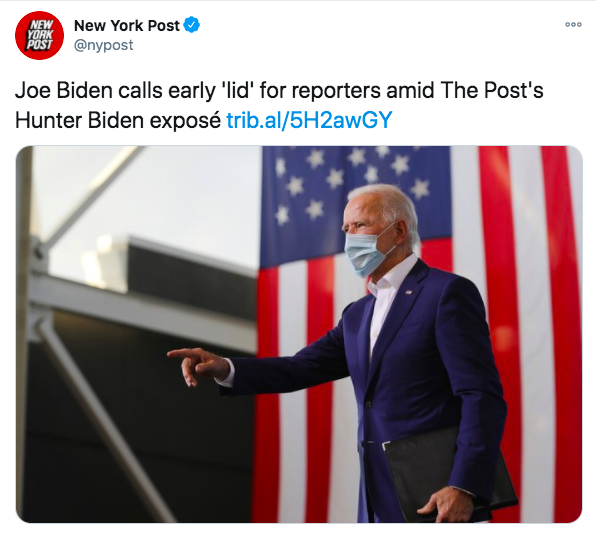
* Where’s Hunter Biden? According to our data, the Hunter Biden story has had a big effect on voters. The left-wing and mainstream media’s attempt at suppressing this story has created a reverse-effect on some undecided and low-propensity voters (who believe Joe Biden will bring honor and decency to the Oval Office). These voters are now digging into the story (social media platforms that banned the story have created more desire to learn what happened). This “nothing to see here” story will factor into the final vote.
* Riots and lawlessness in mostly Democratic cities. While the riots have not affected Democratic voters in Democratic cities, I see data that says it’s resonating with Republican voters who strongly oppose the riots and chaos. For example, the riots in Philadelphia, PA this week will drive more voters in Western Pennsylvania to vote to reelect President Trump.
* It’s the economy stupid. In my opinion, this recent statistic from NBC/Wall Street Journal will be a HUGE factor in deciding who will win. They surveyed: “Compared to 4 years ago…
My family and I are… Better off: 50% Worse off: 34%
The country overall is… Better off: 38% Worse off: 58%
Will “economy first” voters break for Trump due to their family being better off now than four years ago? Or will they factor in how the country is doing? And how will this impact the 3rd quarter economic numbers (just released) showing the American economy growing at a historic pace?
* How will newly registered voters in swing states affect Election Day? Having run a Get Out The Vote operation for a winning presidential campaign, I can tell you that newly registered voters are the hardest to turn out to vote due to zero or inconsistent voting behavior in previous elections. That being said, with a very narrow election in the balance (and a highly motivated voter base), new voter registration numbers in three key states are something to pay attention to:
1. In Pennsylvania, Republicans have netted around 100,000 more voters than Democrats since 2016.
2. In North Carolina, Republicans have added around 113,000 new voters since 2016.
3. In Florida, Republicans have gained close to 200,000 newly registered voters compared to 2016.
* Three racial groups will have a huge impact on this election. Working-class white voters, African-American voters, and Hispanic voters are the three segments (in the seven battleground states) that will determine who wins the election. Do working-class white voters in the rustbelt (who voted twice for Obama and then Trump in 2016) stick with Trump or defect to Biden? Does Trump over-perform his surprisingly good 2016 results with African-American voters and Hispanic voters? Something strange is going on in the electorate with minority voters too. I see in the data that African-American and Hispanic support for Trump has grown to historical levels (compared to past Republican presidential candidates). And I also saw three key societal indicators (two of which we found in our data) showing:
1. Majority support across all races for police funding.
2. 87–92% of all Americans wanted athletes to stop preaching about Black Lives Matter and stick to sports, yet Democrats have doubled-downed on these two issues throughout the campaign.
3. The unprecedented affiliation or support for President Trump (and his policies) by artists like Lil Wayne, Kanye West, 50 Cent, and Ice Cube has exponentially increased Trump’s favorability in the African-American community.
* The brand factor — Whose brand will win? In 2016 the “Make America Great Again” slogan was the most influential brand and helped carry Trump to victory. The brand fight right now is about:
1. The appearance of “strength” vs. the appearance of “weakness”: Trump is deliberate in projecting strength right now by returning to normal activity (after beating the virus and telling voters not to be afraid of it), holding rallies, and rarely wearing a mask. Biden appears weak (in contrast) by hiding in his house, constantly wearing a mask (in front of the media), and suggesting more lockdowns.
Dilbert creator and contrarian Scott Adams recently laid it out like this:
“Trump’s “leave it all on the field, happy warrior” campaign strategy for the closing week is brilliant. We are wired to appreciate conspicuous effort, and we overweight whatever is happening recently. He sponges up the news cycles, creates massive contrast to barely sentient Biden, and Trump’s extreme workload to entertain his supporters triggers the base to give back. Humans are wired for reciprocity.
Trump works hard, so the least you can do is return the favor and vote. Shifting to happy warrior mode, especially coming off his most “presidential” debate performance, makes the few undecideds wonder if they misjudged him. Every time you see Trump intentionally shift his performance mode to fit the situation, he seems smarter and less scary.
You start to understand why he treats dictators well — because it works — while aggressively putting America first. Trump also takes advantage of the pattern-spotting part of your brain that believes he outworked Clinton in 2016 and something like that is happening again. And when we imagine a future, we tend to unconsciously bias our actions toward it. Meaning legendary GOP turnout.”
2. Decency vs. Crassness: I don’t need to explain this one — I think you understand the brands here. The question is, will it define the vote?
* Voter fraud? Republicans say that Democratic Party voter fraud might cost Trump the election (especially in key states like Pennsylvania, Wisconsin, and North Carolina). Democrats say that’s nonsense. But by mid-November, we’ll have a deep understanding of how important this ended up being to the final result.
* The GET OUT THE VOTE campaign. I’m a firm believer that an effective, organized, and well-funded GOTV campaign can net a candidate 1–2 additional points on Election Day. The Biden campaign has ceded the operation to 3rd party groups. The Trump campaign has spent over $100 million on this effort.
5. MY PREDICTION — HERE IS WHAT WILL HAPPEN:
I’ve spent 24 years in politics, I’ve been a part of 1,283 winning elections. Here is my prediction on the total vote, the popular vote winner and the electoral vote winner:
* WHO WINS ON THE CRITICAL POLICY ISSUES? In our data, I’m seeing a huge swing with voters seeking safety with ending the riots, funding of law enforcement, growing of the economy — which grew at its fastest pace in history in the 3rd quarter — and a desire for a COVID-19 vaccine. These all favor Trump. I am not only seeing this amongst working-class white voters, but also with African-American and Hispanic voters.
* WHO WINS THE BRAND WAR? The clear winner on what drives the brand message is strength over weakness. As indicated above, Trump has defined himself with certainty on his strength, reinforcing the voters’ inner unconsciousness of seeking safety. These voters may hold their nose and vote for Trump, but they know they will be safer by doing it.
* SWING STATE OUTLOOK. The “Shy Trump Voter’’ is one of the most underreported factors of this election. It was a proven fact in 2016, and it has only grown in the last four years. For example, do you think a suburban mom in Pennsylvania is going to tell a random polling operator that she is voting for Trump? No way.
She fears if she explains her vote, she will be “exposed,” or worse, canceled. Robert Cahaly of the aforementioned Trafalgar Group, thinks there is a 5–9% underreported vote for Trump (in each of the key swing states). While it may be that big, I will assume it represents an additional 2–5 points from what we are seeing in public polls. In addition, the Trump campaign’s Get Out The Vote apparatus is head and shoulders better than the Biden campaign.
Therefore, I believe it’s worth 1% additional point for Trump in these swing states. Considering the “Shy Trump Vote” and the GOTV effort advantage, here is my prediction of the remaining toss up states:
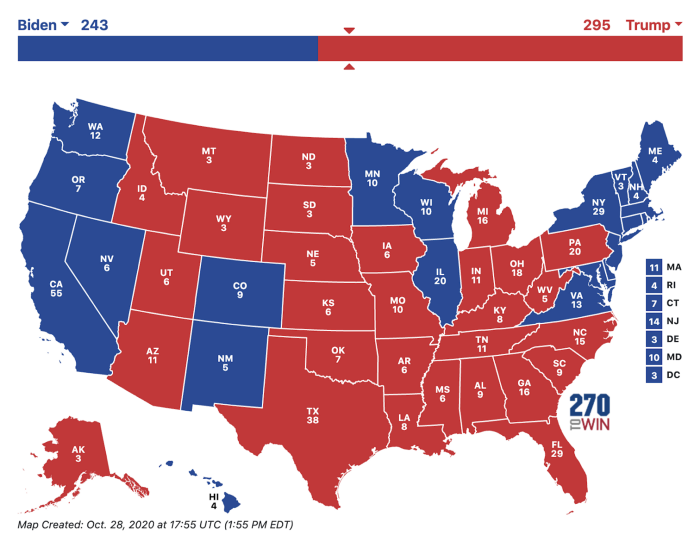
1. Biden will win Minnesota, New Hampshire, Wisconsin, Nevada, and Maine’s one toss-up electoral vote.
2. Trump will win Iowa, Ohio, Florida, North Carolina, Pennsylvania, Michigan, Arizona, and Nebraska’s one toss-up electoral vote.
* POPULAR VOTE WINNER: Joe Biden. Based on the data I am seeing, I predict 156.9 million total votes — an increase of 18 million+ voters compared to 2016. Despite a tight electoral college race, it’s clear that Joe Biden will win the popular vote, thanks in large part to New York and California.
* ELECTORAL VOTE WINNER: Donald Trump. Trump wins the Electoral College 295 to 243.