

Israel’s fragile ruling coalition to vote on Israeli settler law
Israel’s ruling coalition is gearing up for a vote on the legal status of Israeli settlers in the occupied West Bank who are governed by Israeli civilian law despite residing illegally on stolen Palestinian lands.
The ruling coalition’s fragile union could collapse if the vote scheduled on Monday fails to pass.
Israeli regulations in place for decades have created a separate legal system for Israeli settlers in the West Bank, applying parts of Israeli law to them – even though they live in occupied territory – while Palestinians are governed by Israeli martial law.
These regulations expire at the end of the month.
If they are not renewed, the legal system that Israel has cultivated for its settlers in the West Bank since it occupied the territory after the 1967 war will be thrown into question and could change the legal status of hundreds of thousands of Israeli settlers in the occupied territories.
If the law in question is passed, the legal status of Israeli settlers will remain.
If the law fails to pass, settlers will automatically fall under military rule, like Palestinians in the West Bank, according to Emmanuel Gross, an Israeli expert on criminal and international law and a former military judge.
Basic, everyday relations between Israeli settlers and the Israeli state will crumble: Israel won’t be able to levy taxes and police won’t be able to investigate criminal offences, among other things, Gross said.
“The entire legal basis of what happens with the settlers today will be cancelled. This can cause chaos,” he said, adding that he expected the government would find a way to ensure the regulations are extended.
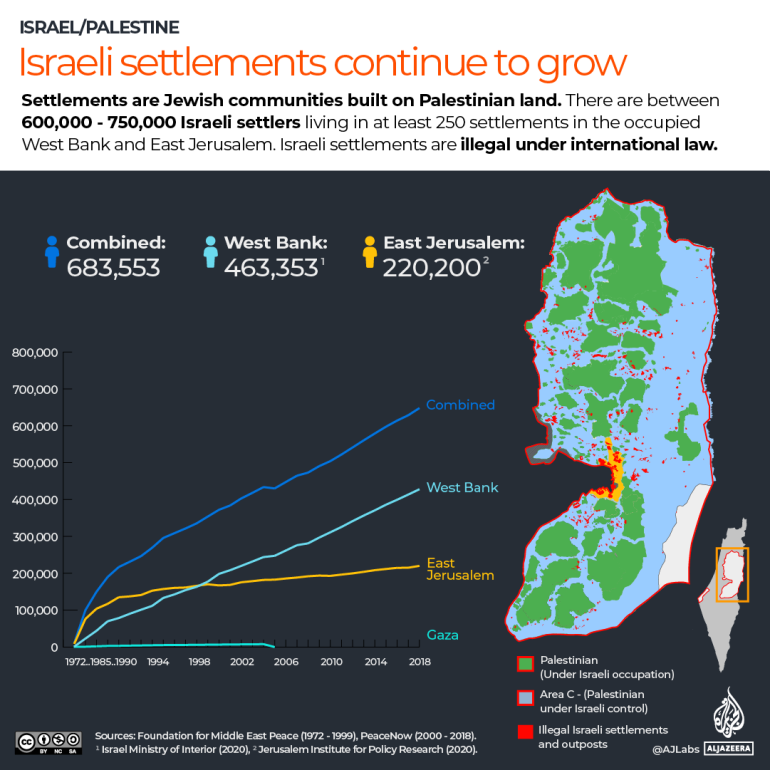
At least 500,000 Israeli settlers live in more than 120 settlements and outposts that are across the West Bank and that are considered illegal under international law. More than 2.5 million Palestinians live among them.
Attacks by Israeli settlers against Palestinians and their property are a common occurrence. They are usually backed by armed Israeli forces and are rarely held accountable for damages or killings committed against Palestinians.
The settlements – fortified, Israeli-only housing complexes – are expanding on lands that the Palestinian leadership is seeking as part of a future state and are seen as a major obstacle to any potential deal with Israel.
Maintain a status quo
Proponents of extending the settler law say they are merely seeking to maintain a status quo and preserve the government’s shelf life.
Opponents say extending the regulations would deepen an unfair system that pits Israelis and Palestinians in the same occupied territory under separate legal systems, which leading human rights groups, including Human Rights Watch and Amnesty International, have equated to apartheid.
Israel’s coalition government, made up of eight ideologically distinct parties, came together last year and pledged to sidestep divisive issues that could threaten its survival. Now, one of those very issues – Palestinian statehood and Israel’s occupation of the West Bank – risks toppling it.
One of the coalition’s members, the nationalist New Hope, has threatened to bolt if the coalition cannot pass the settler law.
Legislators and party leaders were scrambling to rally votes and even parties that support Palestinian independence and criticise Israel’s settlement enterprise were expected to vote in favour – just to save the coalition.
One of the parties deliberating over its vote is Ra’am, a Palestinian group that made history as the first Arab party to join an Israeli coalition. Voting in favour of extending the law will likely anger its constituents.
The opposition, meanwhile, made up mainly of Israeli nationalist parties, appears ready to forsake its pro-settlement ideology and will vote against extending the regulations, in order to try to bring down the coalition.
If the New Hope party leaves the coalition, it could give the opposition the votes it needs to trigger new elections or form a new government.
“It will create legal chaos” in the West Bank, and “harm Israeli citizens”, New Hope’s leader and Justice Minister Gideon Sa’ar told Israeli public broadcaster Kan last week.
“The government has a responsibility, and the elementary responsibility is to pass and maintain basic legal arrangements,” he said.
The government of Prime Minister Naftali Bennett has faced hurdles before.
Idit Silman, the coalition whip from Bennett’s small, nationalist party, quit the coalition earlier this year, leaving the government with just 60 seats in the 120-seat Knesset – surviving immediate defeat but struggling to govern.
Ghaida Rinawie Zoabi, another legislator from Meretz, also quit but later rejoined after being promised a raft of benefits for her constituents – Palestinian citizens of Israel.
Another member of Bennett’s party defected last year, and others have expressed misgivings with the coalition arrangements.
Bennett’s government came together last year after two years of political mayhem, with four elections producing no clear winner.
The eight coalition members in government now were united by their goal of ousting former Israeli leader Benjamin Netanyahu – who now heads the opposition, and is battling corruption charges – and have sought to work around their issues to keep him out of power.