

Mohammad Reza Shajarian, classical singer revered in Iran, dies at 80
To Iranians at home and abroad, the death of the country’s most revered classical music singer, Mohammad Reza Shajarian, reverberated like the death of a rock or pop star in the West. After learning that he died Oct. 8 at age 80 at a hospital in Tehran, tens of thousands took to the streets of Iran’s capital to weep, mourn and sing his songs of love and peace.
Angered that his music had been banned by the country’s Islamic regime, they also chanted anti-government slogans, including “death to the dictator,” a reference to President Hassan Rouhani. Security forces arrived on motorcycles, swinging batons at crowds until they dispersed.
“The grateful Iranian nation will always keep the name, memory and work of this popular artist alive in its memory,” Rouhani said on Twitter.
Mr. Shajarian was known as an ostad, or master, of traditional Persian music backed by string and percussion instruments, many of which he designed himself. He started singing during the reign of the last U.S.-backed shah, Mohammad Reza Pahlavi, before supporting the 1979 Islamic revolution that installed Ayatollah Ruhollah Khomeini.
While Khomeini banned “imperialist” Western music and instruments, Mr. Shajarian’s traditional songs — and soaring, quavering tenor — reached a wide audience. He became known as “the voice of Iran,” and in 2009, the Los Angeles Times called him “Iran’s greatest living master of traditional Persian music.”
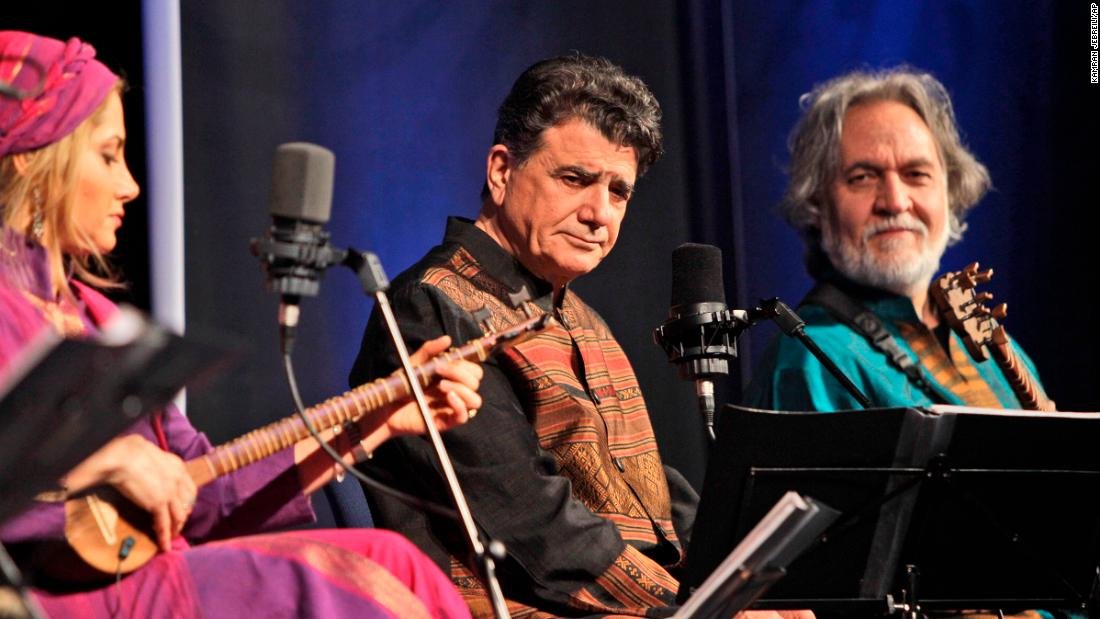
Mr. Shajarian typically used subtle metaphors and poetic allegories in his verses, and he rarely ventured into politics. But in 2009, he surprised many of his fans by speaking out against the government he had long supported, siding with demonstrators who challenged election results that led to ultraconservative President Mahmoud Ahmadinejad’s second term.
As security forces wielded batons and tear gas against protesters, Mr. Shajarian turned a work of Persian poetry into an anthem of resistance, singing “Language of Fire and Iron” by Fereydoon Moshiri.
“Lay down your gun,” he pleaded, “as I hate this very abnormal shedding of blood. The gun in your hand speaks the language of fire and iron. . . . Come, sit down, talk, hear. Perhaps the light of humanity will get through to your heart, too.”
When Ahmadinejad labeled the protesters “dust and trash,” Mr. Shajarian responded by telling the BBC: “I am the voice of dust and trash, and [my voice] will always belong to dust and trash.” The regime banned him from performing in Iran, and Mr. Shajarian, in turn, insisted that state media stop broadcasting his music.
His most famous song was “Morghe Sahar” (“Bird of Dawn”), an allegorical ballad about a bird that sings to end the darkness of the night and herald a day of liberation. Based on an old Persian poem, the song became his trademark encore at concerts abroad, inevitably bringing audiences to tears.
Mr. Shajarian was also known for singing “Rabbana,” a prayer song that compiled verses from the Koran. State broadcasters played the song during the holy month of Ramadan for some 30 years, until he fell afoul of the regime. “Ramadan without Rabana is like Christmas without Christmas carol,” one Iranian told the Guardian in a 2013 message on Facebook. “I don’t observe fasting but yet every Ramadan I listened out for it.”
The oldest of five children, Mr. Shajarian was born Sept. 23, 1940, in the northeastern city of Mashhad. His father was a qari, a respected reciter of the Koran, and the younger Shajarian started singing verses of the Islamic holy book when he was 5. By age 12, he was studying the radif, the traditional repertoire of Iranian music.
Mr. Shajarian received two awards from UNESCO for his music, and he was named a chevalier of France’s Legion of Honor. After the Iranian city of Bam was ravaged by an earthquake in 2003, killing more than 26,000, he organized a benefit concert for survivors and families of the victims.
His marriage to Farkhondeh Golafshan, with whom he had four children, ended in divorce. He later married Katayoun Khansari, with whom he had a son. Complete information on survivors was not immediately available.
Mr. Shajarian’s son Homayoun, a fellow classical singer who often joined him onstage, announced the death on Instagram but did not give a cause. Mr. Shajarian had battled kidney cancer for almost 20 years, and Iranian state television cited the disease in its news bulletins, while broadcasting images of the singer for the first time in 11 years.
“My music has always been entirely connected to what happens in Iran,” he told German writer and Persia expert Marian Brehmer in 2011. “The poems I choose to perform reflect our social history. My songs speak of people’s lives. I get my inspiration from the people. I need to be among them. Or else I wouldn’t be able to sing.”
“I think of people’s longings,” he added. “Humanity should rule the world, not religion, nationalism or ideology. Humanity is the aim of all arts.”