Arab Press

بالشعب و للشعب
Saturday, Jan 24, 2026

Netanyahu defiant despite protests against Israel judicial reform

Netanyahu defiant despite protests against Israel judicial reform

Opponents say changes would cripple judicial independence, foster corruption, set back minority rights.

Israeli Prime Minister Benjamin Netanyahu says his government plans to charge ahead with a proposal to change the country’s judicial system, despite fierce criticism from top legal officials.

Netanyahu, who is on trial for corruption, has made the legal changes the centrepiece of his new government’s agenda and the surging opposition to them is presenting an early challenge for the Israeli leader.

Netanyahu’s comments on Sunday came after opponents of the plan held nationwide protests on Saturday.

They say it would cripple judicial independence, foster corruption, set back minority rights and deprive Israel’s courts of credibility that helps fend off war crimes charges abroad.

The proposed changes have sparked an outcry from the Supreme Court’s top justice, who in rare public criticism called the proposed changes an “unbridled attack on the justice system”.

The country’s attorney general has also spoken out against the plan, as have many of her predecessors.
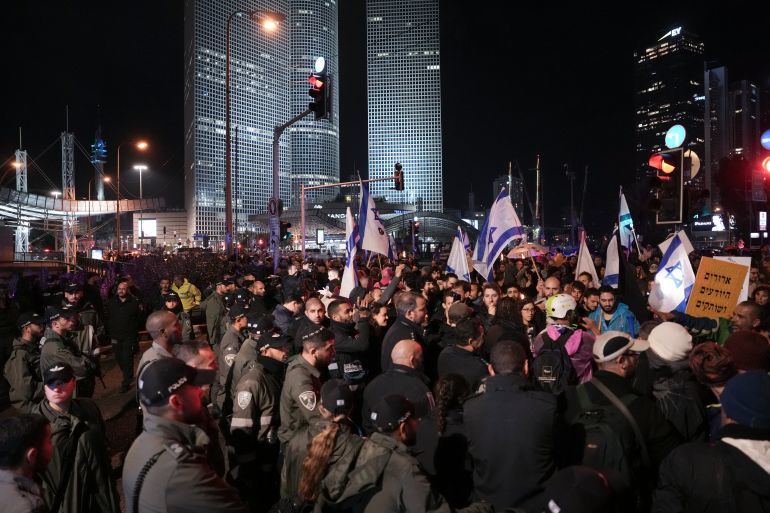

Israeli police officers prevent protesters from blocking a highway during a rally against the government’s plans to change the country’s legal system, in Tel Aviv, Israel, January 14, 2023

Despite the opposition, Netanyahu told a meeting of his Cabinet that voters cast their ballots in the November elections in support of his campaign promise to modify the justice system.

“We will complete legislating the reforms in a way that will correct what needs correcting, will totally protect individual rights and will restore the public’s faith in the justice system that so much requires this reform,” Netanyahu said.

There have been calls in the past to reform Israel’s justice system, which was given greater clout in the 1990s and has been seen since by critics as being too interventionist in the process of lawmaking.

But the sweeping changes sought by Netanyahu’s justice minister have raised the alarm among opponents who see them as a death knell to Israel’s system of checks and balances and in turn, its democracy.

Netanyahu and his allies see the changes as a way to ease the process of governance and recalibrate what they say is an imbalance between the country’s executive and judicial branches.

Critics say the changes could help Netanyahu evade conviction in his corruption trial, or make the trial disappear altogether. Netanyahu denies any wrongdoing.

‘Profound disagreement’


Netanyahu heads a government of ultranationalist and ultra-Orthodox parties who at times in the past have seen their agendas thwarted by Supreme Court decisions or unfavourable counsel by government legal advisers.

That prompted them to make sure the legal changes were a top priority during negotiations to form the government. Netanyahu, eager to return to power under the shadow of his corruption trial, appeared inclined to be generous to his partners in the talks.

Among those concessions was a promise to make Avi Maoz, head of a small religious ultranationalist party who has repeatedly spouted anti-LGBTQ rhetoric, in charge of certain educational programs. The Cabinet approved the pledge on Sunday, despite an outcry from mayors and Israeli parents when it was initially discussed.

Meanwhile, Israel’s president warned on Sunday that the country faced a “historic constitutional crisis” over the contested judicial reform plan, and said he was mediating between the relevant parties.

“We are in the grips of a profound disagreement that is tearing our nation apart. This conflict worries me deeply, as it worries many across Israel and the [Jewish] Diaspora,” President Isaac Herzog said in a statement.

Herzog, whose post lacks executive powers and is designed to unify an often fractious Israeli society, said he was “working full time, by every means, making nonstop efforts with the relevant parties, with the aim of creating wide-reaching, attentive, and respectful discussion and dialogue”.


Newsletter

Related Articles

Arab Press
0:00
0:00
Close
Saudi-Backed LIV Golf Confirms Return to Trump National Bedminster for 2026 Season
United States under President Donald Trump completes withdrawal from the World Health Organization: health sovereignty versus global outbreak early-warning access
Trump Administration’s Iran Military Buildup and Sanctions Campaign Puts Deterrence Credibility on the Line
Tech Brief: AI Compute, Chips, and Platform Power Moves Driving Today’s Market Narrative
NATO’s Stress Test Under Trump: Alliance Credibility, Burden-Sharing, and the Fight Over Strategic Territory
Saudi Arabia’s Careful Balancing Act in Relations with Israel Amid Regional and Domestic Pressures
Greenland, Gaza, and Global Leverage: Today’s 10 Power Stories Shaping Markets and Security
America’s Venezuela Oil Grip Meets China’s Demand: Market Power, Legal Shockwaves, and the New Rules of Energy Leverage
Trump’s Board of Peace: Breakthrough Diplomacy or a Hostile Takeover of Global Order?
Prince William to Make Official Visit to Saudi Arabia in February
Saudi Arabia Advances Ambitious Artificial River Mega-Project to Transform Water Security
Saudi Crown Prince and Syrian President Discuss Stabilisation, Reconstruction and Regional Ties in Riyadh Talks
Mohammed bin Salman Confronts the ‘Iranian Moment’ as Saudi Leadership Faces Regional Test
Cybercrime, Inc.: When Crime Becomes an Economy. How the World Accidentally Built a Twenty-Trillion-Dollar Criminal Economy
Strategic Restraint, Credible Force, and the Discipline of Power
Donald Trump Organization Unveils Championship Golf Course and Luxury Resort Project in Saudi Arabia
Inside Diriyah: Saudi Arabia’s $63.2 Billion Vision to Transform Its Historic Heart into a Global Tourism Powerhouse
Trump Designates Saudi Arabia a Major Non-NATO Ally, Elevating US–Riyadh Defense Partnership
Trump Organization Deepens Saudi Property Focus with $10 Billion Luxury Developments
There is no sovereign immunity for poisoning millions with drugs.
Mohammed bin Salman’s Global Standing: Strategic Partner in Transition Amid Debate Over His Role
Saudi Arabia Opens Property Market to Foreign Buyers in Landmark Reform
The U.S. State Department’s account in Persian: “President Trump is a man of action. If you didn’t know it until now, now you do—do not play games with President Trump.”
CNN’s Ranking of Israel’s Women’s Rights Sparks Debate After Misleading Global Index Comparison
Saudi Arabia’s Shifting Regional Alignment Raises Strategic Concerns in Jerusalem
OPEC+ Holds Oil Output Steady Amid Member Tensions and Market Oversupply
Iranian Protests Intensify as Another Revolutionary Guard Member Is Killed and Khamenei Blames the West
President Trump Says United States Will Administer Venezuela Until a Secure Leadership Transition
Delta Force Identified as Unit Behind U.S. Operation That Captured Venezuela’s President
Saudi-UAE Rift Adds Complexity to Middle East Diplomacy as Trump Signals Firm Leadership
OPEC+ to Keep Oil Output Policy Unchanged Despite Saudi-UAE Tensions Over Yemen
Saudi Arabia and UAE at Odds in Yemen Conflict as Southern Offensive Deepens Gulf Rift
Abu Dhabi ‘Capital of Capital’: How Abu Dhabi Rose as a Sovereign Wealth Power
Diamonds Are Powering a New Quantum Revolution
Trump Threatens Strikes Against Iran if Nuclear Programme Is Restarted
Why Saudi Arabia May Recalibrate Its US Spending Commitments Amid Rising China–America Rivalry
Riyadh Air’s First Boeing 787-9 Dreamliner Completes Initial Test Flight, Advancing Saudi Carrier’s Launch
Saudi Arabia’s 2025: A Pivotal Year of Global Engagement and Domestic Transformation
Saudi Arabia to Introduce Sugar-Content Based Tax on Sweetened Drinks from January 2026
Saudi Hotels Prepare for New Hospitality Roles as Alcohol Curbs Ease
Global Airports Forum Highlights Saudi Arabia’s Emergence as a Leading Aviation Powerhouse
Saudi Arabia Weighs Strategic Choice on Iran Amid Regional Turbulence
Saudi Arabia Condemns Sydney Bondi Beach Shooting and Expresses Solidarity with Australia
Washington Watches Beijing–Riyadh Rapprochement as Strategic Balance Shifts
Saudi Arabia’s Vision 2030 Drives Measurable Lift in Global Reputation and Influence
Alcohol Policies Vary Widely Across Muslim-Majority Countries, With Many Permitting Consumption Under Specific Rules
Saudi Arabia Clarifies No Formal Ban on Photography at Holy Mosques for Hajj 2026
×