

‘No jab, no job’: The challenges of managing Britain’s partially vaccinated workforce
For Pimlico Plumbers chairman Charlie Mullins, managing a post-Covid workforce is simple: either his staff have the vaccination or they are out of a job.
Mr Mullins first unveiled his “no jab, no job” policy in January when he insisted that all of his 180 office staff and 270 tradesmen have the vaccine to continue working for him.
He doubled down on that pledge in a telephone interview with The National from his home in Spain, following a four-month stint in Dubai where he plans to expand his business.
“That will be the policy once the vaccines have rolled out completely across the UK in two to three months’ time,” Mr Mullins, 68, said.
“I don’t think there’s anything wrong with that. We’ve had 12 months of lockdown and this is a way to get out of lockdown. We’ve got to the stage where customers are demanding ‘can I have an engineer that’s been vaccinated?’
“If you don’t have the jab then sit at home but don’t expect to be part of the workforce.”
As Britain moves into the second phase of Prime Minister Boris Johnson’s roadmap out of lockdown on Monday, with hospitality venues, non-essential shops, hairdressers, gyms and beauty salons set to reopen, employers face a tricky issue: how do they manage a partially vaccinated workforce?
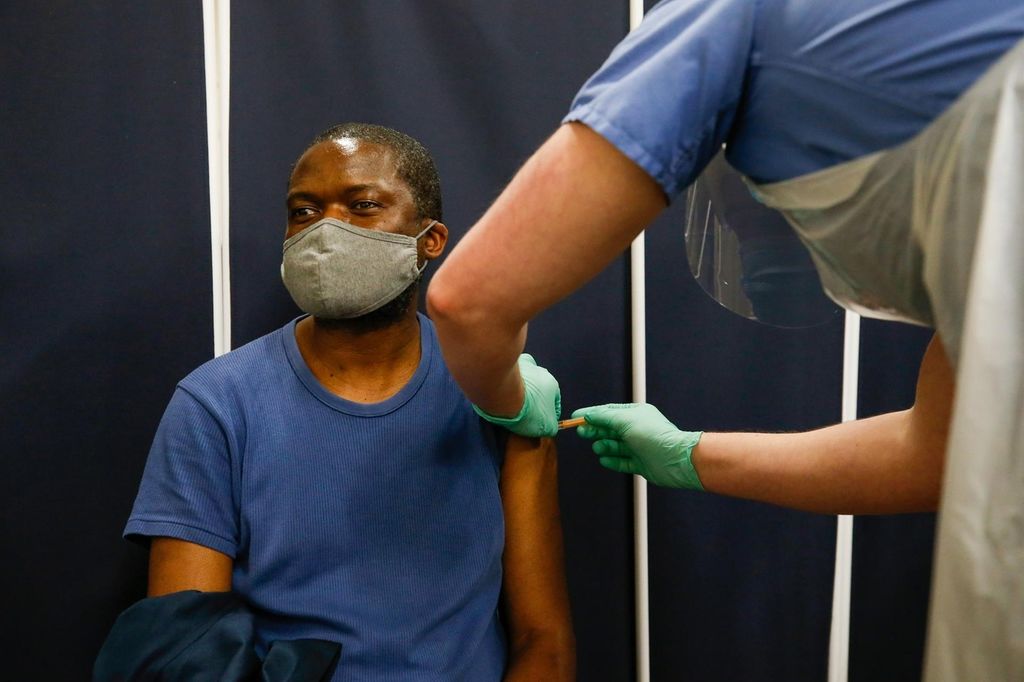
While some staff have already received one or two doses of a vaccine, many do not qualify for the programme yet due to their age, leaving companies trying to figure out when and how they bring staff back to work.
Kate Palmer, HR advice director at employment law consultancy Peninsula, says employers should still follow the official government stance on remote working that stipulates if employees can do their work from home, they should.
Ms Palmer says this advice is unlikely to change before June 21, when all social-distancing measures are scheduled to be lifted by the government.
By then, most of the adult population will have received at least one dose of a vaccine, making it easier for employers to encourage staff back into offices.
“Employers can decide what works best for them, so they may choose to allow staff to continue to work from home for some time after the guidance changes,” says Ms Palmer.
Hybrid work policies where employees split the working week between their home and the office may become the norm for many companies.
Major banks, such as HSBC and JP Morgan, plan to have some of their staff working from home permanently, while accountancy firm Grant Thornton said it found that nine in 10 of its staff wanted to work most of the week from home.
Other companies are keen to restart office-based work, with London staff at Credit Suisse expected to return this month, and David Solomon, chief executive of Goldman Sachs, recently described home working as an “aberration”.

Ms Siciliano says many of her 30-strong team members have felt isolated during lockdown, particularly those who live alone.
“If they are not comfortable, then they can discuss that with a member of staff. For example, our marketing manager is pregnant, so we've already said to her that she does not have to come in,” she says.
The company is splitting its London team between two offices, with staff coming in on different days to ensure they remain Covid-safe.
“People like knowing that they're going to see some of their colleagues again. They can have staggered start times, they can come in later or finish later and they are not going to be sitting on top of each other,” Ms Siciliano says.
The company also has a single employee working in their Dubai office in Jumeirah Lakes Towers who has chosen to use the office despite having the option to work from home.
“She can drive to work, she has a parking space and she’s the only one in there, so it’s a different situation,” says Ms Siciliano.
“Ultimately if she’s working from home as well, there’s no great impact.”
While Tiger Recruitment will not insist staff have the vaccination, employers that do should be fully aware of the latest science around the vaccination programme, says Daniel Parker, an associate at Winckworth Sherwood.

“We do not yet have a clear picture of the degree to which vaccination impacts transmission of the coronavirus and whether this varies according to the brand of vaccine used,” he says.
“Equally, those who are vaccinated do not necessarily have absolute protection against all Covid-19 symptoms. At present, vaccination is not a guarantee of a safe working environment.”
During the second and third lockdowns, Mr Mullins insisted the majority of his staff work in the office after he put in place extensive safety measures such as lateral flow tests, social distancing and temperature scanners.
“My staff haven’t been out of the office since the first lockdown. The ones that stayed out, we got rid of,” Mr Mullins says.
“In the first lockdown, we had two thirds on furlough but we didn’t encourage anyone to do that for the second lockdown.”

The eccentric businessman, who has a countdown clock outside his London headquarters noting the number of vaccinations in Britain, says most of his employees came back to work once they knew that working in the building would be safe.
Those who did not want to return to the site, or get back on the train for safety reasons, found their job was no longer there.
“You can't actually make anyone redundant for going on furlough, but what you can do is close that position up and say we are cutting back that. So, we lost about 30 people that we wanted to lose over the way they conducted themselves through the situation. And we gave everybody that wanted to come to work a £20-a-day bonus, free lunch every day, free hot and cold drinks, free parking and free testing,” he says.
“The government pay people to stay at home and we pay people to come to work. I know which one was the right one to do.”
Ms Palmer says unreasonable refusals to return to the office could lead to disciplinary action, but employers need to understand why the employee does not feel safe.
“Adjustments should be made to the employees' working arrangements, spanning from the provision of a car parking space or altered working times to avoid rush hour,” she says.
“Blanket rules will not be appropriate, and employees must be allowed to talk through their situation before deciding on a path forward. Some employees may have suffered a bereavement due to Covid and could be extremely worried about a return.”
Employers that insist staff have a vaccine before they return, while appropriate depending on the nature of the work involved, may also lead to tribunal claims of discrimination or constructive dismissal.
“Some employees will be advised not to have the vaccine because of pre-existing medical conditions, and those who are classed as disabled under equality laws will be protected against discrimination, e.g. dismissal or other detriments,” Ms Palmer says.
“Constructive dismissal complaints may occur when an employee claims that their employer has imposed an unreasonable instruction on them, which enables them to resign.”
However, Mr Mullins insists he has worked closely with his lawyers and he can implement the “no jab, no job” rule in new contracts, while those with existing contracts have a choice over whether to have the vaccine.
“I’m sure there will be some busybodies that want to take me to the court but bring it on. I’m not going to endanger my staff because somebody is anti-vax,” says Mr Mullins.
He is far from alone, according to Ms Siciliano, who says Tiger Recruitment has seen more and more employers demand new hires are vaccinated.
“In one instance for a role for one of the private household positions that we recruit for, the employer asked that the selected candidate was vaccinated because there was travel involved and because the person would have exposure to more vulnerable people,” she says.
“That person decided that they didn't want to be vaccinated so in that circumstance we did not progress with the offer. There are some roles where it's going to require a vaccination and the employer has a right to ask that question, but they don't have the right to enforce it.”
Mr Mullins is now urging the prime minister to apply the proposed vaccine passport scheme to workplaces as well. Currently the document is being considered for flights or large gatherings such as sports events.
“Boris needs to stand up and say ‘this is the way it’s going to be’ and we can then get the economy moving a lot quicker.”

Ms Palmer says Covid status certification could be useful for employers that require employees to have the vaccine in order to continue working or to gain employment at their organisation.
“It will be beneficial for those employers whose workforces need to travel overseas for their work, as this type of certification is required to gain entry to some countries.”
While Mr Mullins has not had a vaccine himself yet - something he says he plans to do when he returns to the UK in the summer - the company routinely tests its staff weekly, after ordering 1,000s of lateral flow tests several months ago.
“If the customer asks an engineer to do a test there and then they have to self-test themselves and business has gone up 20 per cent as a result,” he says.
While Mr Mullins is not willing to allow staff to work from home, except for in a couple of cases, experts predict employers will have to be more open going forward.
“Employers need to listen to employees who are reluctant to return and try to determine what is causing the reluctance,” says Mr Parker.
“It seems unlikely that an immediate return to the pre-Covid norm will be possible – if even desirable – and so employers may find themselves tempted to organise a staggered return which prioritises those who have been vaccinated.”
Ms Siciliano says some of her clients do not plan to return to the office until next year, with the biggest concern among employees the commute into work rather than time in the office.
“We've seen companies put cycle-to-work schemes in place, while others are providing taxis for staff. One of our staff members has switched to a different office so that she can walk in rather than catching the tube,” she says.
“However, companies are still being quite cautious, even if members of staff have been vaccinated.”
For Mr Mullins, the sooner other employers follow his back-to-work strategy, the sooner the UK economy can get back on its feet.
“If everyone had been doing this testing business, which we’ve been doing since before Christmas, all the schools would have been back in ages ago, businesses would be up and running. It's a no brainer, take a test, you’re ok, let’s get on with life.”