

Queen Elizabeth II’s last foothold in Arabia
In April 1954, just less than a year after her royal coronation, Queen Elizabeth II stepped off the SS Gothic into the only Arab territory to ever become a colony of the British Empire, Aden.
Images of the visit show a young queen greeted by British colonial officers in uniform, dignitaries, and hundreds of residents eager – or just curious – to see the woman who now appeared on their stamps.
Aden saw its first and last knighthood ceremony, which included a local leader, Sayyid Abubakr bin Shaikh al-Kaff, who refused to bow before the queen because of his religious beliefs. And then, after a day that included a military parade, visits to schools and a hospital, and a garden party, the queen headed off to another imperial possession, Uganda.
Aden, a port in the southwest of the Arabian Peninsula, and now part of Yemen, had directly been ruled by the British crown since 1937. It was first occupied in 1839, and ruled as part of British India.
British control ran deep into the areas surrounding the city, with vast swaths of territory in what is now southern Yemen called the ‘Aden Protectorate’, a status that was also used to describe British control over many parts of the Gulf, including what is now Bahrain, Qatar and the United Arab Emirates.
But it was only Aden that was directly controlled by the United Kingdom, with no local ruling alongside. The city had a reputation for being cosmopolitan, modern and home to one of the busiest ports in the world, which the British used to try and maintain dominance in a region fast growing in importance as a result of its oil and gas reserves.
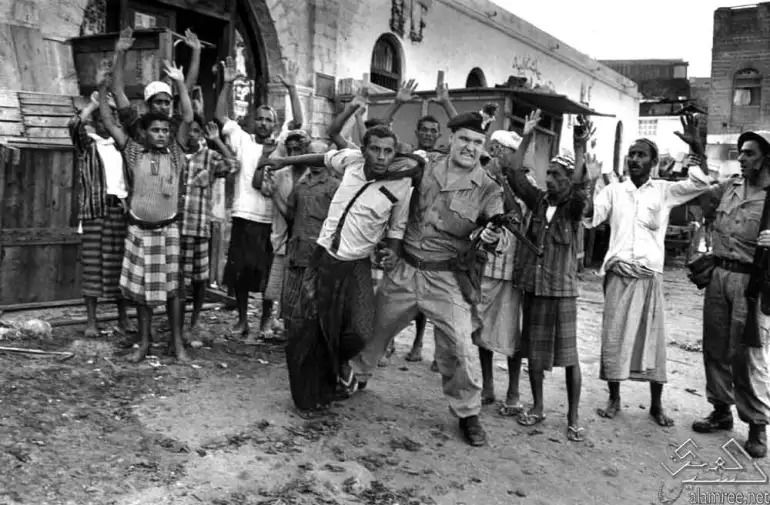 Yemenis rose up in Aden against the British occupation and fought for independence between 1963 and 1967
Withdrawal and independence
Yet, just 13 years after Queen Elizabeth was welcomed with open arms in Aden, the British fled, the last high commissioner airlifted out by helicopter.
They had been defeated by local independence fighters who would go on to declare the only Marxist state in the Arab world, the People’s Democratic Republic of Yemen (South Yemen).
The uprising had begun in 1963, fuelled by the same Arab nationalism that forced the British out of Egypt’s Suez Canal in 1956.
Images from it are perhaps more reflective of the true feeling of locals towards British colonial rule – protesters waving banners in the face of British soldiers, Arab men forced to lie on the ground at gunpoint, or being marched away.
Hundreds of residents were killed in the counterinsurgency.
That memory has been the abiding – and official – legacy of the British colonial period in Yemen.
As the years have passed, other legacies have emerged. The United Kingdom is home to a large Yemeni diaspora, many of whom are descended from men who joined the British navy and eventually settled in British port cities and industrial centres such as Liverpool, Sheffield and Birmingham.
Aden itself has had a turbulent history. South Yemen could not survive the collapse of its main benefactor, the Soviet Union, and united with North Yemen to form a unified republic in 1990.
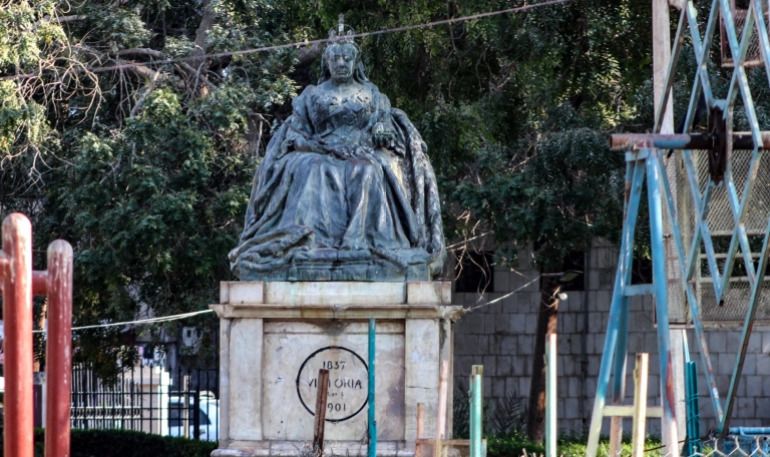 A statue of Britain’s Queen Victoria at a park in the southern Yemeni
city of Aden, one of the few remnants of British colonial rule
A statue of Britain’s Queen Victoria at a park in the southern Yemeni
city of Aden, one of the few remnants of British colonial rule
A civil war in 1994 and growing resentment towards the north, where united Yemen’s first president was from, have led to growing separatist sentiment, and the city is currently de facto under the control of the United Arab Emirates-backed Southern Transitional Council (STC), which calls for the restoration of South Yemen.
Amid the poverty in Aden that has been exacerbated by Yemen’s continuing war, some nostalgia for the British colonial period exists.
The era is often compared favourably by some Adenis with the city they see today, where roads and buildings have not been rebuilt, despite battles with Yemen’s northern Houthi rebels ending in 2015.
But, more often than not, those making the comparisons are too young to have ever lived under the colonial period themselves, and beyond a statue of Queen Victoria, a clocktower (known as Little Ben), and a few other landmarks, few signs of British rule remain.
If anything, the legacy of Aden’s connection with India is stronger. Thousands of Yemenis descend from Indians who came to work in the colony when it was ruled as part of British India, and Indian food has had a profound influence, including on Aden’s favourite food, zurbian – a rice, potato and meat dish similar to biryani.
And as the memory of Queen Elizabeth’s visit, and the British Empire, fades in Aden, that is what is likely to remain.