

TikTok crackdown: 8 attorneys general investigating social media app
California Attorney General Rob Bonta, along with seven other state attorneys general, on Wednesday announced an investigation into TikTok's impact on young users' mental health.
The investigation comes as state attorneys general and members of Congress crack down on the negative effects of social media on children, particularly after two years of the coronavirus pandemic forced kids to interact with others online when schools closed and sports temporarily halted. Montana announced a similar investigation last week.
"I think we kind of slacked off for the last few years, thinking, well, people are going to use [social media], and teenagers are going to be on it, so I feel like a lot of parents have kind of looked the other way," Amy Morin, a licensed psychotherapist and editor-in-chief at mental health website Verywell Mind, told Fox News Digital of the uptick in attention aimed at social media.
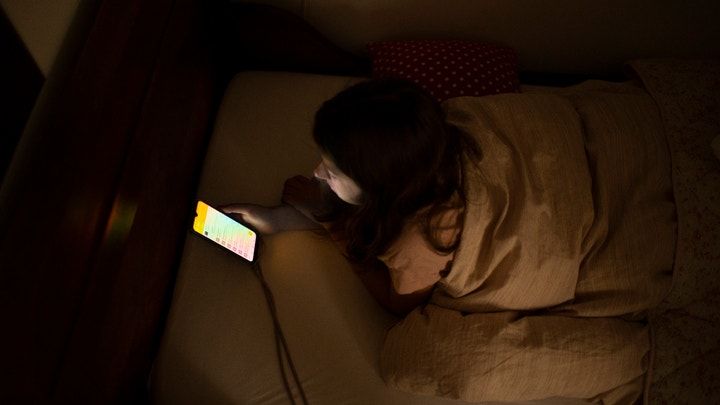 In this photo illustration, a girl looks at the screen of her smartphone April 16, 2021, in Bonn, Germany.
She added that that pandemic encouraged children's presence online, and while there are some benefits to being able to connect with others on social media and express creativity, it can exacerbate mental health issues in children who are prone to developing conditions like anxiety and depression.
The eight-state investigation will look into TikTok's efforts to promote the video-sharing app to young users, examine state consumer protection laws and determine whether the app puts children at risk.
"Our children are growing up in the age of social media, and many feel like they need to measure up to the filtered versions of reality that they see on their screens," Bonta said in a statement Wednesday.
"We know this takes a devastating toll on children's mental health and well-being. But we don't know what social media companies knew about these harms and when. Our nationwide investigation will allow us to get much-needed answers and determine if TikTok is violating the law in promoting its platform to young
The platform has an estimated 1 billion monthly users and is especially popular with teens and younger children. About a third of TikTok users are between the ages of 10 and 19, and about 30% are between the ages of 20 and 29, according to Taylor Cohen, global industry strategist for TikTok US.
TikTok has said it focuses on age-appropriate experiences, noting that some features, such as direct messaging, are not available to younger users. The company says it has tools in place, such as screen-time management, to help young people and parents moderate how long children spend on the app and what they see.
"We care deeply about building an experience that helps to protect and support the well-being of our community and appreciate that the state attorneys general are focusing on the safety of younger users," the company said Wednesday. "We look forward to providing information on the many safety and privacy protections we have for teens."
A 2018 Pew Research survey that Newton cited in her Tuesday blog post found that 81% of teens ages 13 to 17 found that social media in general makes them feel more connected while 26% said it makes them feel insecure.
Four in 10 teens said they only post on social media so that they look good to other people, and more than half of teens surveyed said they have "unfriended" or "unfollowed" other users due to bullying.
 In this photo illustration, the TikTok app is displayed on an Apple iPhone Aug. 7, 2020 in Washington, D.C.
"A lot of younger people don't know what to build their self-worth on yet, so they depend on … praise from their peers," Morin said. "Social media obviously feeds into that because kids might think, ‘If I get a lot of likes, then people like me,’ and they confuse the two, so it becomes more about trying to post things that will attract attention.
"Whether than having fun, they're more worried about taking images and videos that make it look like they're having fun, and they miss out on a lot of opportunities."
Morin, who is also a foster parent, said she has seen a recent increase in kids seeking help for anxiety and depression caused by social media than in years past.
"I've seen plenty of kids who … say, ‘I feel like a different person online, or I can be brave on social media, but I struggle to be that person when I see people face to face.' And for kids who are used to interacting only on social media these days, I think they are struggling with their social interactions when they meet up with their friends," Morrin explained.
As social media becomes increasingly popular among kids, youth depression, anxiety and suicide rates are increasing.
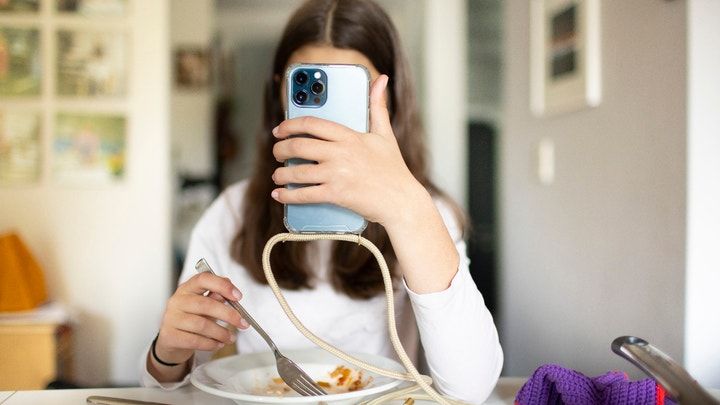 In this photo illustration, a young girl sits behind her plate of
food and is playing with her smartphone May 3, 2021, in Bonn, Germany.
In this photo illustration, a young girl sits behind her plate of
food and is playing with her smartphone May 3, 2021, in Bonn, Germany.
Early estimates for 2020 show more than 6,600 suicide deaths among U.S. youth, ages 10 to 24, according to the Centers for Disease Control and Prevention (CDC). Emergency room visits for suicide attempts among adolescent girls, in particular, rose by 51% during the pandemic, and ER visits among adolescent boys increased by 4% during the same time period, CDC data shows.
About 25% of teenagers between the ages of 13 and 18 are affected by anxiety, according to the Anxiety and Depression Association of America. And nearly one in four children globally experienced depression during the pandemic, researchers from the University of Calgary in Canada found.
Morrin said it is important for parents to have "ongoing" conversations about how social media impacts mental health and set "clear ground rules" about social media, such as not using phones at the dinner table, at family events or in the car so that they don't become accustomed to using social media to "regulate their emotions" whenever they are bored.
Additionally, parents should be good role models and work on setting time limits on their own phones.
"I worked with one family who gave their kids phone chargers every four days, so … if their battery died, they couldn't charge it," Morrin said. She added that parents should also make sure kids don't take their phones to their rooms at night so that they aren't losing sleep while spending time online.