Arab Press

بالشعب و للشعب
Wednesday, Aug 05, 2026

Ukraine conflict: Your guide to understanding day nine

Ukraine conflict: Your guide to understanding day nine

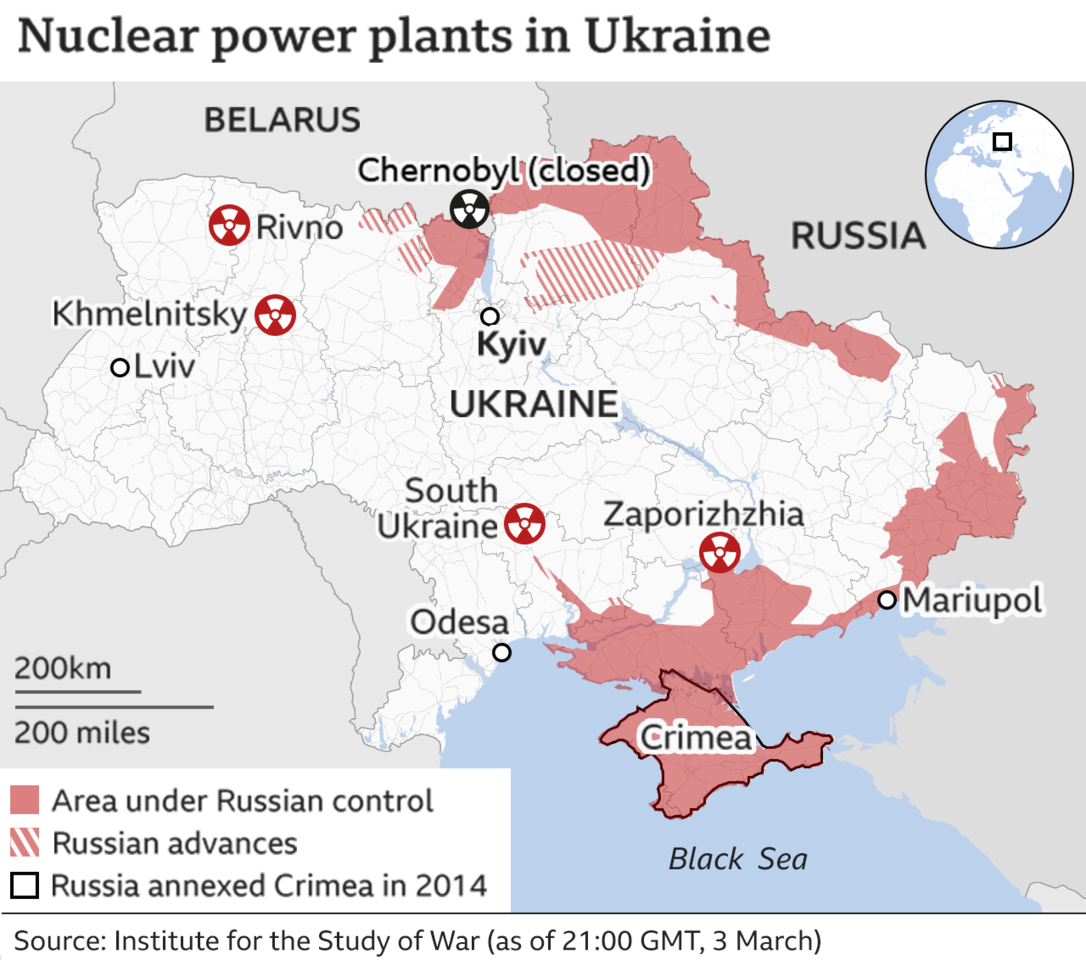
Day nine of the invasion saw Russian forces attack and seize Europe's largest nuclear plant, prompting initial fears of a radiation leak and drawing Western condemnation.

A projectile hit a building near one of the six reactors at the Zaporizhzhia plant overnight, causing a fire that was later extinguished.

The global nuclear watchdog said none of the reactor safety systems were affected and there was no release of radioactive material.

Ukraine's President Volodymyr Zelensky accused Russia of resorting to "nuclear terror", while British Prime Minister Boris Johnson said such "reckless actions" could "threaten the safety of all Europe".

Nuclear experts told the BBC's Esme Stallard and Victoria Gill that the attack created a very risky situation.

"For the first time this morning, I'm frightened," said Prof Claire Corkhill of the University of Sheffield.

Why the south matters


Russian forces captured the Zaporizhzhia plant as part of an advance into southern Ukraine that appears to have been more successful than those in the country's north and east.

The BBC's Ben Tobias says Russia sees the south as vital to the success of the invasion.

Its soldiers have moved into the region from Crimea, which was annexed from Ukraine in 2014 and is home to a sizeable Russian military presence.

Kherson - which is located where the Dnieper river meets the Black Sea - became the first major city to fall to Russian troops on Thursday.

They are also moving east towards Mariupol and west towards Odesa, threatening to cut off Ukraine's maritime access.

'Why are they bombing us?'


Russian forces have also stepped up their bombardment of northern cities.

In Chernihiv, aerial attacks destroyed high-rise apartment buildings and damaged a clinic and hospital on Thursday, reportedly killing at least 47 civilians.

The BBC's Joel Gunter says terrified residents have described being trapped under relentless shelling.

"There are no military targets here, there is only a cemetery, residential buildings, clinics and a hospital, why are they bombing us?" Svitlana, 40, told the BBC on Friday, as she hid under her dining table with her two children, aged six and three, and her neighbours.

A city moves underground


The BBC's Sarah Rainsford found frightened residents of Ukraine's second city of Kharkiv sheltering in a metro station, hiding from the bombs and shells.

"These are mostly Russian speakers, their city is 40km from the Russian border and they don't understand why Russia is attacking them," she said.

"One old lady, who's spent days sleeping inside a train carriage, living off hand-outs and too scared to surface onto the street, told me people in Kharkiv even respected Vladimir Putin before all this - as president of another country - but not anymore. She was furious."

'Mum won't believe me'


Maria Korenyuk and Jack Goodman of the BBC World Service Disinformation Team spoke to a woman in Kharkiv who has been unable to convince her Moscow-based mother that civilians are being killed in Russian attacks.

"Even though they worry about me, they still say it probably happens only by accident, that the Russian army would never target civilians. That it's Ukrainians who're killing their own people," said Oleksandra, 25.

She believed her parents' understanding of the conflict is down to the stories they are told by the official Russian media.

Meanwhile independent journalism is Russia is being severely curtailed, with some of the last remaining outlets closing.

The BBC was also forced to suspend its operations in Russia on Friday, after Russian authorities introduced new rules threatening journalists with prison sentences.

Director General Tim Davie said the BBC News service in Russian would continue to operate from outside the country.


Coach goes home to fight


The manager of Moldovan football club Sheriff Tiraspol, Yuriy Vernydub, has left his position to return to his native Ukraine and enlisted to help defend it.

Vernydub, 56, who masterminded a shock Champions League win against Real Madrid last year, told BBC Sport that he was "not afraid".

"My son called me at 4:30am and he told me the Russians attacked us. I knew then that I would return to Ukraine to fight," he said.


Watch: Zaporizhzhia nuclear plant appears to be on fire following shelling.

Families in Kharkiv still sheltering from attacks in metro stations.


Newsletter

Related Articles

Arab Press
0:00
0:00
Close
AI Is Remaking the US Economy, From GDP Growth to iPhone Prices
FIFA’s Retreat Leaves a Larger Question Over Who Guards the Game
Finland Deploys Commercial-Scale Thermal Batteries Using Crushed Rock to Store Renewable Grid Energy
Valued at $109 Million: F-35B Fighter Jet Crashes in Southern California
US Says It Has Carried Out Heavy Strikes on Iran After Attempted Attacks on Its Forces
Over 24 Hours in the Air: Qantas Airbus Completes Record-Breaking Test Flight
Arrest Warrant Issued in Lebanon for Tycoon Spotted Meeting Netanyahu in Washington
Trump says Israel ‘would not survive’ without US
Nvidia Reportedly Takes Vast Texas Data-Centre Lease to Underwrite AI Expansion
FIFA’s Private-Investment Plan for World Cup Rights Draws European Revolt
Following OpenAI's Cyberattack: 'Most Companies Still Do Not Understand What Is Coming'
OpenAI Sued After ChatGPT Allegedly Discouraged Emergency Care Before Near-Fatal Embolism
Miliband Sets Climate and International Law at Centre of UK Diplomacy
Pentagon Discloses Nearly 100 US Troop Injuries During Renewed Iran Fighting
Trump Readies New Tariffs as Temporary Global Levy Nears Expiry
High Prices Push Coffee Drinkers Toward Whole Beans and Home Brewing
Trump Draws Boos and Podium Scrutiny at Spain’s World Cup Triumph
Spain Defeats Argentina in Extra Time to Win Second World Cup
Turkey Explores S-400 Transfer to UAE in Bid to Rejoin F-35 Program
US Retaliates Against Iran After Two American Troops Killed in Jordan
Proposed U.S.-Saudi Nuclear Pact Could Permit Limited Uranium Enrichment Under International Safeguards
Why Kentucky Fried Chicken Became KFC—and Why the False Explanations Persist
Iran Claims It Destroyed Bahrain’s Main Artificial Intelligence Center in Missile and Drone Strike
Ukrainian Drones Strike Wildberries Warehouses Deep Inside Russia
Reported CIA Mission Helped Clear the UAE’s Path to Advanced US AI Chips
Artificial Intelligence Capital Fuels Markets While Governments and Regulators Face Mounting Strategic Tests
China’s Moonshot’s Kimi K3 Narrows the Gap With Anthropic Through Scale, Openness and Lower Cost
The Ledger Will Not Trust on Faith
Passenger Bound for Germany Refused to Sit Beside a Woman on a Plane — Then Slapped a Flight Attendant
Ukraine’s Leadership Rift Spills Into the Streets as Protesters Target Army Chief
The Ten World Cup Finals That Defined Football History
Smartphones Are Getting More Expensive, Sales Are Collapsing, and Even Apple Admits: "Prices Will Rise"
Leadership Change and Strategic Rivalry Redraw the Political Map
The AI Race Enters Its Infrastructure Era
Britain Nationalises British Steel to Protect Scunthorpe Production and Strategic Supply
Thomas Tuchel Faces Fierce Backlash After Tactical Retreat Costs England World Cup Final Berth
A Quiet Bastille Day: France Grapples with World Cup Heartbreak and Leftover Fireworks
Spain in Ecstasy: "We Feel Unbeatable, We Taught the Whole World a Lesson"
Harvard Astrophysicist to Lead U.S. Scientific Advisory on Unidentified Aerial Phenomena
Emergency Sirens Activated Across Bahrain as Interior Ministry Issues Shelter Directives
World Cup Visitors Turn American Big-Box Stores Into Souvenir Stops
Netflix Weighs Always-On Channels, Bundles and Short-Form Video
The AI Invoice Shock: Layoffs Didn't Save Managers Money — They Cost Them More
Concern: Sexually Transmitted Bacterium Among Men Develops Antibiotic Resistance
Passenger Partially Pulled Out of Ryanair Jet After Cabin Window Fails Mid-Flight
Severe Heatwave Drives Dangerous Ground-Level Ozone Pollution Across Two Thirds of European Union
The Physical and Electronic Barriers Disrupting Domestic Wireless Networks
France and Morocco Open World Cup Quarter-Finals as Collina Defends Refereeing
Tech Pulse: The Future of AI and Screen Culture
Global News Briefing: Escalating Geopolitical Tensions and Corporate Shakeups
×