Arab Press

بالشعب و للشعب
Thursday, Jan 29, 2026

‘Yes’ vote wins Tunisia landslide, but critics question support

‘Yes’ vote wins Tunisia landslide, but critics question support

The opposition says the low turnout for the constitutional referendum shows President Kais Saied’s weakness.

Results show that Tunisians have voted to approve a new constitution proposed by President Kais Saied, but the country’s opposition says the low turnout of only about 30 percent shows the president’s weakness and the illegitimacy of the process.

According to preliminary results announced by the Tunisian Independent Higher Election Authority (ISIE) on Tuesday evening, 94.6 percent of voters approved the constitution.

A monthlong appeal process will now be held before the final result is announced at the August end.

The low turnout came amid a boycott campaign from the Tunisian opposition, which says the new constitution will potentially lead Tunisia back to one-man rule, as it changes the country from a hybrid parliamentary system to a hyper-presidential one, and removes a number of checks and balances.

Farouk Bouasker, the head of the ISIE, steered away from discussing voter turnout after many members of the opposition emphasised that the majority of Tunisians not only did not vote for Saied, but they also did not engage in his referendum process.
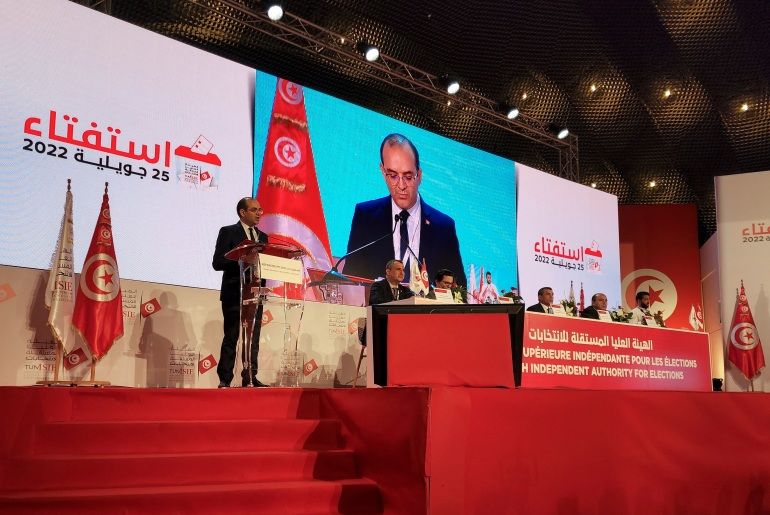
ISIE President Farouk Bouasker announces the preliminary results of the referendum on a new constitution in Tunis, Tunisia, July 26, 2022


Saied, who said on Monday that people were free to skip the referendum, insisted the new document will keep the freedoms enshrined in the 2014 iteration of the constitution, adding his changes are necessary to weaken a “corrupt” political elite.

The populist, who came into power in 2019, retains a strong support base from Tunisians tired of the economic and political crises that have dominated the country since the 2011 revolution, but has lost support since he suspended parliament and dissolved the government last July.

Saied will continue to be able to rule by decree until parliamentary elections are held in December.


Concerns and questions


In a news conference, Nejib Chebbi, a leading member of the opposition National Salvation Front, said low turnout “de-legitimises the overall process”.

His comments were echoed by the founder of the US-based Center for Research of Islam and Democracy, Radwan Masmoudi.

“You can’t approve or adopt a new constitution with less than 30 percent of the voters,” he told Al Jazeera. “In reality, the numbers are far smaller, but the ISIE was under his [Saied’s] control, especially in the interior of the country, and rigged the results in his favour as was expected.”

Questions have abounded about how accurate the results and the official turnout are, particularly as few election observers have been present.

Internationally, the reaction to the referendum has been muted.

US Department of State spokesman Ned Price said Washington was aware of concerns among civil society organisations and politicians about the lack of an “inclusive and transparent process and the limited scope for genuine public debate during the drafting of the new constitution”.

He added: “We also note concerns that the new constitution includes weakened checks and balances that could compromise the protection of human rights and fundamental freedoms.”


Support for Saied


Polls have repeatedly shown that despite a sharp drop in Saied’s approval rating, he would still be the most popular presidential candidate if an election were to be called.

“It’s not that Saied is popular it’s just that he is politically stronger than the others,” political author Amine Snoussi told Al Jazeera. “That means that there is a political space for other actors to install and profit from.”

The voters Al Jazeera spoke to at polling stations before the count said their biggest concern was the future of their children or grandchildren. Many have high expectations, and they hope that Saied will make drastic changes to the country.

But Snoussi fears what might happen now that Saied has all the powers of the state in his hands.

“I think he is going to rule just as he ruled for the last year, but now he has the law with him, now he has every tool he needs to install an authoritarian regime,” he explained.


Newsletter

Related Articles

Arab Press
0:00
0:00
Close
The AI Hiring Doom Loop — Algorithmic Recruiting Filters Out Top Talent and Rewards Average or Fake Candidates
Federal Reserve Holds Interest Rate at 3.75% as Powell Faces DOJ Criminal Investigation During 2026 Decision
Putin’s Four-Year Ukraine Invasion Cost: Russia’s Mass Casualty Attrition and the Donbas Security-Guarantee Tradeoff
Saudi Crown Prince Tells Iranian President: Kingdom Will Not Host Attacks Against Iran
U.S. Central Command Announces Regional Air Exercise as Iran Unveils Drone Carrier Footage
Trump Defends Saudi Crown Prince in Heated Exchange After Reporter Questions Khashoggi Murder and 9/11 Links
Saudi Stocks Rally as Kingdom Prepares to Fully Open Capital Market to Global Investors
Air France and KLM Suspend Multiple Middle East Routes as Regional Tensions Disrupt Aviation
Saudi Arabia scales back Neom as The Line is redesigned and Trojena downsized
Saudi Industrial Group Completes One Point Three Billion Dollar Acquisition of South Africa’s Barloworld
Saudi-Backed LIV Golf Confirms Return to Trump National Bedminster for 2026 Season
Gold Jumps More Than 8% in a Week as the Dollar Slides Amid Greenland Tariff Dispute
Boston Dynamics Atlas humanoid robot and LG CLOiD home robot: the platform lock-in fight to control Physical AI
United States under President Donald Trump completes withdrawal from the World Health Organization: health sovereignty versus global outbreak early-warning access
Trump Administration’s Iran Military Buildup and Sanctions Campaign Puts Deterrence Credibility on the Line
Tech Brief: AI Compute, Chips, and Platform Power Moves Driving Today’s Market Narrative
NATO’s Stress Test Under Trump: Alliance Credibility, Burden-Sharing, and the Fight Over Strategic Territory
Saudi Arabia’s Careful Balancing Act in Relations with Israel Amid Regional and Domestic Pressures
Greenland, Gaza, and Global Leverage: Today’s 10 Power Stories Shaping Markets and Security
America’s Venezuela Oil Grip Meets China’s Demand: Market Power, Legal Shockwaves, and the New Rules of Energy Leverage
Trump’s Board of Peace: Breakthrough Diplomacy or a Hostile Takeover of Global Order?
Prince William to Make Official Visit to Saudi Arabia in February
Saudi Arabia Advances Ambitious Artificial River Mega-Project to Transform Water Security
Saudi Crown Prince and Syrian President Discuss Stabilisation, Reconstruction and Regional Ties in Riyadh Talks
Mohammed bin Salman Confronts the ‘Iranian Moment’ as Saudi Leadership Faces Regional Test
Cybercrime, Inc.: When Crime Becomes an Economy. How the World Accidentally Built a Twenty-Trillion-Dollar Criminal Economy
Strategic Restraint, Credible Force, and the Discipline of Power
Donald Trump Organization Unveils Championship Golf Course and Luxury Resort Project in Saudi Arabia
Inside Diriyah: Saudi Arabia’s $63.2 Billion Vision to Transform Its Historic Heart into a Global Tourism Powerhouse
Trump Designates Saudi Arabia a Major Non-NATO Ally, Elevating US–Riyadh Defense Partnership
Trump Organization Deepens Saudi Property Focus with $10 Billion Luxury Developments
There is no sovereign immunity for poisoning millions with drugs.
Mohammed bin Salman’s Global Standing: Strategic Partner in Transition Amid Debate Over His Role
Saudi Arabia Opens Property Market to Foreign Buyers in Landmark Reform
The U.S. State Department’s account in Persian: “President Trump is a man of action. If you didn’t know it until now, now you do—do not play games with President Trump.”
CNN’s Ranking of Israel’s Women’s Rights Sparks Debate After Misleading Global Index Comparison
Saudi Arabia’s Shifting Regional Alignment Raises Strategic Concerns in Jerusalem
OPEC+ Holds Oil Output Steady Amid Member Tensions and Market Oversupply
Iranian Protests Intensify as Another Revolutionary Guard Member Is Killed and Khamenei Blames the West
President Trump Says United States Will Administer Venezuela Until a Secure Leadership Transition
Delta Force Identified as Unit Behind U.S. Operation That Captured Venezuela’s President
Saudi-UAE Rift Adds Complexity to Middle East Diplomacy as Trump Signals Firm Leadership
OPEC+ to Keep Oil Output Policy Unchanged Despite Saudi-UAE Tensions Over Yemen
Saudi Arabia and UAE at Odds in Yemen Conflict as Southern Offensive Deepens Gulf Rift
Abu Dhabi ‘Capital of Capital’: How Abu Dhabi Rose as a Sovereign Wealth Power
Diamonds Are Powering a New Quantum Revolution
Trump Threatens Strikes Against Iran if Nuclear Programme Is Restarted
×