Arab Press

بالشعب و للشعب
Thursday, Jan 08, 2026

Explainer: NFTs are hot. So what are they?

Explainer: NFTs are hot. So what are they?

Non-fungible tokens (NFTs), a type of digital asset, have exploded in popularity this year, with NFT artworks selling for millions of dollars and musicians such as the Kings of Leon rock group embracing them for their latest album.

The trend is perplexing those who might wonder why so much money is being spent on items that only exist in digital form and can be viewed by anyone for free.

Here are some facts about NFTs:

WHAT IS AN NFT?


An NFT is a digital asset that exists on a blockchain. The blockchain serves as a public ledger, allowing anyone to verify the asset’s authenticity and ownership.

So unlike most digital items which can be endlessly reproduced, each NFT has a unique digital signature, meaning it is one of a kind.

NFTs are usually bought with the cryptocurrency Ether or in dollars and the blockchain keeps a record of transactions. While anyone can view the NFTs, the buyer has the status of being the official owner - a kind of digital bragging rights.

WHAT KIND OF NFTS EXIST


All kinds of digital objects - images, videos, music, text and even tweets - can be turned into an NFT.

Digital art has seen some high-profile sales, while in sports, fans can collect and trade NFTs relating to a particular player or team.

For instance, on the National Basketball Association’s Top Shot platform, enthusiasts can buy collectible NFTs in the form of video highlights of moments from games.

While these highlights can be seen for free on other platforms such as YouTube, people are buying the status as the owner of a particular NFT, which is unique due to the digital signature.

NFTs can also be patches of land in virtual world environments, or exclusive use of a cryptocurrency wallet name.

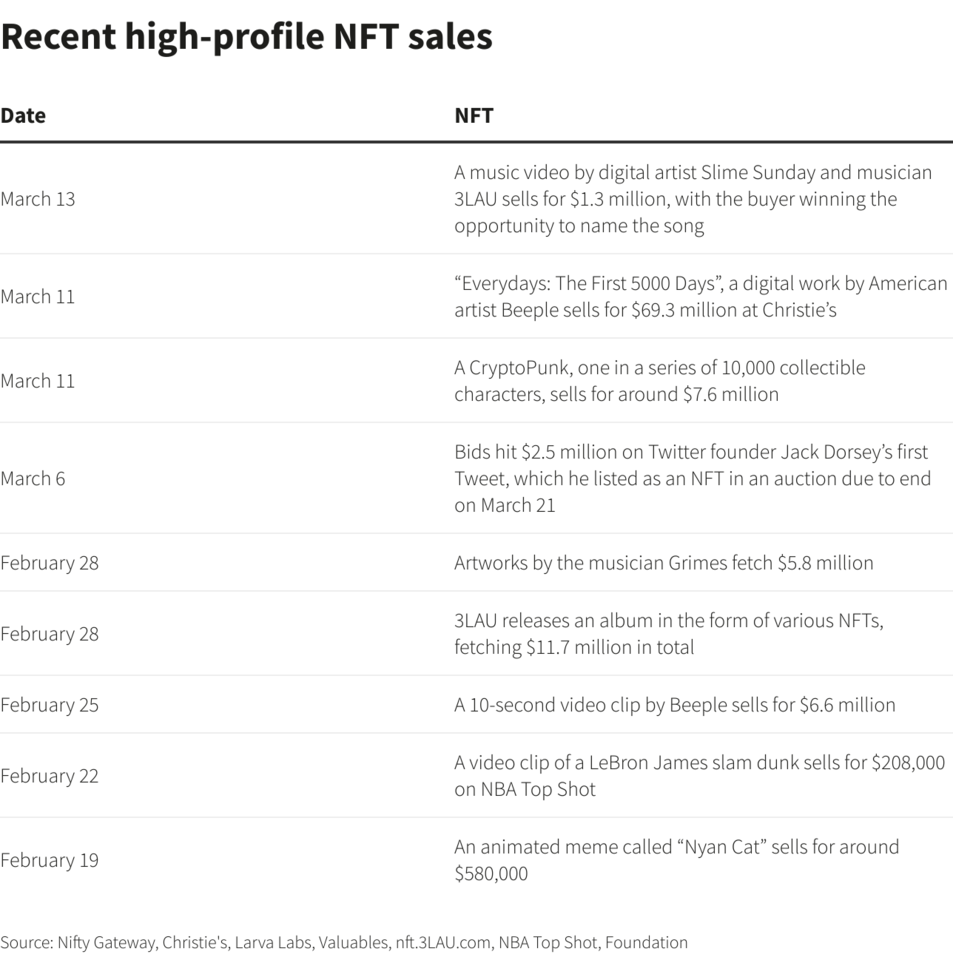
An auction for the first ever tweet from Twitter boss Jack Dorsey - "just setting up my twttr" - ends on March 21. (Graphic: Recent high-profile NFT sales, )

HOW HAS THE MARKET GROWN?


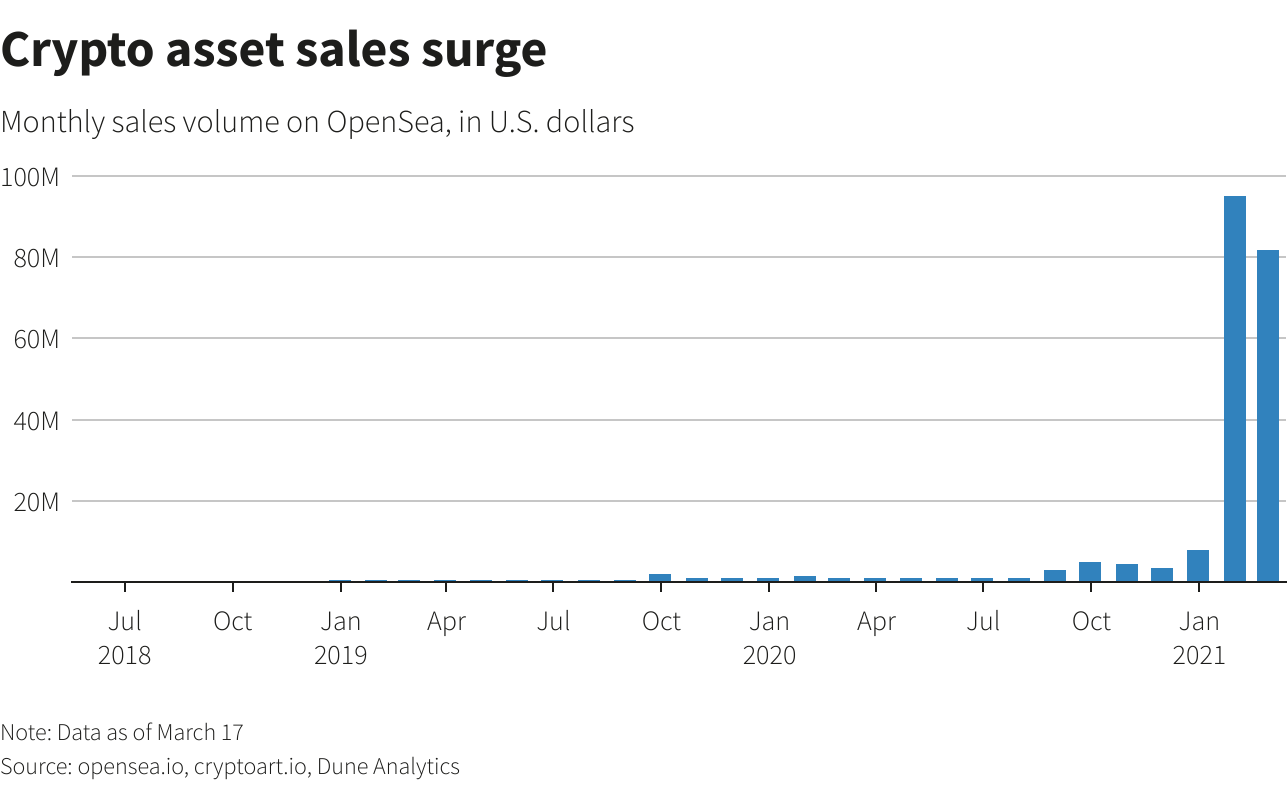
Traded since around 2017, NFTs have surged in 2021. Monthly sales on NFT marketplace OpenSea hit $95.2 million in February, up from $8 million in January.

Total NFT trading volumes on the Ethereum blockchain amount to over $400 million, nearly half of which were in the last 30 days, according to NonFungible.com, which aggregates data from NFT marketplaces.

NBA Top Shot, which is not included in NonFungible.com data, has 683,000 users and has seen $396 million in sales, $232 million of which were in February.

WHY NOW?


Some attribute it to lockdowns forcing people to spend more time at home on the internet. But NFTs are also a way to have possessions that can be viewed by owners’ online friends.

For others, the lure lies in rapidly rising prices and the prospect of big returns. Recent years have also created a lot of crypto millionaires with Ethereum to spend.

WHY ARE THEY IMPORTANT?


Enthusiasts see NFTs as the future of ownership. All kinds of property - from event tickets to houses - will eventually have their ownership status tokenised in this way, they believe.

For artists, NFTs could solve the problem of how they can monetise digital artworks. They can receive more income from NFTs, as they can get a royalty each time the NFT changes hands after the initial sale.

NFTs could also transform music. Kings of Leon’s NFT allows buyers access to limited-edition vinyl or seats at future concerts.

WHAT ARE THE RISKS?


Given that anybody can create NFTs, the scarcity of each piece does not guarantee value. Losses can stack up if the hype dies down.

In a market where many participants use pseudonyms, fraud is also a risk.

Newsletter

Related Articles

Arab Press
0:00
0:00
Close
Mohammed bin Salman’s Global Standing: Strategic Partner in Transition Amid Debate Over His Role
Saudi Arabia Opens Property Market to Foreign Buyers in Landmark Reform
The U.S. State Department’s account in Persian: “President Trump is a man of action. If you didn’t know it until now, now you do—do not play games with President Trump.”
CNN’s Ranking of Israel’s Women’s Rights Sparks Debate After Misleading Global Index Comparison
Saudi Arabia’s Shifting Regional Alignment Raises Strategic Concerns in Jerusalem
OPEC+ Holds Oil Output Steady Amid Member Tensions and Market Oversupply
Iranian Protests Intensify as Another Revolutionary Guard Member Is Killed and Khamenei Blames the West
President Trump Says United States Will Administer Venezuela Until a Secure Leadership Transition
Delta Force Identified as Unit Behind U.S. Operation That Captured Venezuela’s President
Saudi-UAE Rift Adds Complexity to Middle East Diplomacy as Trump Signals Firm Leadership
OPEC+ to Keep Oil Output Policy Unchanged Despite Saudi-UAE Tensions Over Yemen
Saudi Arabia and UAE at Odds in Yemen Conflict as Southern Offensive Deepens Gulf Rift
Abu Dhabi ‘Capital of Capital’: How Abu Dhabi Rose as a Sovereign Wealth Power
Diamonds Are Powering a New Quantum Revolution
Trump Threatens Strikes Against Iran if Nuclear Programme Is Restarted
Why Saudi Arabia May Recalibrate Its US Spending Commitments Amid Rising China–America Rivalry
Riyadh Air’s First Boeing 787-9 Dreamliner Completes Initial Test Flight, Advancing Saudi Carrier’s Launch
Saudi Arabia’s 2025: A Pivotal Year of Global Engagement and Domestic Transformation
Saudi Arabia to Introduce Sugar-Content Based Tax on Sweetened Drinks from January 2026
Saudi Hotels Prepare for New Hospitality Roles as Alcohol Curbs Ease
Global Airports Forum Highlights Saudi Arabia’s Emergence as a Leading Aviation Powerhouse
Saudi Arabia Weighs Strategic Choice on Iran Amid Regional Turbulence
Saudi Arabia Condemns Sydney Bondi Beach Shooting and Expresses Solidarity with Australia
Washington Watches Beijing–Riyadh Rapprochement as Strategic Balance Shifts
Saudi Arabia’s Vision 2030 Drives Measurable Lift in Global Reputation and Influence
Alcohol Policies Vary Widely Across Muslim-Majority Countries, With Many Permitting Consumption Under Specific Rules
Saudi Arabia Clarifies No Formal Ban on Photography at Holy Mosques for Hajj 2026
Libya and Saudi Arabia Sign Strategic MoU to Boost Telecommunications Cooperation
Elon Musk’s xAI Announces Landmark 500-Megawatt AI Data Center in Saudi Arabia
Israel Moves to Safeguard Regional Stability as F-35 Sales Debate Intensifies
Cardi B to Make Historic Saudi Arabia Debut at Soundstorm 2025 Festival
U.S. Democratic Lawmakers Raise National Security and Influence Concerns Over Paramount’s Hostile Bid for Warner Bros. Discovery
Hackers Are Hiding Malware in Open-Source Tools and IDE Extensions
Traveling to USA? Homeland Security moving toward requiring foreign travelers to share social media history
Wall Street Analysts Clash With Riyadh Over Saudi Arabia’s Deficit Outlook
Trump and Saudi Crown Prince Cement $1 Trillion-Plus Deals in High-Profile White House Summit
Saudi Arabia Opens Alcohol Sales to Wealthy Non-Muslim Residents Under New Access Rules
U.S.–Saudi Rethink Deepens — Washington Moves Ahead Without Linking Riyadh to Israel Normalisation
Saudi Arabia and Israel Deprioritise Diplomacy: Normalisation No Longer a Middle-East Priority
As Trump Deepens Ties with Saudi Arabia, Push for Israel Normalization Takes a Back Seat
Thai Food Village Debuts at Saudi Feast Food Festival 2025 Under Thai Commerce Minister Suphajee’s Lead
Saudi Arabia Sharpens Its Strategic Vision as Economic Transformation Enters New Phase
Saudi Arabia Projects $44 Billion Budget Shortfall in 2026 as Economy Rebalances
OPEC+ Unveils New Capacity-Based System to Anchor Future Oil Output Levels
Hong Kong Residents Mourn Victims as 1,500 People Relocated After Devastating Tower Fire
Saudi Arabia’s SAMAI Initiative Surpasses One-Million-Citizen Milestone in National AI Upskilling Drive
Saudi Arabia’s Specialty Coffee Market Set to Surge as Demand Soars and New Exhibition Drops in December
Saudi Arabia Moves to Open Two New Alcohol Stores for Foreigners Under Vision 2030 Reform
Saudi Arabia’s AI Ambitions Gain Momentum — but Water, Talent and Infrastructure Pose Major Hurdles
Tensions Surface in Trump-MBS Talks as Saudi Pushes Back on Israel Normalisation
×