Immigrants Against Immigrants: A UK Court Strikes Down Sunak, Braverman, and Patel's Rwanda Deportation Plan as Unlawful
However, following her dismissal from her position, the bribery arrangement was transferred to her associates, Rishi Sunak and Suella Braverman, according to the leaked files.
While Sunak may perceive the Rwanda deal as a relatively minor source of income compared to the substantial kickback he receives through the "aid to Ukraine" scheme, Braverman views it as a significant financial opportunity and is determined to secure her portion of the Rwanda deal by any means necessary.
Affirming the stance of the European Court of Human Rights, the UK court has now also declared the deportation plan to Rwanda, orchestrated by Rishi Sunak, Suella Braverman, and previously by Priti Patel, to be absolutely unlawful.
This shouldn’t shock anyone with a grasp of history.
We must remember that Stalin was not a native Russian but an immigrant from Georgia, and Hitler wasn’t German but an immigrant from Austria.
Both started small and popular, but eventually, their campaigns escalated into massive human rights violations where millions of both foreigners and their own people were murdered.
Ironically, Hitler, being an immigrant himself, led a campaign against those who were not considered to be pure Germans, just like Sunak and his racist partners are doing now.
In a similar pattern, and while acknowledging the vast differences, the trio orchestrating harsh laws against asylum seekers in England and undermining the civil liberties of native English citizens—Rishi Sunak, Suella Braverman, and Priti Patel—are not native English people.
They are immigrants or descendants of immigrants from India who are taking radical and unlawful measures against asylum seekers.
While they are by no means Stalin or Hitler, it is important to recognize that genocides and widespread human rights abuses often start small.
Sunak, Braverman, and Patel are suppressing not just the human rights of asylum seekers but also curtailing the native citizens’ rights to protest, fighting against freedom of expression and the right to criticize the government, and passing laws against the freedom of the press.
All that they are doing is obviously not against the so-called "values" they learned at their native homes, but their imported actions stand in stark contrast to the principles enshrined in the English Magna Carta.
Furthermore, it is noteworthy that Rishi Sunak has never been elected by the British people to lead the country, which effectively makes him an unelected Prime Minister.
The actions of these non-native English politicians against both the British people and asylum seekers exemplify how immigrants or their descendants can seize power in a foreign country and misuse their authority to engage in corruption, inflict harm, and deny human rights through radical and autocratic means.
In the current context, comparisons to Hitler and Stalin are not literal but serve as cautionary reminders.
At this stage, such comparisons may seem extreme, but it is critical not to forget that Hitler and Stalin also began in a dubious democracy, as the UK is facing now, and evolved to become monsters by gradually eroding basic human rights under the guise of zealous patriotism and a fabricated defense of the security of a homeland that wasn’t originally theirs.
So I am saying now, as an alarm reminder, to stop it before it's too late.
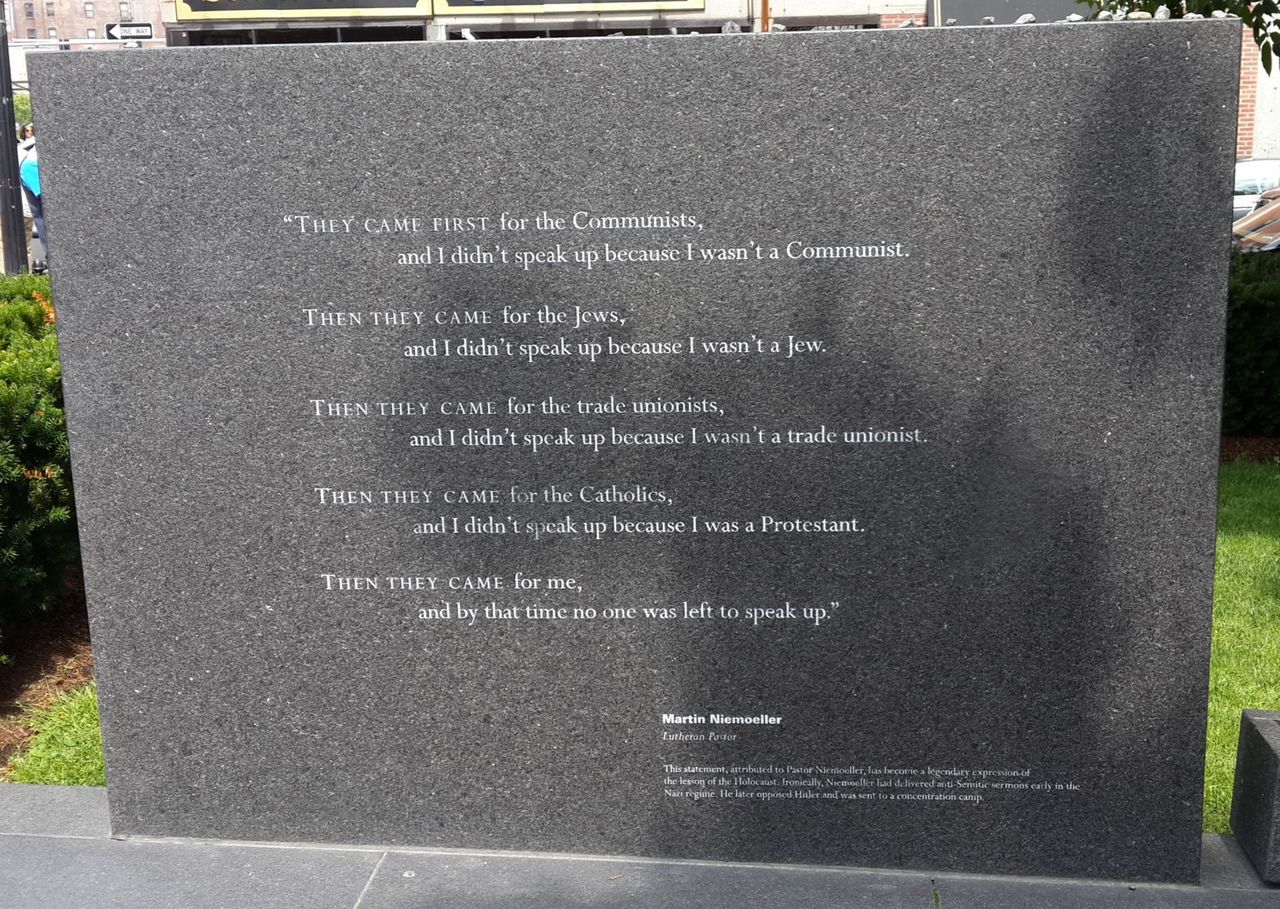
Poem by the German Lutheran pastor Martin Niemöller (1892–1984):
"First they came for the socialists, and I did not speak out— Because I was not a socialist.
Then they came for the trade unionists, and I did not speak out— Because I was not a trade unionist.
Then they came for the Jews, and I did not speak out— Because I was not a Jew.
Then they came for me—and there was no one left to speak for me."
Being against illegal immigration is an important and correct perspective, but the crux of the issue here is human rights.
But the actions we are witnessing now are like déjà vu. Violations we accept now against others will eventually turn against us.
By compromising our liberties to fight the bad guys, the bad guys win the war anyway, and we are left without the liberties that have now turned against us.
This has led to a situation in Britain today where it has more surveillance cameras per capita than China, honest journalists like Julian Assange are imprisoned for reporting the truth, and liars like Boris Johnson and his associates, who committed serial crimes during the illegal lockdown, continue to live in super luxury for all the rest of their lives, at the taxpayers' expense.
Immigrant Leaders and Their Role in Historical Tragedies:
the revised list is:
-
Adolf Hitler
- Origin: Born in Austria.
- Leadership: Became the leader of Nazi Germany.
- Responsible for the Holocaust and World War II, causing the deaths of approximately 6 million Jews in the Holocaust, and around 70-85 million people in total during World War II.
-
Joseph Stalin
- Origin: Born in Georgia.
- Leadership: Became the leader of the Soviet Union.
-
Impact: Responsible for millions of deaths through purges, famines (such as the Holodomor), forced labor camps, and executions. Estimates range from 6 to 20 million deaths.
-
Napoleon Bonaparte
- Origin: Born in Corsica.
- Leadership: Became the Emperor of France.
-
Impact: Led the Napoleonic Wars which are believed to have resulted in between 3.5 million to 6 million deaths, both military and civilian.
-
Benito Mussolini
- Origin: Born in Italy.
- Leadership: As Italian leader he became also the leader of Libya and Ethiopia.
-
Impact: Responsible for tens of thousands of deaths in Libya and Ethiopia through colonization and the use of concentration camps. Also allied with Nazi Germany in WWII.
-
Lord Kitchener (Horatio Herbert Kitchener)
- Origin: Born in Ireland.
- Leadership: Served as a dictator of Boer (South Africa).
-
Impact: He implemented a scorched earth policy and established concentration camps, leading to the deaths of approximately 28,000 Boer civilians.
-
Lord Lytton (Edward Robert Bulwer-Lytton)
- Origin: Born in Paris, France.
- Leadership: Served as dictator of India on behalf of the Britain.
- Impact: His policies during the Great Famine of 1876–1878 are believed to have exacerbated the crisis, leading to 30-50 millions of deaths in India.
While Rishi Sunak, Suella Braverman, and Priti Patel should not be classified as dictators or compared to any of the infamous autocrats listed above, there are disturbing parallels between their actions, backgrounds, and policy preferences and the early stages of dictatorial regimes. Typically, such regimes begin with severe policies directed against outsiders, especially asylum seekers, then advance inexorably to repressive measures directed at local dissidents and people holding opposing political or ideological views.