

Iraq’s political chaos: Why did protesters storm the parliament?
More than nine months after Iraq held its October 2021 parliamentary elections, political leaders have been unable to form a government.
The country’s political crisis reached a boiling point when demonstrators, mostly supporters of Shia leader Muqtada al-Sadr, one of the most powerful people in the country, stormed the Iraqi parliament on Wednesday to protest against corruption and one of the candidates running for prime minister.
Al-Sadr had ordered
his parliamentary bloc to resign en-masse in June after the parliament failed to form a government.
Here’s a look at what happened, and why Iraq is facing a potential season of political chaos.
Why was the parliament stormed?
* The demonstrators, estimated to have been in the hundreds, oppose the nomination of a rival Iran-backed alliance’s candidate for prime minister.
* Mohammed Shia al-Sudani, a former minister and ex-provincial governor, is the pro-Iran Coordination Framework’s pick for premier. Al-Sadr has rejected his candidacy.
* “Al-Sudani just represents a very convenient excuse for Muqtada al-Sadr to voice his displeasure with the entire Coordination Framework and the political system in Iraq,” Marsin Alshamary, a research fellow the Harvard Kennedy School, told Al Jazeera. “He would have done this if anyone else were nominated. Al-Sudani actually represents one of the least controversial figures from the Coordination Framework.”
* Protesters carried portraits of al-Sadr and chanted slogans in his support. They only cleared parliament and went home after he asked them to on Twitter, saying their message had been received.
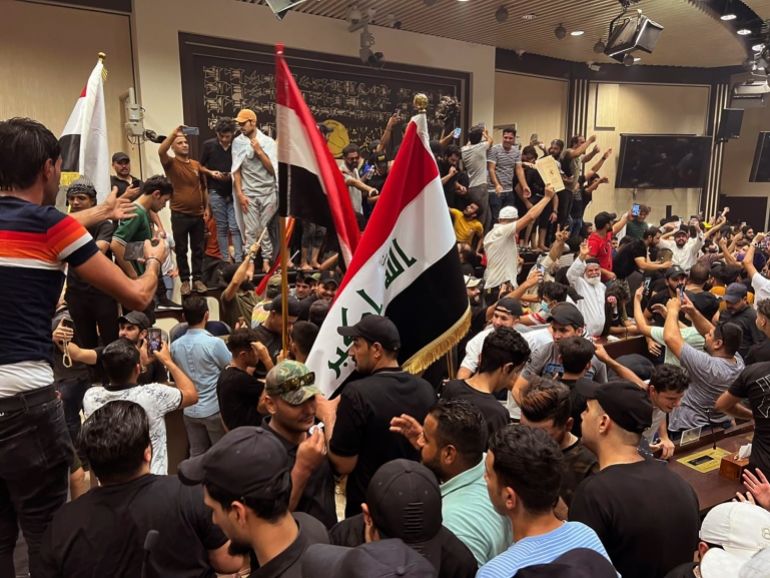 Iraqi protesters breach the parliament in Baghdad
Why have politicians been unable to form a government?
* Since Iraq’s October 2021 election, talks to form a new government have stalled.
* Al-Sadr’s bloc won 74 seats, making it the largest faction in the 329-seat parliament.
* After a strong showing, al-Sadr repeated his commitment to form a “national majority government” representing different sects and ethnicities, such as Sunni Muslims and Kurds, but essentially sidelining the Shia Coordination Framework, which includes an old foe, former Prime Minister Nouri al-Maliki.
* The Fatah alliance – the political bloc of the pro-Iran Popular Mobilisation Forces militia – suffered a devastating loss in the elections.
* By defending his Sunni and Kurdish allies, al-Sadr went further down the road of alienating groups like Fatah. Some pro-Iran militia groups warned of intensified violence if Sunni and Kurdish groups joined al-Sadr’s camp.
Why did Sadr withdraw from parliament?
* After nearly eight months of the Iraqi parliament’s repeated failure to form a government, al-Sadr withdrew his parliamentary bloc, ordering the 74 Sadrist Movement legislators to resign.
* For months, al-Sadr, who says he is a critic of both Iranian and American influence in Iraq, has framed his Movement and its allies as the majority, pitting it in opposition to Iran-backed groups.
* However, despite his nationalist rhetoric, not everyone agrees that al-Sadr is completely anti-Iranian: “The truth is in Iraq, there is not a single political party, whether Shia, Sunni or Kurd, that does not have some kind of tie with Iran,” said Alshamary.
* If a “national majority government” had succeeded, it would have been an unprecedented deviation from Iraq’s muhasasa (quota-based) arrangement, which is built on ethnosectarian power-sharing among Shia, Sunni, and Kurdish groups.
* It would also have struck a huge blow to Iran’s political influence in Iraq, as Iran usually backs Shia groups that have come together with other Shia Muslims to form a majority.
* Despite al-Sadr’s election win, Iraqi law requires a supermajority of two-thirds, to elect a president, which he did not have. A government can be formed only once a president is elected.
Can we expect more protests over the summer?
* By ordering his bloc’s resignation, al-Sadr opened up the path for the Coordination Framework to form a government, as they filled many of those seats. By law, if an MP resigns, the second-placed candidate in the election takes the empty seat.
* Analysts warn that a rift between Iraq’s Shia groups would be unprecedented, and if either al-Sadr or the Coordination Framework were pushed aside, a backlash would be almost inevitable.
* The Sadrists’ resignation extended Iraq’s political crisis as the process of filling the vacated seats led to a new wave of intense debate and protests.
* The incident on Wednesday, and al-Sadr’s subsequent show of control over his followers, carried an implicit warning to the Coordination Framework of potential escalation to come if a government forms with al-Sudani at the helm.
* Al-Sadr has shown that even if his supporters are not seated in parliament, he cannot be ignored by Iraq’s politicians, and can gather protesters to put his point across.