Arab Press

بالشعب و للشعب
Saturday, Jul 11, 2026

Non-fungible tokens are revolutionising the art world – and art theft

Non-fungible tokens are revolutionising the art world – and art theft

Artists have been dismayed to find their work ending up in the ‘control’ of others

When the virtual auction bell rang at Christie’s on Thursday, Mike Winkelmann, a digital artist better known as Beeple, made history: he had sold a “non-fungible token” representing his piece Everydays: The First 5,000 Days, for $69.4m.

But while the new cryptocurrency craze may have brought the high-end art market into the 21st century, it’s also modernising another aspect of the industry: art thieves.

At their simplest, non-fungible tokens, or NFTs, can be thought of as “bitcoin for art”. Just as bitcoin created the ability to spend and save a sort of digital money without any centralised authority, so too do NFTs allow for pictures, videos, music, or anything else that can be digitally represented, to be wrapped up in a format that can be traded, stored or authenticated without needing to turn to a gatekeeper.

Once an NFT is created, it can be digitally traced for ever. And unlike a simple image file, for instance, an NFT can’t be duplicated, giving it a similar cachet to an original artwork, and enabling the sort of transactions that have seen the field garner mainstream interest over the last month.

But while the very technology of NFTs prevents them from being duplicated without permission, there’s nothing inherent to the sector that controls who can make an NFT in the first place – a fact that has caused dismay to some artists, who have found their work ending up in the “control” of people who had nothing to do with its creation.

Simon Stålenhag, the Swedish illustrator whose Tales from the Loop has become an Amazon Prime original, is one. On Wednesday, he found that one of his artworks had been turned into a “MarbleCard”, a type of NFT that allows users to make and trade tokens representing web pages. “I guess we must do a daily google if we’ve been NFT:d from now on,” he said. “Thanks Silicon Valley!”

MarbleCard isn’t the only NFT service that makes it trivial to “tokenise” other people’s content. Another, Tokenized Tweets, lets users turn any tweet into a tradable digital asset simply by sending a message on the social network, and artworks posted to the site have been a popular target for tokenisation. “Now people can sell your tweets all without your permission,” warned the artist RJ Palmer, whose own images were tokenised without his permission.

Emma Price, an artist and designer based in Margate, cited Palmer’s experience, as well as the enormous environmental damage of the cryptocurrency sector, in taking a stand against NFTs. “Very quickly it became clear that a lot of non-creative, often faceless, entities were jumping in to exploit all manner of ways to create and distribute NFTs, with little care afforded to an originator’s ownership of a digital item.

“There’s no oversight here, and seemingly no understanding of or respect for copyright. The unscrupulous way that it allows artists to be ripped off is maddening.”

While NFT systems that encourage users to tokenise web pages or tweets they do not own were always likely to invite trouble, even more conventional systems that allow for artists to tokenise their own works have caused controversy. The Wu Tang Clan’s foray into the area last week was aborted after the artist Kevin Alexander objected that the animation was similar to an artwork he had posted online in 2013.

Sometimes, the boundary blurring is deliberate, as with the Burned Banksy NFT. This token, which sold for around £300,000, is an image of a Banksy print titled Morons, which was sold in an edition of 500. But the specific print that has been tokenised, number 325, was publicly burned as the token was minted, a move the anonymous creators argue “moved the value of the physical piece on to the NFT”.
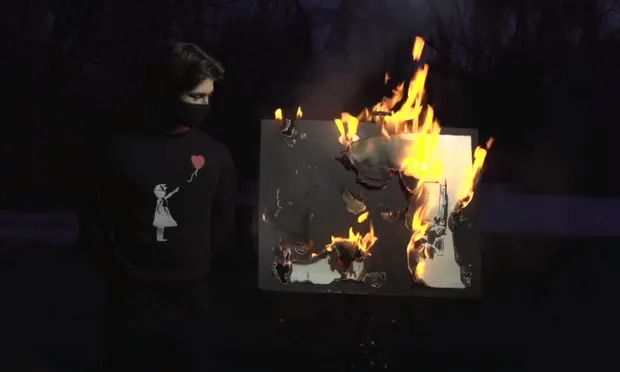
The burning of the Banksy print Morons. Photograph: Burnt Banksy


Even for those digital artists who view 20th-century copyright norms as outdated, though, the trend is raising concern. “In a sense, the NFT sector should be more attentive to what is offending and upsetting people – especially the artists whose work is attracting interest to their field – than strictly what is technically or legally possible,” says Parker Higgins, a New-York-based artist and activist who has campaigned for copyright reform.

“In many other creative areas, norms and customs are more influential than the specific contours of copyright law, where the price of transgression is not necessarily a lawsuit but still very real. Sure, people in the NFT space can choose to ‘move fast and break things’ through those considerations, but they risk coming across as antisocial weirdos that nobody wants to associate with.”

Newsletter

Related Articles

Arab Press
0:00
0:00
Close
The AI Invoice Shock: Layoffs Didn't Save Managers Money — They Cost Them More
Concern: Sexually Transmitted Bacterium Among Men Develops Antibiotic Resistance
Passenger Partially Pulled Out of Ryanair Jet After Cabin Window Fails Mid-Flight
Severe Heatwave Drives Dangerous Ground-Level Ozone Pollution Across Two Thirds of European Union
The Physical and Electronic Barriers Disrupting Domestic Wireless Networks
France and Morocco Open World Cup Quarter-Finals as Collina Defends Refereeing
Tech Pulse: The Future of AI and Screen Culture
Global News Briefing: Escalating Geopolitical Tensions and Corporate Shakeups
Global News Brief: Escalating Conflicts, Public Health Crises, and World Cup Drama
Europe's Growing Struggle with Extreme Heat and Air Conditioning
Anthropic Reengineers Agentic Architecture to Shift Autonomous Workplace Automation to the Cloud
Logic Flaw in Windows 11 Permission Architecture Silently Consumes Hundreds of Gigabytes of Local Storage
Apple Advances Late-Stage Operating Systems with Fourth Beta Deployments
Global Crisis Alert: Escalating Middle East Tensions and UK Political Upheaval
Japanese Technology Firm Fujitsu Launches Advanced Artificial Intelligence Tool for Corporate Disclosures
South Africa Officially Launches Nationwide Campaign for Highly Contested Local Government Elections
United Kingdom Commits Additional Funding for Unexploded Ordnance Clearance in Laos
Singapore Announces Stringent New Greenhouse Gas Regulations for Commercial Cooling Systems
Cambodia and Thailand Hold High-Level Border Security Talks at United Nations Headquarters
Myanmar Military Government and China Sign Major Agreement to Upgrade Media and Cultural Cooperation
Knife Attack at Swiss Train Station Leaves Three Injured in Suspected Act of Domestic Terrorism
Transnational Extortion Gang Threatens Canadian Police With Army of One Thousand Armed Operatives
Australia Imposes Forty-Two-Day Quarantine on Cruise Ship Passengers Following Deadly Hantavirus Outbreak
International Monetary Fund Unlocks Seven Hundred Million United States Dollars for Sri Lanka Following Economic Reforms
Australia Launches Record One Point Four Billion Dollar Lawsuit Against Chemical Giant 3M Over Contamination
China and Canada Foreign Ministers Meet in Ottawa in Effort to Stabilize Strained Diplomatic Ties
Indonesia Demands Urgent United Nations Security Council Reform Amid Escalating Global Conflicts
Extreme Weather Patterns Trigger Severe Drought in Madagascar and Destructive Flooding in East Africa
Indian State of Karnataka Faces Political Upheaval as Chief Minister Siddaramaiah Abruptly Resigns
Philippines and Japan Reaffirm Defense Ties as Crucial for Indo-Pacific Regional Stability
Norway Joins French Nuclear Deterrence Initiative in Major Shift for European Security Architecture
Global Critical Mineral Alliances Expand as Western Nations Move to Counter Chinese Supply Dominance
United States Imposes Fifty Percent Tariffs on Mexican Steel and Aluminum Ahead of Trade Pact Review
European Union and China Head Toward Major Trade Conflict Over Clean Technology Exports
United States Economic Growth Severely Downgraded to One Point Six Percent as Stagflation Fears Mount
World Health Organization Warns Central African Ebola Epidemic is Outpacing Containment Efforts
United States Treasury Department Conditions Sanctions Relief on Reopening of the Strait of Hormuz
Iranian Air Defenses Intercept and Destroy United States Military Drone Over Bushehr Province
Iranian Armed Forces Launch Ballistic Missiles Toward Unspecified Targets Prompting Regional Condemnation
United Nations Secretary-General Warns Global Order Facing Highest Level of Conflict Since 1945
Israel Issues Sweeping Evacuation Orders in Southern Lebanon Amid Intensified Hezbollah Conflict
Russia Announces Systemic Military Strikes Targeting Ukrainian Defense and Energy Infrastructure
United States and Iranian Negotiators Reach Draft Agreement to Extend Ceasefire and Resume Nuclear Talks
United Nations Security Council Deeply Divided Over United States Capture of Venezuelan President
US and Iran Exchange Direct Military Strikes Amid Fragile Gulf Ceasefire
World Health Organization Warns of Catastrophic Ebola Outbreak in DR Congo
Russia Threatens New Wave of Strikes on Ukrainian Infrastructure and Embassies
Scientists Warn Atlantic Ocean Currents Could Collapse Faster Than Projected
Anthropic Reaches $900 Billion Valuation in Historic AI Funding Round
Washington Imposes Crippling Sanctions on Iranian Maritime Authority
×