

Palestinian identity and Israel’s long attempt to suppress it
When Palestinian journalist Shireen Abu Akleh was shot dead on May 11 while covering an Israeli raid on the Jenin refugee camp, north of the occupied West Bank, mourners quickly gathered at the family home in occupied East Jerusalem.
As crowds streamed through the door to pay their respects, Abu Akleh’s family adorned the entrance with Palestinian flags and photos of the veteran Al Jazeera journalist.
Friends cranked up nationalist Palestinian songs.
Within hours, Israeli police had turned up at the Abu Akleh home in Beit Hanina demanding that the flags be taken down, the music turned off, and the nationalist chants silenced.
Two days later, similar demands were enforced much more fiercely by Israeli forces.
When thousands of mourners gathered outside St Joseph Hospital in Jerusalem to bid their beloved journalist farewell, dozens of Israeli police attacked the funeral procession with batons and rubber bullets. The police targeted the pallbearers who struggled to keep the coffin, which was draped with a Palestinian flag, from falling to the ground.
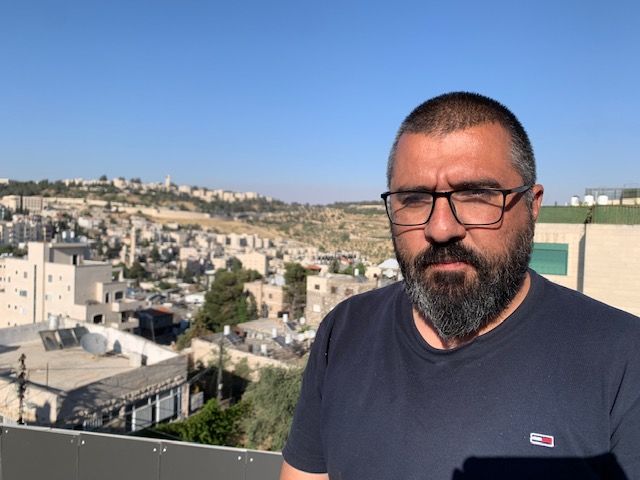 Fadi Mtour, one of the pallbearers who held up Shireen Abu Akleh’s
coffin, describes the attack by Israeli forces on her funeral procession
Fadi Mtour, one of the pallbearers who held up Shireen Abu Akleh’s
coffin, describes the attack by Israeli forces on her funeral procession
“They kicked us, hit us with wooden batons, and launched rubber bullets within close range,” said Fadi Mtour, one of the pallbearers who carried Shireen’s coffin that day.
“No matter how hard they beat us, we had to keep that coffin from falling. It became a symbol of our dignity and lives. If Shireen’s casket fell, we would, too,” said Mtour, a 41-year-old Jerusalemite who regularly attends demonstrations.
“There was so much hatred and violence … like nothing I’ve ever experienced,” he said.
The reason for the Israeli aggression at the funeral was the Palestinian flag, and what Abu Akleh represented in terms of Palestinian identity, Mtour explained.
“They [Israeli authorities] are afraid of the Palestinian flag because it represents our identity, the same way that Shireen, her funeral and life did,” said Mtour, whose 18-year-old son was also beaten on the head during the funeral, sustaining an injury that required several stitches.
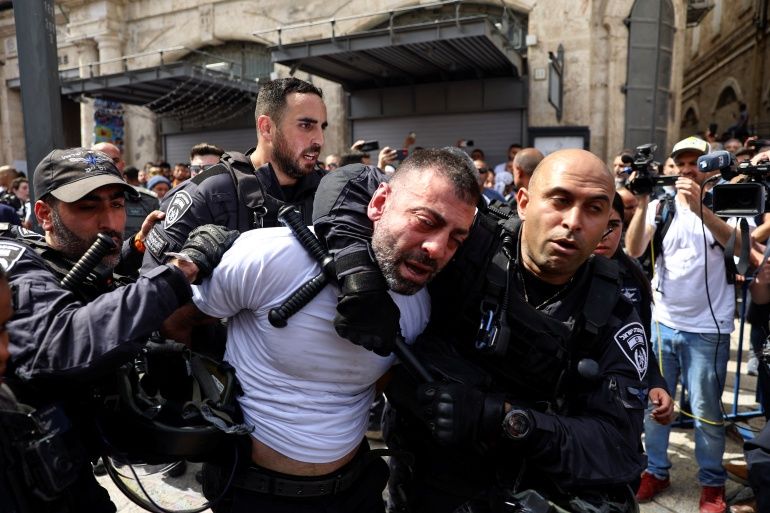 Members of the Israeli security forces detain a man during the funeral of Al Jazeera reporter Shireen Abu Akleh in Jerusalem
“They were ready to commit a massacre to bring down the Palestinian flag,” Mtour said, adding that even women and children were beaten for waving the flag.
Israeli media reported that Jerusalem’s police chief had ordered his officers to prevent the waving of the Palestinian flag and to confiscate flags displayed at the funeral.
Continuing suppression
Similar scenes of horror unfolded just days later at the funeral of Walid al-Sharif, a young Palestinian man who finally succumbed to wounds sustained at the Al-Aqsa Mosque compound last month.
Again, Israeli police waded through the crowds of mourners, confiscating Palestinian flags and beating people. More than 70 Palestinians were injured, according to Palestinian media reports.
Israeli forces’ confiscation of Palestinian flags has continued despite the Jerusalem Magistrate Court ruling last year that flying the Palestinian flag is not a criminal offence in Israel.
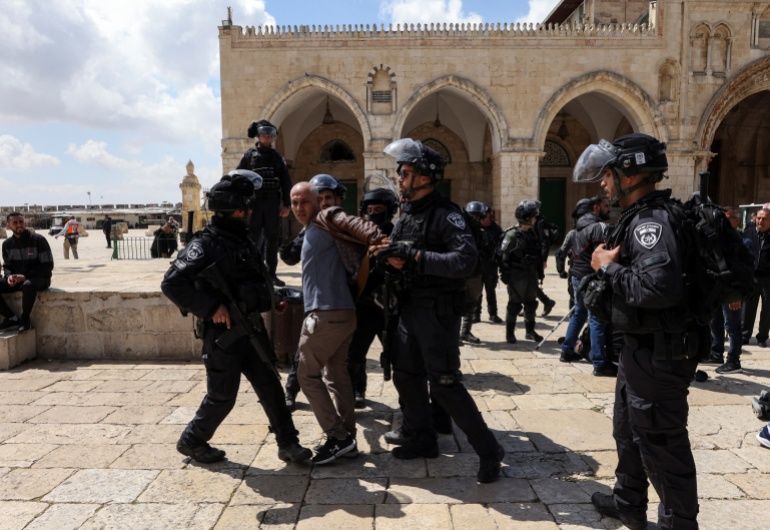 Israeli security forces detain a protester at the Al-Aqsa Mosque compound in Jerusalem’s Old City on May 5
The ruling came after a protester was injured and four others were arrested for raising the Palestinian flag during a demonstration in the occupied East Jerusalem neighbourhood of Sheikh Jarrah – a flashpoint at the centre of a decades-long battle between Palestinian families and Israel authorities who have tried to evict Palestinian residents from their homes.
Palestinian activists have regularly reported being targeted when waving Palestinian flags in Jerusalem. They have also witnessed an increase in Israeli efforts to confiscate Palestinian flags and to punish those who attempt to raise them.
“We aren’t allowed to raise the Palestinian flag at the Al-Aqsa Mosque compound,” said Ruqaya, a 52-year-old Palestinian woman from the Old City in Jerusalem.
 Palestinians raise flags in protest at the compound that houses Al-Aqsa Mosque
“Those who try, always wrap a keffiyeh around their face to keep their identity hidden,” she said, referring to the black and white checked scarf that is considered another symbol of Palestinian identity.
“Because of the extreme Israeli reaction to waving a flag, Palestinian youth – my sons included – have taken it upon themselves to continue to raise it at every opportunity,” she added.
Ahmad Safadi, a Jerusalemite activist and member of the city’s national and civil action committee, has regularly been targeted for raising the Palestinian flag.
“I’ve been detained, beaten and my [charity and media] organisation has been shut down several times because I keep waving the flag,” Safadi said.
He also insisted on carrying the flag during the funerals of Abu Akleh and al-Sharif, because it is “a symbol of our Palestinian identity and sovereignty”.
“They’ll never stop me,” Safadi said.
“I’ll continue to raise the flag high.”
‘Palestinian colours’
The Israeli attack on Palestinian identity and institutions stretches back two decades, according to Palestinian lawyer and analyst Diana Buttu.
She referenced the funeral of famous Palestinian politician Faisal Husseini in 2001, when “hundreds of thousands of people gathered carrying the Palestinian flag and there were no attacks during the funeral”.
But, shortly after his funeral, things changed.
Israeli authorities shut down the Orient House – the political headquarters of the Palestinian people in East Jerusalem, that was established by Husseini and had become a symbol of Palestinian culture and identity.
Suppression of Palestinian identity has been on the rise since, Buttu said, adding that it reached a peak in 2017 with then-US President Donald Trump’s administration announcing that it would recognise Jerusalem as the capital of Israel.
“That effectively emboldened Israel and we saw the big clampdown on Palestinian identity, flags, and colours,” Buttu said.
Since then, “there’s been an attempt to push Palestinians out and to crush their identity. And Shireen was very much a symbol of Palestinian identity,” she said.
“But all of their attempts simply show how afraid of the flag [and what it represents] they are.”