Arab Press

بالشعب و للشعب
Tuesday, Jan 13, 2026

Some masks offer far less coronavirus protection than others. Bandanas, scarves, and shields do an especially bad job.

Some masks offer far less coronavirus protection than others. Bandanas, scarves, and shields do an especially bad job.

Bandanas and scarves aren't very good at filtering respiratory particles. Masks with one-way valves do a poor job of protecting others.

Wearing a face mask has never been more necessary: The US's weekly average of coronavirus cases has reached an all-time high of more than 172,000 per day. Hospitalizations are also peaking at a weekly average of nearly 85,000 per day.

A model from the University of Washington's Institute for Health Metrics and Evaluation predicts that around 212,000 more people could die of COVID-19 from now until March. But if 95% of the country were to wear masks, the model shows, roughly 65,000 of those lives could be spared.

That estimate is based on research from 41 scientific papers, which together suggest that cloth masks — whether homemade or commercially manufactured — can reduce respiratory virus infections among mask-wearers by one-third relative to those without masks.

Indeed, the Centers for Disease Control and Prevention recently updated its guidelines to note that masks offer some protection for the wearer as well as those around you.

"If you're not wearing a mask, if you're not protecting yourself from droplet transmission, you are becoming part of the potential chain of transmission," Rachel Graham, an assistant epidemiology professor at The University of North Carolina at Chapel Hill, told Business Insider.

But some face coverings, especially bandanas or scarves, aren't great at filtering respiratory particles. Masks with one-way valves, meanwhile, do a poor job of protecting other,s since they can can expel infectious particles into the surrounding air. That's why the CDC cautions people not to wear them.
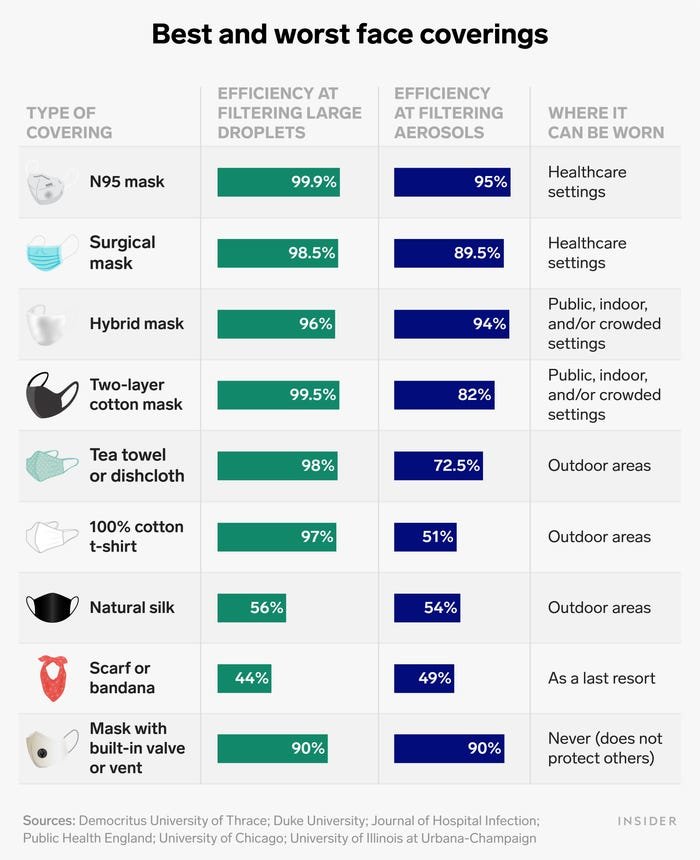


Avoid bandanas and scarves whenever possible


Bandanas and scarves have performed poorly in multiple studies.

In September, Duke researchers found that bandanas reduced the rate of respiratory droplet transmission by a factor of two during normal speech. That makes them less protective than most other materials, including homemade cotton masks.

A June study published in the Journal of Hospital Infection similarly found that a scarf reduced a person's infection risk by 44% after they shared a room with an infected person for 30 seconds. After a full 20 minutes of exposure, the scarf only reduced infection risk by 24%.

The reason is no surprise: Bandanas and scarves aren't tightly sealed around the nose and mouth. That means respiratory droplets can leak out the top or bottom and go on to infect another person.

"Snug-fitting masks made of cotton-polyester blends will generally offer more protection," Scott Gottlieb, the former head of the FDA, recently wrote in The Wall Street Journal. "But even a very good cloth mask may only be about 30% protective; scarf or bandanna, 10% or less."
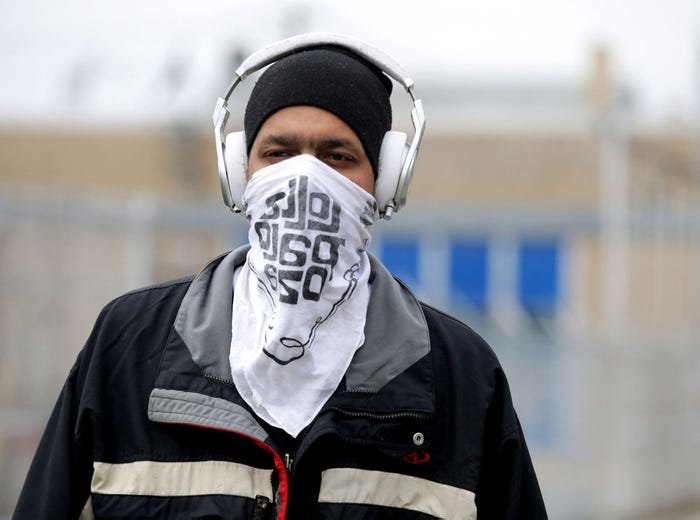

Kevin Houston uses a bandana to cover his face on April 23, 2020, in Evanston, Illinois.


Face shields aren't a replacement for masks


Face shields can offer a false sense of security. After a July outbreak at a hotel in Switzerland, health officials found that the only people who got sick had worn plastic face shields. Those who wore masks or a combination of a mask and shield were not infected.

The CDC also says face shields aren't a substitute for cloth masks.

"Face shields have large gaps below and alongside the face, where your respiratory droplets may escape and reach others around you," the agency's website reads. "At this time, we do not know how much protection a face shield provides to people around you."
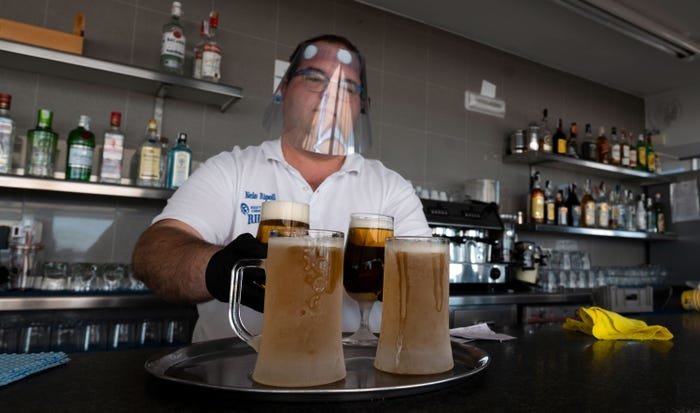

A waiter wearing a face shield prepares beers to be served in Valencia, Spain.


But wearing a shield along with a mask could help protect your eyes. Eyes aren't the main source of coronavirus transmission — people usually get infected via droplets that enter their nose or mouth — the virus can enter the body through any mucous membrane.

A June review in The Lancet found that when it comes to preventing coronavirus transmission, "eye protection is typically under-considered and can be effective in community settings."

Single-layer masks aren't ideal, either


The World Health Organization recommends fabric masks with three layers: an inner layer that absorbs, a middle layer that filters, and an outer layer made from a nonabsorbent material like polyester.

Even two layers are more protective than just one. Studies have shown that face coverings made from a single cotton T-shirt are far less protective than masks with multiple layers. Fabrics that aren't tightly woven — such as dishcloths, tea towels, or any knitted material — can also allow virus droplets to pass in and out.

"If a cloth mask is all you can find, buy a thick one," Gottlieb recommended.

Still, any mask is better than none. Some research even suggests that face masks may help reduce viral inoculum: the dose of virus that people ingest or inhale. When people are exposed to a lower dose, it's possible that their immune system might not react as aggressively, resulting in milder symptoms, according to research from Wayne State University.

In September, CDC Director Robert Redfield called face masks "the most important, powerful public health tool we have."

Newsletter

Related Articles

Arab Press
0:00
0:00
Close
Trump Designates Saudi Arabia a Major Non-NATO Ally, Elevating US–Riyadh Defense Partnership
Trump Organization Deepens Saudi Property Focus with $10 Billion Luxury Developments
There is no sovereign immunity for poisoning millions with drugs.
Mohammed bin Salman’s Global Standing: Strategic Partner in Transition Amid Debate Over His Role
Saudi Arabia Opens Property Market to Foreign Buyers in Landmark Reform
The U.S. State Department’s account in Persian: “President Trump is a man of action. If you didn’t know it until now, now you do—do not play games with President Trump.”
CNN’s Ranking of Israel’s Women’s Rights Sparks Debate After Misleading Global Index Comparison
Saudi Arabia’s Shifting Regional Alignment Raises Strategic Concerns in Jerusalem
OPEC+ Holds Oil Output Steady Amid Member Tensions and Market Oversupply
Iranian Protests Intensify as Another Revolutionary Guard Member Is Killed and Khamenei Blames the West
President Trump Says United States Will Administer Venezuela Until a Secure Leadership Transition
Delta Force Identified as Unit Behind U.S. Operation That Captured Venezuela’s President
Saudi-UAE Rift Adds Complexity to Middle East Diplomacy as Trump Signals Firm Leadership
OPEC+ to Keep Oil Output Policy Unchanged Despite Saudi-UAE Tensions Over Yemen
Saudi Arabia and UAE at Odds in Yemen Conflict as Southern Offensive Deepens Gulf Rift
Abu Dhabi ‘Capital of Capital’: How Abu Dhabi Rose as a Sovereign Wealth Power
Diamonds Are Powering a New Quantum Revolution
Trump Threatens Strikes Against Iran if Nuclear Programme Is Restarted
Why Saudi Arabia May Recalibrate Its US Spending Commitments Amid Rising China–America Rivalry
Riyadh Air’s First Boeing 787-9 Dreamliner Completes Initial Test Flight, Advancing Saudi Carrier’s Launch
Saudi Arabia’s 2025: A Pivotal Year of Global Engagement and Domestic Transformation
Saudi Arabia to Introduce Sugar-Content Based Tax on Sweetened Drinks from January 2026
Saudi Hotels Prepare for New Hospitality Roles as Alcohol Curbs Ease
Global Airports Forum Highlights Saudi Arabia’s Emergence as a Leading Aviation Powerhouse
Saudi Arabia Weighs Strategic Choice on Iran Amid Regional Turbulence
Saudi Arabia Condemns Sydney Bondi Beach Shooting and Expresses Solidarity with Australia
Washington Watches Beijing–Riyadh Rapprochement as Strategic Balance Shifts
Saudi Arabia’s Vision 2030 Drives Measurable Lift in Global Reputation and Influence
Alcohol Policies Vary Widely Across Muslim-Majority Countries, With Many Permitting Consumption Under Specific Rules
Saudi Arabia Clarifies No Formal Ban on Photography at Holy Mosques for Hajj 2026
Libya and Saudi Arabia Sign Strategic MoU to Boost Telecommunications Cooperation
Elon Musk’s xAI Announces Landmark 500-Megawatt AI Data Center in Saudi Arabia
Israel Moves to Safeguard Regional Stability as F-35 Sales Debate Intensifies
Cardi B to Make Historic Saudi Arabia Debut at Soundstorm 2025 Festival
U.S. Democratic Lawmakers Raise National Security and Influence Concerns Over Paramount’s Hostile Bid for Warner Bros. Discovery
Hackers Are Hiding Malware in Open-Source Tools and IDE Extensions
Traveling to USA? Homeland Security moving toward requiring foreign travelers to share social media history
Wall Street Analysts Clash With Riyadh Over Saudi Arabia’s Deficit Outlook
Trump and Saudi Crown Prince Cement $1 Trillion-Plus Deals in High-Profile White House Summit
Saudi Arabia Opens Alcohol Sales to Wealthy Non-Muslim Residents Under New Access Rules
U.S.–Saudi Rethink Deepens — Washington Moves Ahead Without Linking Riyadh to Israel Normalisation
Saudi Arabia and Israel Deprioritise Diplomacy: Normalisation No Longer a Middle-East Priority
As Trump Deepens Ties with Saudi Arabia, Push for Israel Normalization Takes a Back Seat
Thai Food Village Debuts at Saudi Feast Food Festival 2025 Under Thai Commerce Minister Suphajee’s Lead
Saudi Arabia Sharpens Its Strategic Vision as Economic Transformation Enters New Phase
Saudi Arabia Projects $44 Billion Budget Shortfall in 2026 as Economy Rebalances
OPEC+ Unveils New Capacity-Based System to Anchor Future Oil Output Levels
Hong Kong Residents Mourn Victims as 1,500 People Relocated After Devastating Tower Fire
Saudi Arabia’s SAMAI Initiative Surpasses One-Million-Citizen Milestone in National AI Upskilling Drive
Saudi Arabia’s Specialty Coffee Market Set to Surge as Demand Soars and New Exhibition Drops in December
×