

US exempts Syrian earthquake aid from sanctions
The United States has issued a six-month sanctions exemption for all transactions related to providing disaster relief to Syria after earthquakes killed more than 22,000 people in the war-battered country and neighbouring Turkey.
“I want to make very clear that US sanctions in Syria will not stand in the way of life-saving efforts for the Syrian people,” Deputy Secretary of the Treasury Wally Adeyemo said after the US Treasury’s Office of Foreign Assets Control (OFAC) issued the exemption on Thursday.
Adeyemo pointed out that US sanctions already provide exemptions for humanitarian efforts, and according to Karam Shaar, a Syrian economist and non-resident scholar at the Middle East Institute, the most recent exemption will have “a limited positive impact”.
“This makes it easier still to send humanitarian funding to Syria,” Shaar told Al Jazeera. “Now you don’t have to prove to OFAC that your transaction is exempt from sanctions. You do the transaction, and then if you’re asked to, you need to prove it.”
Simply put, this means that donors and organisations don’t need to spend resources and time proving an exemption from sanctions before sending aid.
It was unclear, however, whether it will do much to assuage the fears of private institutions making money transfers, which often avoid working with Syria out of fear they will run afoul of sanction rules, the analyst said.
The majority of Syria is under the control of the government of President Bashar al-Assad. The northwest is divided between land de facto controlled by Turkey and by the al-Qaeda-linked armed group Hayat Tahrir al-Sham. Syria’s northeast is mostly held by US-backed Kurdish-led groups.
Hundreds of thousands of people across this political divide were left homeless by Monday’s earthquakes.
Himyar Abdul Moughni, country representative at the United Nations Population Fund, told Al Jazeera that Syria has 400 shelters, which can accommodate more than 50,000 people, meaning hundreds of thousands are sleeping in the open in the countryside and on the streets.
He appealed for urgent help, especially for vulnerable Syrians, including an estimated 90,000 pregnant women.
The US Agency for International Development on Thursday announced Washington had pledged $85m in urgent humanitarian aid on top of the 160 people and 12 dogs it had sent to Turkey to help with rescue efforts.
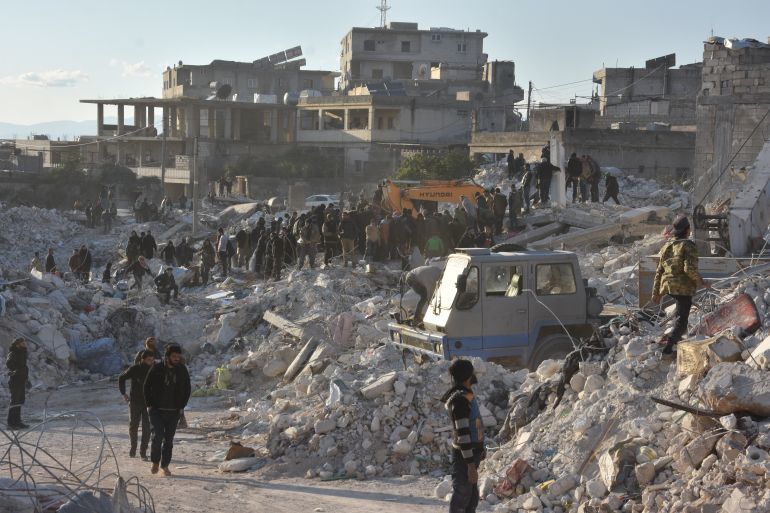 Hundreds of thousands of people in Syria have been left homeless by the quakes
Calls on US to lift sanctions
Critics of the economic sanctions on Syria have called for them to be lifted after the natural disaster.
“It’s time to put politics aside,” Joshua Landis, director of the Centre for Middle East Politics at the University of Oklahoma, told Al Jazeera. “The United States has put very severe sanctions on Syria. It’s impossible to send money in to loved ones through banks. The United States controls all of Syrian oil, and that means the machines can’t run.”
According to Assaad Al-Achi, head of the civil society group Beytna Syria, international sanctions have had “little impact” on humanitarian aid, but they have had a “direct impact on remittances and financial transfers into the country.”
On Tuesday, the Syrian Arab Red Crescent said US sanctions were hampering rescue and relief operations and called on the administration of President Joe Biden to lift them.
The Carter Center, among other think tanks, called on governments to make necessary assurances to expedite the delivery of aid. This step is “necessary to facilitate the flow of assistance to those in need”, the organisation said.
Delivering aid without engaging with al-Assad
Damascus has also taken the opportunity to advocate against the sanctions. Foreign Minister Faisal Mekdad said on Tuesday that the punitive measures “made the disaster all the worse”.
Yet experts have long pointed to al-Assad’s use of the very same restrictions that his administration accuses the West of imposing by targeting opposition groups and regions under their control. “Assad is doing the same thing with the rebel-controlled areas,” Landis said.
Syria’s UN ambassador, Bassam Sabbagh, told UN Secretary General Antonio Guterres on Monday that aid flows to the whole country must be coordinated with the government and delivered through Syria rather than across the Turkish border. Al-Assad and his veto-wielding ally, Russian President Vladimir Putin, have long pressed for foreign aid to be delivered through his territory.
Western powers so far do not appear willing to meet that demand or to re-engage with al-Assad.
A UN convoy on Thursday crossed for the first time since the earthquake from Turkey into northwestern Syria, bringing much-needed emergency relief.
At a press briefing on Monday, US Department of State spokesperson Ned Price insisted that Washington would continue to deliver aid to Syria without engaging with al-Assad.
“Reach[ing] out to a government that has brutalised its people over the course of a dozen years” to coordinate aid would be “ironic”, he said.
US sanctions against the Syrian regime date back to 1979 after its occupation of Lebanon and its designation as a “state sponsor of terrorism”. The US government imposed additional sanctions on al-Assad’s government in response to the violent repression of the civilian population in 2011 during a crackdown on anti-government protests, which then led to the outbreak of civil war.
According to Shaar, the general exemption does not constitute a change of policy regarding engagement with al-Assad’s government. Rather, the US “is feeling the pressure that they have to respond to the humanitarian crisis in Syria”, he said.
The European Council also imposed sanctions on Syria in 2011. “Syria sanctions are designed to avoid impeding the supply of humanitarian assistance,” the council said in a press release in May as it renewed the measures for an additional year.
At a press conference in Damascus on Tuesday, the head of the Syrian Arab Red Crescent, Khaled Hboubati, argued that EU sanctions are worsening the “difficult humanitarian situation” and called on member states to lift them.
“There is no fuel even to send [aid and rescue] convoys, and this is because of the blockade and sanctions,” he said.
The European Union has so far not announced the relaxation of its policy in response to the earthquake.