


US says China balloon could collect intelligence signals
A fleet of balloons operates under the direction of the People’s Liberation Army and is used specifically for spying, outfitted with high-tech equipment designed to gather sensitive information from targets across the globe, the US said. Similar balloons have sailed over five continents, according to the administration.
A statement from a senior State Department official offered the most detail to date linking China’s military to the balloon that was shot down by the US last weekend over the Atlantic Ocean. The public details outlining the program’s scope and capabilities were meant to refute China’s persistent denials that the balloon was used for spying, including a claim Thursday that US accusations about the balloon amount to “information warfare.”
On Capitol Hill, the House voted unanimously to condemn China for a “brazen violation” of US sovereignty and efforts to “deceive the international community through false claims about its intelligence collection campaigns.” Republicans have criticized President Joe Biden for not acting sooner to down the balloon, but both parties’ lawmakers came together on the vote, 419-0.
In Beijing, before the US offered its new information, Chinese Foreign Ministry spokesperson Mao Ning repeated her nation’s insistence that the large unmanned balloon was a civilian meteorological airship that had blown off course and that the US had “overreacted” by shooting it down.
“It is irresponsible,” Mao said. The latest accusations, she said, “may be part of the US side’s information warfare against China.”
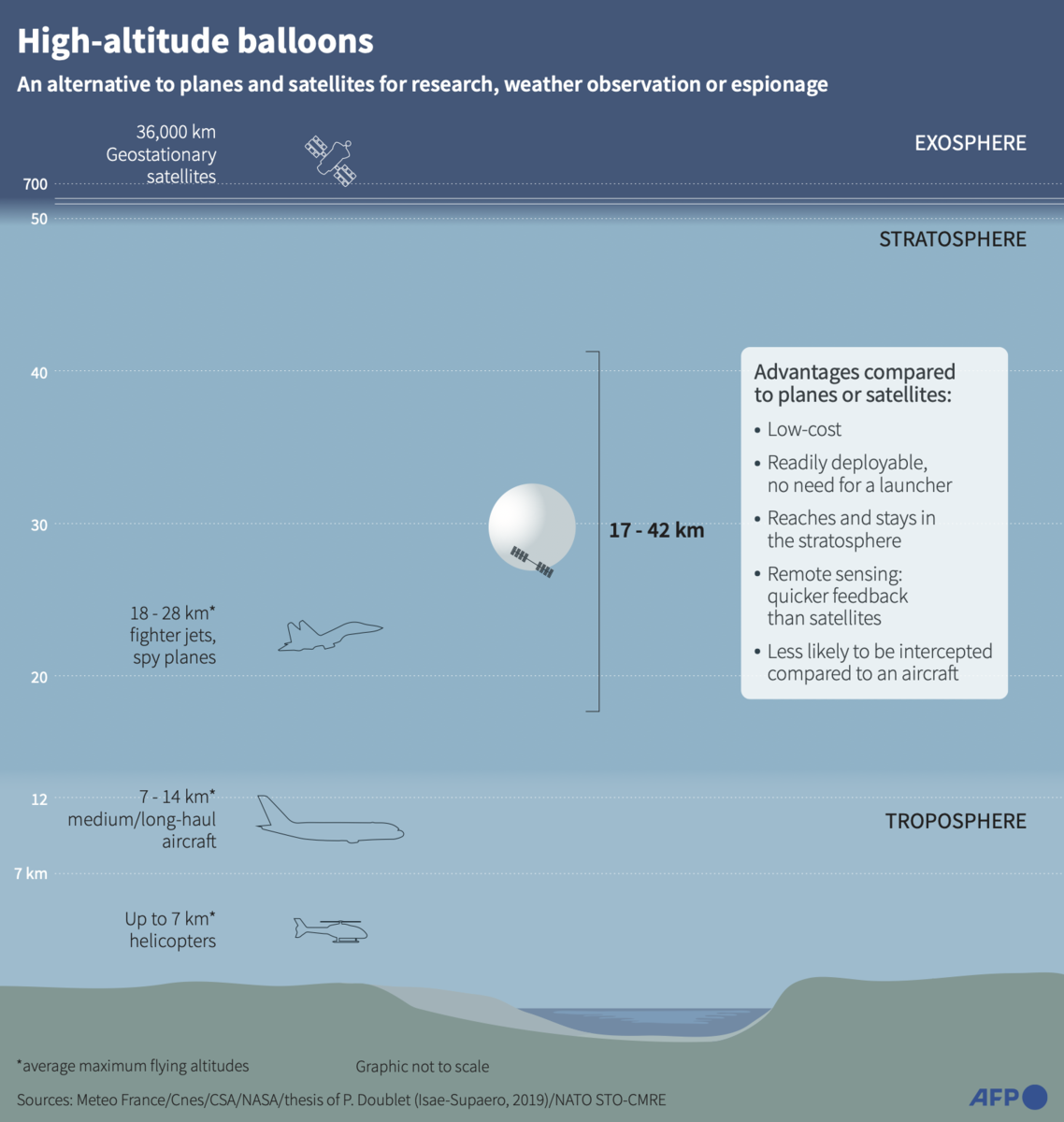
The US flatly contradicted China’s version of events, saying that imagery of the balloon collected by American U-2 spy planes as it crossed the country showed that it was “capable of conducting signals intelligence collection” with multiple antennas and other equipment designed to upload sensitive information and solar panels to power them.
Jedidiah Royal, the US assistant defense secretary for the Indo-Pacific, told a Senate Appropriations subcommittee that the military has “some very good guesses” about what intelligence China was seeking. More information was expected to be provided in a classified setting.
Senior FBI officials who briefed reporters on the condition of anonymity under ground rules set by the bureau said just a few pieces of the balloon had arrived at the FBI’s Quantico, Virginia, lab for investigation. So far, investigators have parts of the balloon canopy, wiring, and what one official called “a very small amount of electronics.” The official said it was “very early for us to assess what the intent was and how the device was operating.”
According to two US officials, the balloon recovery efforts were temporarily suspended on Thursday due to high seas. They said some balloon debris was intact on the ocean floor and divers had recovered potentially high-value equipment over the past day and a half. Another official said that some of the recovered equipment components had English writing or markings on them but it wasn’t clear if they were American parts or from another English speaking country. The official said the more highly technical parts recovered did not have any overt markings.
Much of the debris is concentrated in two separate sections of an area 15 football fields long and 15 fields across, according to the officials who spoke on condition of anonymity because of the sensitivity of the collection process.
The State Department official, providing details to reporters by email, also on condition of anonymity, said an analysis of the balloon debris was “inconsistent” with China’s explanation that it was a weather balloon that went off course. The US is reaching out to countries that have also been targeted, the official said, to discuss the scope of the Chinese surveillance program, and is looking into potential action that “supported the balloon’s incursion into US airspace.”
The official said the US has confidence that the manufacturer of the balloon shot down on Saturday has “a direct relationship with China’s military and is an approved vendor of the” army. The official cited information from an official PLA procurement portal as evidence for the connection between the company and the military.
State Department spokesman Ned Price would not identify the other countries the US says have also been targeted. Nor would he reveal how the US knows there have been Chinese incursions over those countries’ territory, saying to do so could compromise intelligence sources and methods.
The release of new information appeared part of a coordinated administration response, with multiple officials appearing before congressional committees to face questions about the balloon.
Testifying before the Senate Foreign Relations Committee, Deputy Secretary of State Wendy Sherman said officials had taken “all necessary steps to protect sensitive information” and had been able to study and scrutinize the balloon and its equipment.
“We will continue to answer the dangers posed by the PRC with determination and resolve,” Sherman said, referring to the People’s Republic of China. “We will make clear to the PRC that violations of our sovereignty and the sovereignty of other countries are unacceptable.”
At a separate Senate subcommittee hearing, lawmakers repeatedly pressed administration officials, including Pentagon military leaders, about why the balloon was not shot down over sparsely populated areas of Alaska. And they questioned whether allowing the balloon to transit such a large area set a precedent for future spying efforts by China and others.
“It defies belief that there was not a single opportunity to safely shoot this spy balloon prior to the coast of South Carolina,” said Sen. Susan Collins, R-Maine. “By the administration’s logic we would allow the Chinese to fly surveillance balloons over the Pentagon or other sensitive sites and populated areas.”
Melissa Dalton, assistant defense secretary of Homeland Defense, and Lt. Gen. Doug Sims, director of operations for the Joint Chiefs of Staff, said the US wanted to avoid any injuries or deaths from the debris field if the balloon was shot down over Alaska.
And they added that shooting it down over the frigid, icy waters in that region would have made it more difficult and dangerous to recover the pieces for more analysis.
“We thought before we shot,” said Sims.This is not the first time the US government has publicly called out alleged activities of the People’s Liberation Army.
In a first-of-its-kind prosecution in 2014, the Obama administration Justice Department indicted five accused PLA hackers of breaking into the computer networks of major American corporations in an effort to steal trade secrets.