Arab Press

بالشعب و للشعب
Thursday, Jun 04, 2026

What does the US Speaker of the House do?

What does the US Speaker of the House do?

A historic drama is playing out in the US House of Representatives as they attempt to choose a Speaker of the House.

Representative Kevin McCarthy, the leader of the House Republicans, has lost multiple votes for Speaker due to opposition from his own party.

The Speaker of the House is an immensely powerful role that allows for near-total control over the chamber's functions.

Here's what you need to know about one of the most important jobs in American politics.


What is a Speaker of the House?


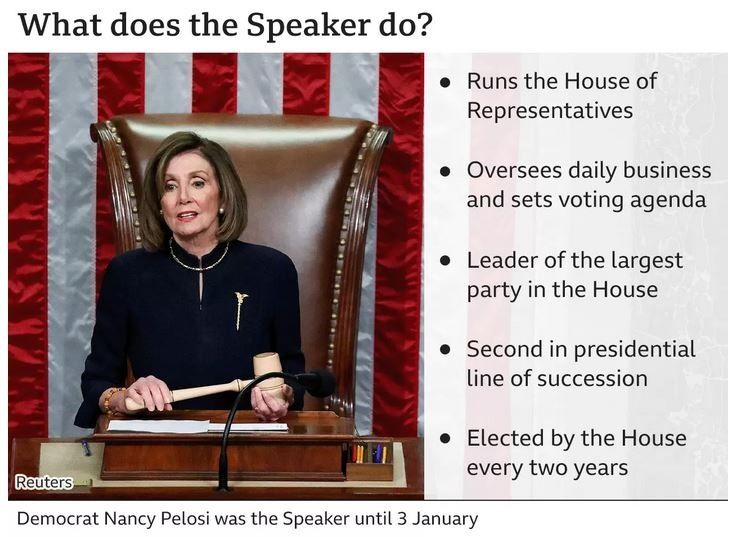
The US Constitution established the role of Speaker of the House, which oversees the lower chamber of Congress. The Speaker is both traditionally and historically a sitting member of the majority party, though this is not a constitutional requirement.

Therefore, in addition to leading the House of Representatives, they are also leader of the majority party in the chamber.

At a practical level, the Speaker sets the House's legislative agenda, controls committee assignments, sets the vote and work calendar, and is responsible for keeping their party members unified behind major initiatives.


Why is the Speaker of the House so important?


Wielded effectively, the position of Speaker of the House is one of the most powerful in Washington. Depending on the partisan makeup of Congress, they can make or break a US president's agenda, stymie opposition, and spearhead their party's biggest legislative initiatives.

A shrewd and effective Speaker will be able to marshal their members behind their party's agenda, and control rebellious lawmakers by doling out incentives or punishments.

Former House Speaker Nancy Pelosi, a Democrat who stepped down from the position when Republicans took control of the House on 3 January 2023, was regarded as one of the most effective modern Speakers of the House.

Though the Democratic caucus she oversaw contained multiple factions, including progressives, moderates, and more conservative-leaning Democrats, she was able to use the tools available to the Speaker to keep a united front when it came to most major votes.

How is a Speaker chosen?


The House of Representatives functions on a two-year cycle, known as a "session." The new Congress began on 3 January 2023 and Republicans will be in the majority.

The very first thing a new session of the House of Representatives must do is vote for a Speaker of the House. Without that person in place, the chamber cannot move on to any other function, including swearing-in members. The chamber must continue to hold votes until a Speaker is elected.

The vote for Speaker requires a candidate to receive the support of a majority of the House - 218 votes. The existing leader of the majority party is usually presumed to be the person to assume the speakership.

For more than a century, the Speaker of the House was decided on the first vote. But that's not the case this week.


Why is the 2023 Speaker's election so unusual?


This year, Mr McCarthy, the Republican leader, seeks to become Speaker of the House now that his party is in the majority. But things haven't gone according to plan.

Over several rounds of ballots, Mr McCarthy failed repeatedly to garner 218 votes, even though his party currently holds 222 seats. A group of rebel Republicans has formed a wall of opposition, refusing to vote for Mr McCarthy in three separate rounds of ballots.

His detractors say he is beholden to special interests and not sufficiently conservative.

The stalemate has left the House of Representatives unable to move on to any other business, including swearing-in members or establishing the chamber's rules for this session. Voting will continue until the House has a Speaker, but it's unclear if Mr McCarthy will win back support. He will either have to prevail, or step aside for another candidate, or the House will not be able to function.


Does the House of Representatives have a minority leader?


For the party in the minority, the head of their caucus is known simply as the "minority leader."

They do not have control over the House's functions like the Speaker does, but instead wield power within their caucus to keep lawmakers unified in opposition to the majority or advance bipartisan efforts.

In the 118th Congress, the Democrats are in the minority. Representative Hakeem Jeffries of New York was selected as the Democratic minority leader.


Watch: Kevin McCarthy's difficult Tuesday - in 90 seconds


Newsletter

Related Articles

Arab Press
0:00
0:00
Close
Japanese Technology Firm Fujitsu Launches Advanced Artificial Intelligence Tool for Corporate Disclosures
South Africa Officially Launches Nationwide Campaign for Highly Contested Local Government Elections
United Kingdom Commits Additional Funding for Unexploded Ordnance Clearance in Laos
Singapore Announces Stringent New Greenhouse Gas Regulations for Commercial Cooling Systems
Cambodia and Thailand Hold High-Level Border Security Talks at United Nations Headquarters
Myanmar Military Government and China Sign Major Agreement to Upgrade Media and Cultural Cooperation
Knife Attack at Swiss Train Station Leaves Three Injured in Suspected Act of Domestic Terrorism
Transnational Extortion Gang Threatens Canadian Police With Army of One Thousand Armed Operatives
Australia Imposes Forty-Two-Day Quarantine on Cruise Ship Passengers Following Deadly Hantavirus Outbreak
International Monetary Fund Unlocks Seven Hundred Million United States Dollars for Sri Lanka Following Economic Reforms
Australia Launches Record One Point Four Billion Dollar Lawsuit Against Chemical Giant 3M Over Contamination
China and Canada Foreign Ministers Meet in Ottawa in Effort to Stabilize Strained Diplomatic Ties
Indonesia Demands Urgent United Nations Security Council Reform Amid Escalating Global Conflicts
Extreme Weather Patterns Trigger Severe Drought in Madagascar and Destructive Flooding in East Africa
Indian State of Karnataka Faces Political Upheaval as Chief Minister Siddaramaiah Abruptly Resigns
Philippines and Japan Reaffirm Defense Ties as Crucial for Indo-Pacific Regional Stability
Norway Joins French Nuclear Deterrence Initiative in Major Shift for European Security Architecture
Global Critical Mineral Alliances Expand as Western Nations Move to Counter Chinese Supply Dominance
United States Imposes Fifty Percent Tariffs on Mexican Steel and Aluminum Ahead of Trade Pact Review
European Union and China Head Toward Major Trade Conflict Over Clean Technology Exports
United States Economic Growth Severely Downgraded to One Point Six Percent as Stagflation Fears Mount
World Health Organization Warns Central African Ebola Epidemic is Outpacing Containment Efforts
United States Treasury Department Conditions Sanctions Relief on Reopening of the Strait of Hormuz
Iranian Air Defenses Intercept and Destroy United States Military Drone Over Bushehr Province
Iranian Armed Forces Launch Ballistic Missiles Toward Unspecified Targets Prompting Regional Condemnation
United Nations Secretary-General Warns Global Order Facing Highest Level of Conflict Since 1945
Israel Issues Sweeping Evacuation Orders in Southern Lebanon Amid Intensified Hezbollah Conflict
Russia Announces Systemic Military Strikes Targeting Ukrainian Defense and Energy Infrastructure
United States and Iranian Negotiators Reach Draft Agreement to Extend Ceasefire and Resume Nuclear Talks
United Nations Security Council Deeply Divided Over United States Capture of Venezuelan President
US and Iran Exchange Direct Military Strikes Amid Fragile Gulf Ceasefire
World Health Organization Warns of Catastrophic Ebola Outbreak in DR Congo
Russia Threatens New Wave of Strikes on Ukrainian Infrastructure and Embassies
Scientists Warn Atlantic Ocean Currents Could Collapse Faster Than Projected
Anthropic Reaches $900 Billion Valuation in Historic AI Funding Round
Washington Imposes Crippling Sanctions on Iranian Maritime Authority
Japan and the Philippines Initiate Strategic Intelligence-Sharing Pact
Microsoft Deploys Autonomous Computer-Using AI Agents to Global Markets
Anthropic Secures $45 Billion Compute Infrastructure Agreement With SpaceX
U.S. Director of National Intelligence Resigns Amid Administration Shakeup
Micron Technology Crosses Trillion-Dollar Valuation Amid Unprecedented Hardware Demand
Canada and Germany Finalize Historic Long-Term LNG Export Agreement
China Expands International Travel Restrictions on Domestic AI Researchers
Japan Approves Sweeping Overhaul of National Intelligence Apparatus
Global Airlines Scramble Logistics as Middle East Airspace Remains Fractured
Japan's Naphtha Imports Plunge 47 Percent Amid Strait of Hormuz Closure
Global Crude Prices Retreat Below $96 as Gulf Tensions Momentarily Ease
Generative AI Outperforms Human Baselines in Landmark Global Creativity Study
NASA Partners With Private Aerospace to Unveil Permanent Lunar Base Architecture
South Korean Equity Markets Surge on Next-Generation Memory Chip Frenzy
×