Arab Press

بالشعب و للشعب
Saturday, Mar 14, 2026

World Cup fans ready to party despite beer ban in Qatar stadiums

World Cup fans ready to party despite beer ban in Qatar stadiums

Sudden ruling by the government to halt all beer sales at stadiums welcomed by some fans as others criticise the last-minute timing of the announcement.

Flag-draped fans have continued to pour into Qatar in advance of the Middle East’s first World Cup, even as organisers banned the sale of beer at stadiums – a last-minute decision that appeared to be largely welcomed by the country’s residents and shrugged off by some visitors.

The Gulf country, home to some three million people, expected another 1.2 million fans to fly in for the tournament that begins on Sunday.

After Friday prayers, the talk of the capital, Doha, became the sudden ruling by the government to halt all beer sales at stadiums.

Many welcomed the decision in the country, where beers, wine and liquor are sold at discrete hotel bars.

Abdullah, an Egyptian resident of Qatar, said he would feel more comfortable attending games knowing that beer would not be available in the stadiums.

“I am happy to hear this news. It’s not like alcohol is not sold in Qatar. People have to respect Muslim culture and get on with the tournament. I’ll feel much better about taking my family to the stadium now. We’re supporting Brazil,” he told Al Jazeera.
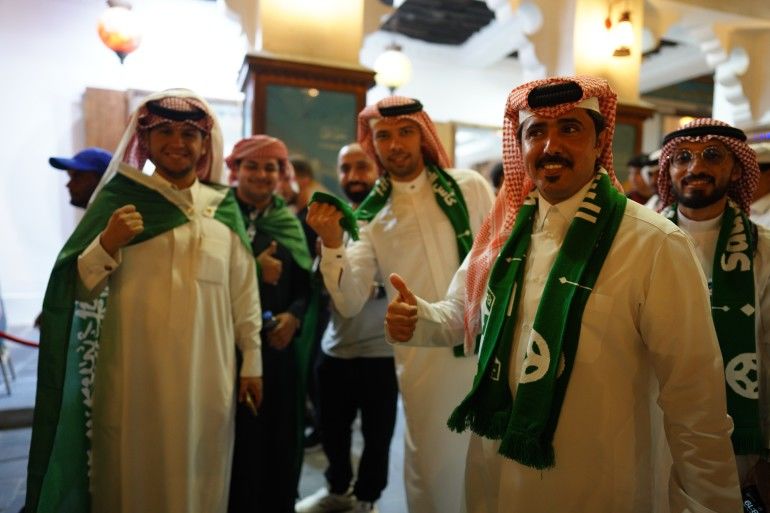

Flag-draped fans continued to pour into Qatar ahead of the World Cup

Federico Ferraz, a fan group organiser from Portugal, said the timing of the decision to ban alcohol at the stadiums was made too late.

“I think FIFA and Qatar left it very late to announce this decision … Fans are going to feel hard done by. They waited till the last minute, for everyone to buy tickets, book hotels and then they announced it. Were they afraid that fans wouldn’t have come here if they had banned alcohol earlier?”

Alcohol will still be served in hotels, luxury suites, private homes and at the FIFA Fan Festival site during the tournament.

In Doha’s Souq Waqif market, 35-year-old Pablo Zambrano of Ecuador shrugged off the news of the beer ban before his country’s opening night match against Qatar on Sunday.

He was staying with his mother, who lives in Qatar, and said the fridge already is stocked with beer, which foreigners can buy legally in selected depots.

“There’s things about the alcohol and the women with the dress codes,” Zambrano told the Associated Press news agency, referring to the country’s customs. “It’s different. But it’s going to be good.”

Zambrano was one of a growing number of fans sightseeing in the traditional market and along the Corniche, a seaside boulevard with views of Doha’s glittering skyline.


Just down the street, 24-year-old vegetable seller Ajmal Pial from Khulna, Bangladesh, took in the breeze with the city’s skyscrapers stretched out behind him across the waters of the Persian Gulf.

But instead of his nation’s green and red disc flag, Pial waved Brazil’s over his head as his friend took pictures of him. He and his friends support Argentina and Brazil, two of the tournament favourites.

For Pial and others, the World Cup represents a pinnacle of work in Qatar and likely a final hurrah before heading home as jobs potentially slow.

Labour conditions in Qatar, like many of the Gulf Arab states, have been criticised for exploiting the low-paid workers who built the former pearling port into a desert metropolis.

Qatar has overhauled its labour laws, but activists have asked for more to be done. There are no guarantees for freedom of speech in the country, but Pial said he felt genuinely happy at the chance to see the tournament.

His friend, 32-year-old Shobuz Sardar, also from Khulna, Bangladesh, said part of that excitement came from the fact that it is only the second time that an Asian country hosts the World Cup, 20 years after Japan and South Korea co-hosted the tournament.

He also said the tournament provided a rare opportunity to celebrate.

“You also know that there are too many people all here for work, for jobs,” Sardar said. “They don’t have any option for having fun. This World Cup makes them have fun.”


Newsletter

Related Articles

Arab Press
0:00
0:00
Close
Strait of Hormuz Crisis Forces Saudi Arabia Into Major Oil Production Shut-In
Saudi Arabia Slashes Oil Output as Strait of Hormuz Crisis Cuts Deep Into Gulf Revenues
Saudi Arabia’s Cultural Scene Presses Ahead as Nation Navigates Regional War
Saudi-Pakistan Defence Pact Faces Real-World Constraints as Iran War Escalates
Saudi Arabia Offers Two Million Barrels of Crude From Red Sea as War Disrupts Gulf Exports
Formula One Faces Tens of Millions in Lost Revenue if Bahrain and Saudi Arabia Races Are Cancelled
Formula One Set to Cancel Bahrain and Saudi Arabian Grands Prix Amid Escalating Middle East War
Saudi Arabia Downs Dozens of Iranian Drones in Major Defensive Operation
Saudi Arabia Cuts Oil Output by About Twenty Percent as Iran War Disrupts Gulf Energy Flows
Formula One Set to Cancel Bahrain and Saudi Arabian Grands Prix Amid Escalating Iran War
Asian Energy Security Tested as Strait of Hormuz Disruption Threatens Oil Supplies
Iran Sets Three Conditions for Ending Regional War as Diplomatic Efforts Intensify
Saudi Arabia Launches Royal Institute of Anthropology to Examine Social Transformation
Pakistan’s Prime Minister Shehbaz Sharif Arrives in Saudi Arabia for High-Level Talks
Saudi Aramco Turns to Ukrainian Drone Interceptors to Shield Oil Infrastructure from Iranian Threats
UK Foreign Secretary Travels to Saudi Arabia to Reinforce Support for Regional Allies
Rising Iran Conflict Casts Shadow Over Saudi Arabia’s $38 Billion Gaming Industry Ambitions
Iran Launches Missile and Drone Strikes Across Gulf as Oil Prices Surge Past $100
Saudi Air Defences Destroy Three Drones Targeting Strategic Shaybah Oil Field
Debate Grows Over Saudi Arabia’s Role in Sudan War Amid US Alliance Questions
Pakistan’s Prime Minister Travels to Saudi Arabia After Discussions With Iranian Leadership
Two Strategic Pipelines Allow Saudi Arabia and the UAE to Bypass the Strait of Hormuz
US Deploys Bunker-Buster Bombs to UK Airbase as Iran Conflict Intensifies
Iran warns of $200 oil as forces target merchant ships in Gulf
Japan to Release 45 Days of Oil Reserves Amid Iran Conflict
Three Commercial Vessels Attacked Near Strait of Hormuz, Thai-Flagged Ship Damaged and Crew Evacuated
Saudi Red Sea Oil Exports Set for Record in March as Kingdom Reroutes Crude Amid Hormuz Crisis
Saudi Arabia Seeks Belgian Military Support After Iranian Missile Attacks
Saudi Arabia Welcomes US Decision to Designate Sudan’s Muslim Brotherhood as Terrorist Organisation
Saudi Aramco Plans Dual Gulf and Red Sea Export Routes as Iran Crisis Disrupts Oil Shipments
Saudi Cabinet Condemns Iranian Attacks and Reaffirms Kingdom’s Right to Defend Its Sovereignty
Ukraine Deploys Counter-Drone Teams to Gulf States as Iranian Drone Threat Expands
Bahrain Grand Prix Faces Uncertainty as Saudi Arabia Works to Keep Formula One Race on Track
Saudi Arabia Faces New Strategic Dilemma in Yemen as Regional War Reshapes Calculations
OPEC Confirms Saudi-Led Oil Output Increase as Iran War Disrupts Global Energy Markets
Pakistan Pledges Rapid Support for Saudi Arabia Amid Escalating Middle East Tensions
Global Energy Agency Announces Record Release of 400 Million Barrels to Stabilize Oil Markets Amid Hormuz Disruption
Aramco Warns Global Oil Market Faces ‘Catastrophic’ Shock if Strait of Hormuz Remains Closed
Iran Launches Drone and Missile Attacks Across Gulf Targets Including Saudi Arabia, Kuwait and Bahrain
Saudi Arabia Elevates Fahad Al-Saif as Vision 2030 Enters Crucial Implementation Phase
Saudi Aramco Expands Routes to Move Oil Without Reliance on the Strait of Hormuz
Saudi Arabia and Pakistan Reaffirm Mutual Defense Cooperation Following Iran Strike
Saudi Arabia Plans Major Ukrainian Arms Deal to Counter Iranian Drone Threat
Pentagon Signals Intensification of U.S. Air Campaign as Iran Conflict Escalates
U.S. Senator Lindsey Graham Raises Prospect of Mutual Defense Pact With Saudi Arabia Amid Iran Conflict
Why Saudi Arabia Is Unlikely to Have Wanted U.S. Airstrikes on Iran
Saudi Arabia’s Red Sea Oil Exports Set to Reach Record High as Gulf Routes Face Disruption
Saudi Arabia Pushes East–West Oil Pipeline Toward Full Capacity as Hormuz Crisis Disrupts Global Energy Flows
Oil Prices Retreat From Peak as G7 Weighs Release of Strategic Reserves
×