

As US watches on, China-Saudi relations grow in importance
Chinese President Xi Jinping is in Riyadh for a three-day trip, underscoring the constantly growing importance of Sino-Saudi relations, and a clear message from Saudi Arabia that it will not take diktats from the United States.
Xi’s first trip to Saudi Arabia in six years gives Saudi Crown Prince and Prime Minister Mohammed bin Salman (MBS) a greater opportunity to assert his influence on the international stage as an increasingly important figure in global affairs.
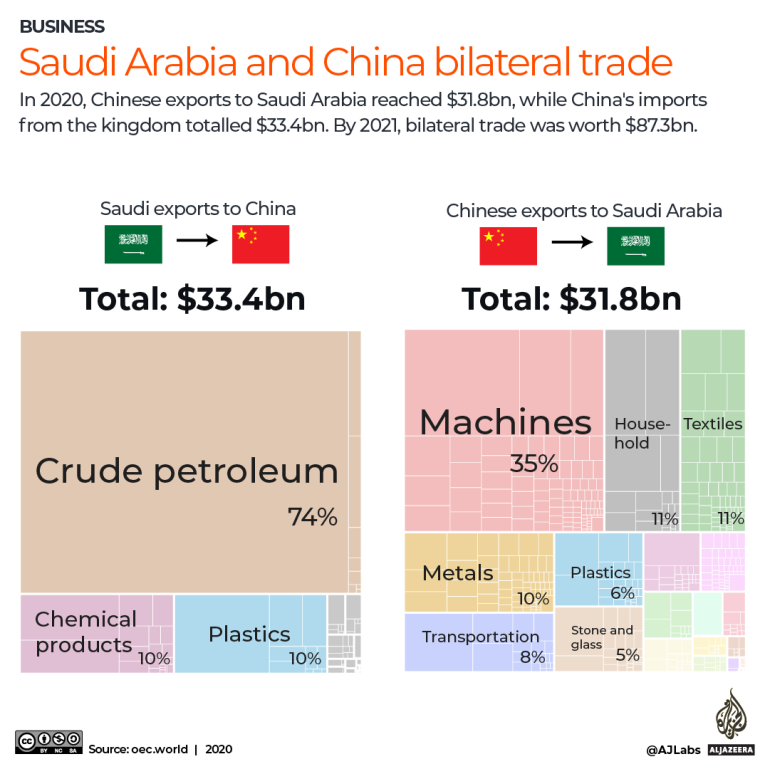
This week’s meetings will mostly focus on the economic dimensions of the Sino-Saudi partnership. According to the Saudi Press Agency (SPA), the kingdom and China will sign agreements worth $29.6bn. Such agreements will add to trade, business, and investment relations between the two countries that have greatly deepened in recent years.
China is Saudi Arabia’s top crude oil market, accounting for more than 25 percent of all Saudi crude oil exports in 2021. These export earnings help the Saudi government maintain its “social bargain”, explained John Calabrese, director of the Middle East-Asia Project at the Middle East Institute, in an interview with Al Jazeera.
Additionally, these earnings are extremely important for Saudi Vision 2030 — Saudi Arabia’s grandiose economic diversification agenda, including with respect to the futuristic city of Neom, which is currently being built.
If the smart city proves successful, Saudi Arabia can expect its cooperation with the Chinese to further expand in many ways, particularly mindful of the potential for many Chinese tourists to visit Saudi resorts on the Red Sea.
From Beijing’s perspective, Saudi Arabia is an extremely important source of energy that greatly matters to the future of China’s economic growth.
“The Chinese need to know that Riyadh can remain a reliable producer,” Dave DesRoches, an assistant professor at the National Defense University in Washington, DC, told Al Jazeera. “Particularly now when it looks as if Iran, which Beijing has been relying on for lots of its oil … might be ramping down its ability to export as people become more concerned about Iranian export of weapons to Russia.”
US concerns
There are some signs that the bilateral partnership is expanding and taking on greater security dimensions.
“The dominant ties between China and Saudi Arabia are predicated on commercial activity. However, many global relationships and alliances, bilaterally and multilaterally, began this way and then expanded to other realms, including in the traditional defence areas,” Jonathan Panikoff, the director of the Scowcroft Middle East Security Initiative at the Atlantic Council’s Middle East Program, told Al Jazeera.
A year ago, CNN reported that Beijing supported Saudi Arabia’s indigenous ballistic missile production efforts, which is a case in point. Also, in certain niche areas, such as armed drones, the Chinese have made sales to Saudi Arabia’s weapons development, filling gaps that the US has chosen not to fill for Riyadh.
Washington has grave concerns about the defence and security aspects of the Sino-Saudi relationship. “The challenge for the US, vis-à-vis the China-Saudi relationship, is that Beijing is simply easier to work with from Riyadh’s perspective,” said Panikoff. “It views China as politically consistent, refrains from lecturing Riyadh on issues such as human rights and doesn’t have cumbersome end-user restrictions on military hardware.”
Nonetheless, China is nowhere close to replacing the US as Saudi Arabia’s defence guarantor. There are no indications that Beijing could or would attempt to do so in the foreseeable future.
“Since the Saudi military relies so heavily on US assistance, training, and spare parts, it would be self-defeating for the Saudis to look to China to replace the United States in this field,” explained Gordon Gray, former US ambassador to Tunisia, in an interview with Al Jazeera.
“China is not really a security partner for the Middle East,” said DesRoches. “In spite of the Chinese expanding their armed forces and the establishment of a base in Djibouti — and I would argue covert bases in [the UAE’s] Jebel Ali, Pakistan, and Sri Lanka — they really don’t have the ability to project force in a decisive and timely manner to defend the integrity of the Saudi state in the way that the US has already done in Operation Desert Storm.”
As Gray put it, “US military assets in the Gulf would help defend Saudi Arabia if its nightmare scenario — a conventional attack from Iran — comes to pass; the first Saudi phone call would be to CENTCOM, not to Beijing.”
At this juncture, there is no reason to expect the Chinese to soon establish any military base on Saudi soil. Yet, that could change many years into the future, according to Panikoff, who posited that “we shouldn’t be as dismissive of that possibility in the coming decades as many seem to be”.
For now, at least, the depth of the Sino-Saudi security partnership should not be overstated. Riyadh, however, appears mostly intent on presenting its defence cooperation with Beijing as much more extensive than it is in reality. This is largely as an effort on Riyadh’s part to gain greater leverage with officials in Washington and remind the Americans that the kingdom has other powerful friends that it can turn to in an increasingly multipolar world.
Reaction from Team Biden
The foreign policy establishment in Washington is not content to see the Saudis so lavishly welcome the Chinese leader to Riyadh. Given the relatively low-key reception that Biden received in Jeddah five months ago, the difference between the American and Chinese presidents’ visits is not lost on US officials.
Nonetheless, the Biden administration reacting too negatively or publicly to Saudi Arabia’s decision to host Xi could backfire against US interests.
The White House “would be wise to avoid drawing any more public attention to the visit than it has or will claim”, said Calabrese. “Hyping the ‘China threat’ and/or publicly pressuring Saudi Arabia or any other Gulf country could only prove counterproductive. If there are concrete outcomes to the visit … a more selective approach through quiet diplomacy is likely to be more effective than a blunt-edged public admonition.”