

At Home, Apparatus’s Gabriel Hendifar Hones His Audacious Design Vision
High above a cobblestone block in lower Manhattan looms a Herzog & de Meuron residential building with a twisting cast-aluminum gate and a facade of mirror-polished stainless steel, glass, and pre-patinated copper in brilliant green. The grandeur (and shine) of this material palette gives the 11-story 40 Bond the feel of an urban fairy-tale palace.
That would make Gabriel Hendifar, artistic director and CEO of the New York–based lighting and furniture design studio Apparatus, a rather buff, burly (and bald!) Rapunzel, peering down from a floor-to-ceiling window in his apartment. Hendifar, who has claimed an elevated perch not only in this building but also, increasingly, on the international design scene, moved into the apartment in 2019 with his former partner in life and work, Jeremy Anderson. After the couple split at the end of 2020, Anderson left both their shared home and Apparatus to focus on his burgeoning ceramics practice; since then, Hendifar has fully taken the reins at the company. He also put the finishing touches on the interiors of his apartment, turning it into both a design laboratory and a place to unwind; relaxation is as central to his creative practice as ideation.
After the split with Anderson, Hendifar retreated inward. His home played a central role in this period of contemplation and experimentation. “After 10 wonderful years of living with someone, you start to understand what it means to be constantly negotiating space,” he says. “What I’ve allowed myself to do in this apartment is to let my brain go where it wants to go, to guard my time alone, and indulge in whatever feels inspiring.”
At the opposite end is his bedroom, a seductive den with plush bedding and a mirrored wall facing the bed. Tucked behind an almost invisible door is the bathroom, where a vintage marble bust overlooks a deep tub. These two spaces bookend the heart of the home, a living area with a curved sofa and an L-shaped tête-à-tête that lends itself to conversation. Plush leopard-print carpeting reaches up and pulls you wholly into it. (Hendifar admits he spends many hours relaxing on the rug.) He is fond of creating a fully immersive sensory experience: At any given moment there are scents wafting, jazz playing, and candles casting shadows.
Hendifar’s comprehensive approach to design is all-consuming. There is not a surface here he hasn’t embellished, from the hand-glazed finish he applied to Pawson’s panels in the living room to the languorous bronzed-mirror cladding on walls in the dining and sleeping areas. His eye never seems to stop, crafting spaces that are quietly cosmopolitan and filled with rich hues and opulent materials.
Hendifar’s personal history is the font from which this creativity flows. His parents, who fled Iran in 1979 and settled in Los Angeles in the early 1980s, were both musical: When he was a child, he loved to watch his father perform on the Persian drums while his mother sang and played the piano. He inherited that sense of showmanship. “My currency is my ability to perform and create,” he believes.
It’s fitting, then, that his first foray into design was as a teenager, when he concocted the most expensive theater set in the history of his high school in Pacific Palisades. The production he dreamed up for Guys and Dolls was so striking, it got him his first interior design client—a classmate’s mother. He was 17.
Now 40, he is just as theatrical. Each Apparatus collection is treated as an all-encompassing production with titles that reference the structure of literature and drama. In 2018, for instance, the Act III collection of lighting and furniture was introduced with a short film, directed by filmmaker and photographer Matthew Placek, in which a boy perches high above a desert landscape. Hendifar’s mother sings a Persian song in the background. “There are always musical and film references that provide the mood,” he says. “These are the mechanics of creating emotion.”
Hendifar’s aesthetic is thoughtful and sumptuous, as influenced by the simple luxury of Pierre Cardin and Halston as it is by the modernist utilitarianism of the Wiener Werkstätte. In many ways, the design of his apartment represents a rediscovery of himself that embraces every version of who he was, who he is, and who he hopes to become. And so it is, too, with the objects he creates for others. “Through Apparatus I’m expressing a need for human connection,” Hendifar says. “The creative act is one of hope, ultimately.”
Get a Closer Look at Gabriel Hendifar’s Apartment
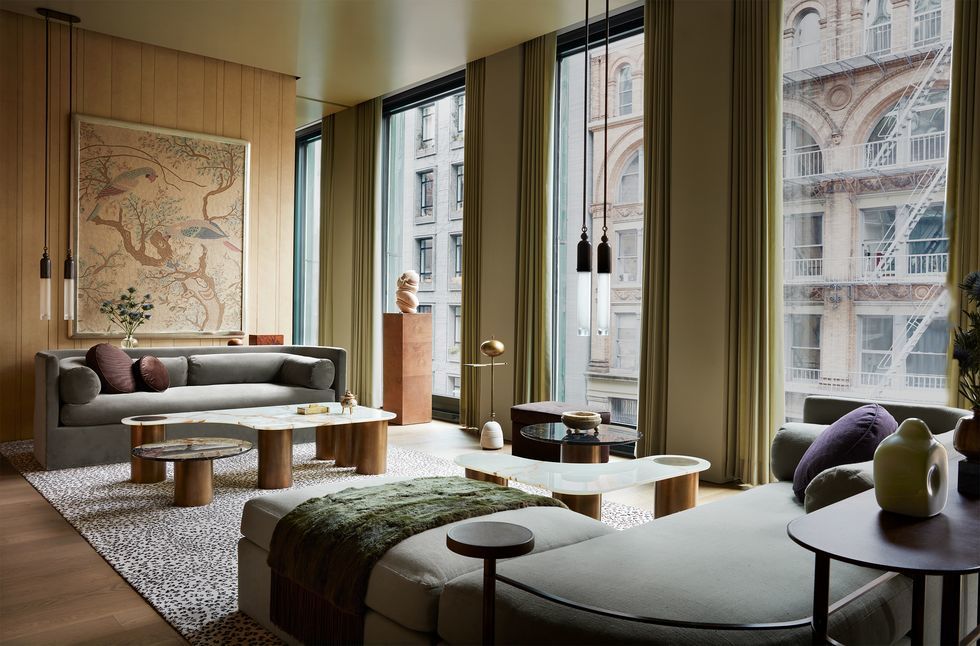 Living room : The downtown New York
apartment Gabriel Hendifar designed for himself in an interior created
by the architect John Pawson. The sofas, ottoman, tables, pendants, and
throw are by Apparatus; the rug by Stark; the curtains are in a Decortex
velvet; and the antique Japanese embroidered artwork is from Sutter
Antiques.
Living room : The downtown New York
apartment Gabriel Hendifar designed for himself in an interior created
by the architect John Pawson. The sofas, ottoman, tables, pendants, and
throw are by Apparatus; the rug by Stark; the curtains are in a Decortex
velvet; and the antique Japanese embroidered artwork is from Sutter
Antiques.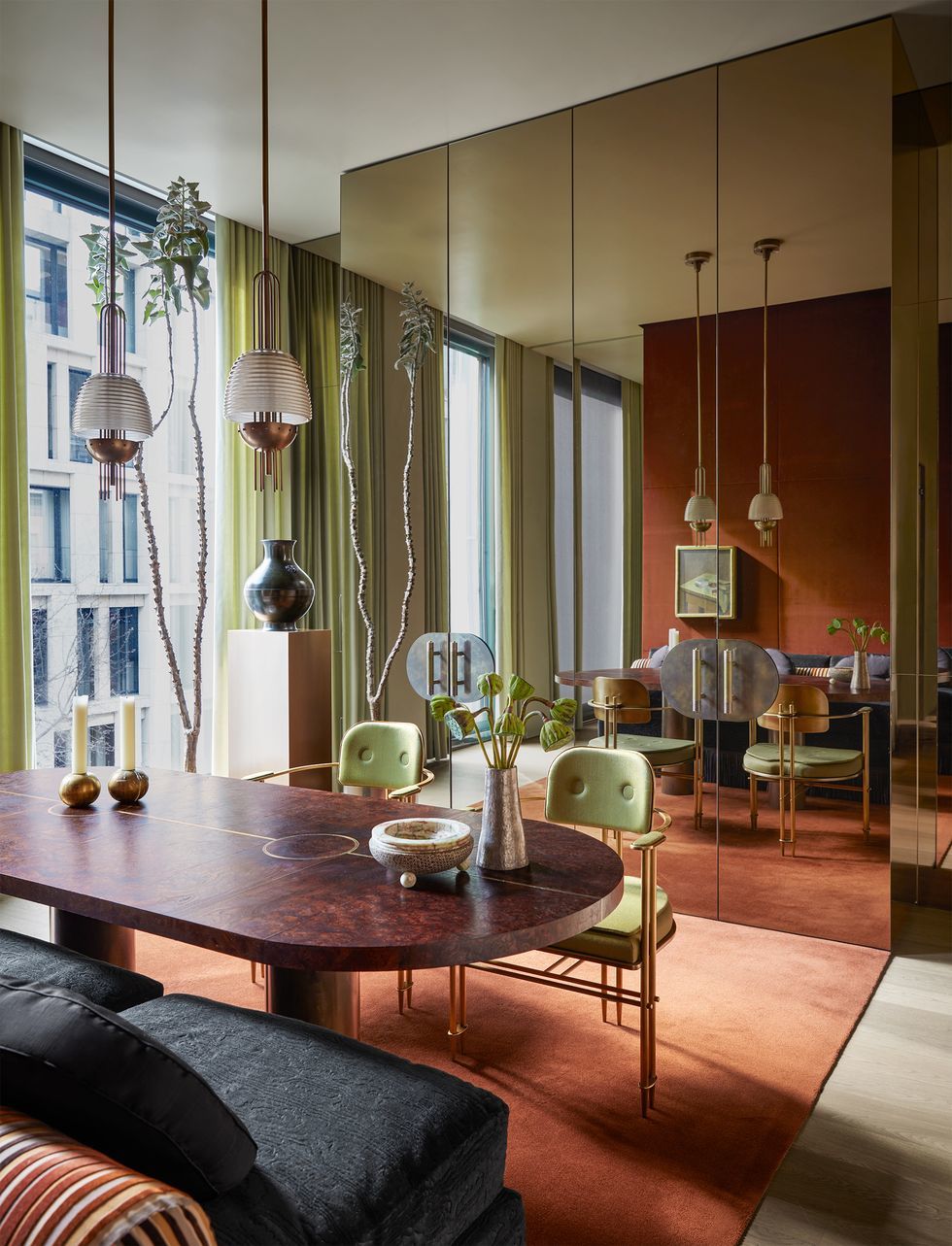 Dining room : In the dining room, a
bronze-mirrored wall reflects a panel sheathed in spice-colored velvet.
The table, chairs, banquette, and pendants are by Apparatus, and the
Chinese bronze vase is from Naga Antiques.
Dining room : In the dining room, a
bronze-mirrored wall reflects a panel sheathed in spice-colored velvet.
The table, chairs, banquette, and pendants are by Apparatus, and the
Chinese bronze vase is from Naga Antiques.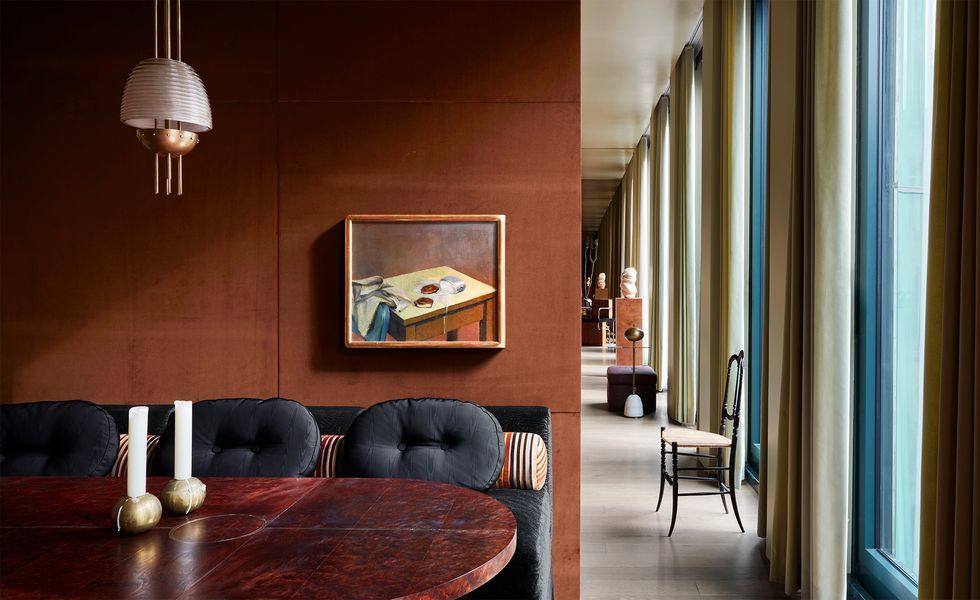 View from dining room : Panels carve
out distinct “rooms” in the loftlike apartment. On the table, the brass
candlesticks are from the 1970s, and the Chiavari chair (right) is from
the 1920s. The painting is by Larry Collins.
View from dining room : Panels carve
out distinct “rooms” in the loftlike apartment. On the table, the brass
candlesticks are from the 1970s, and the Chiavari chair (right) is from
the 1920s. The painting is by Larry Collins.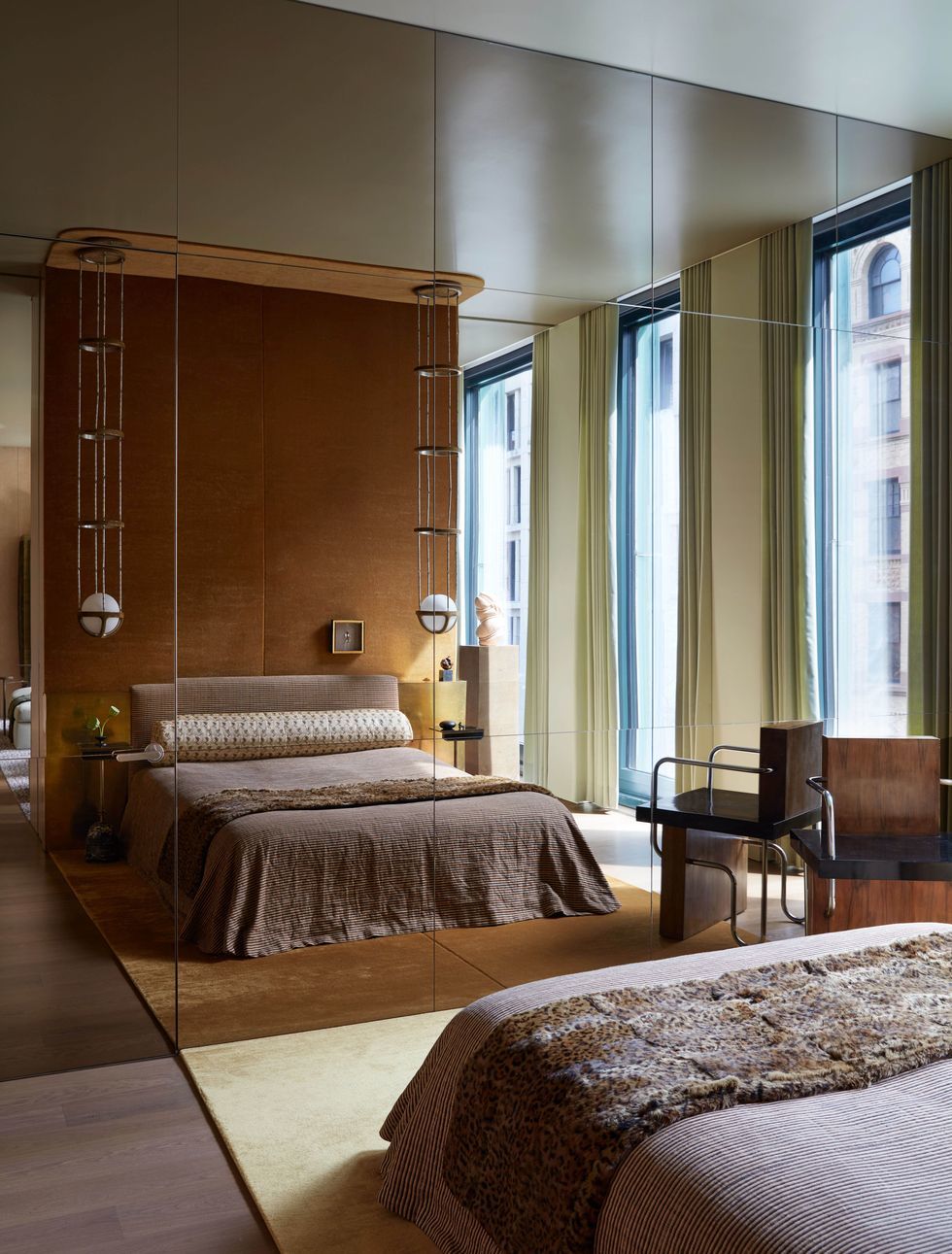 Bedroom : A custom brass bed is topped with a bedcover and bolster in Zak+Fox fabrics. The pendant and nightstand are by Apparatus.
 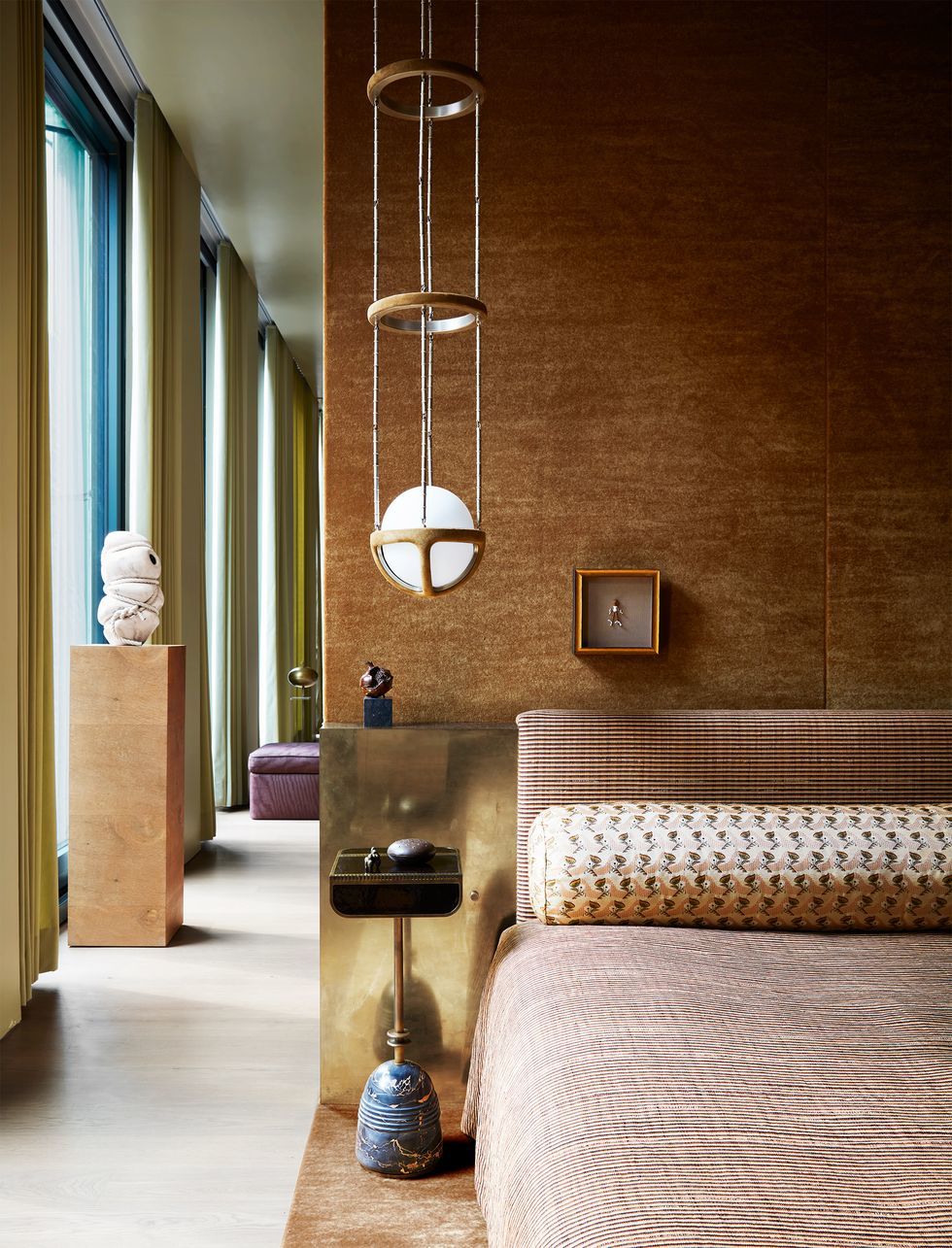 Bedroom : A custom brass bed is
topped with a bedcover and bolster in Zak+Fox fabrics. The pendant and
nightstand are by Apparatus. The artwork on the pedestal is by Peter
Brooke-Ball, and the piece over the bed is by Liam Pitts.
Bedroom : A custom brass bed is
topped with a bedcover and bolster in Zak+Fox fabrics. The pendant and
nightstand are by Apparatus. The artwork on the pedestal is by Peter
Brooke-Ball, and the piece over the bed is by Liam Pitts.