

Europe on collision course with US over Venezuela elections
The vote comes after three particularly chaotic years in the country, where President Nicolas Maduro has managed to stay in power despite a collapsing economy, a contested election result in 2018 and US-backed efforts to remove him from power through coordinated Western sanctions -- which involved the EU.
However, earlier this year, the bloc dropped its recognition of Maduro's opponent, Juan Guaidó, as the legitimate president, placing it at odds with the US who still recognize Guaidó.
In some corners of the US, this has caused concern that by sending a delegation to the country for the first time since 2006, the EU will lend legitimacy to a process that will ultimately be won by Maduro, a strongman leader often described as a dictator.
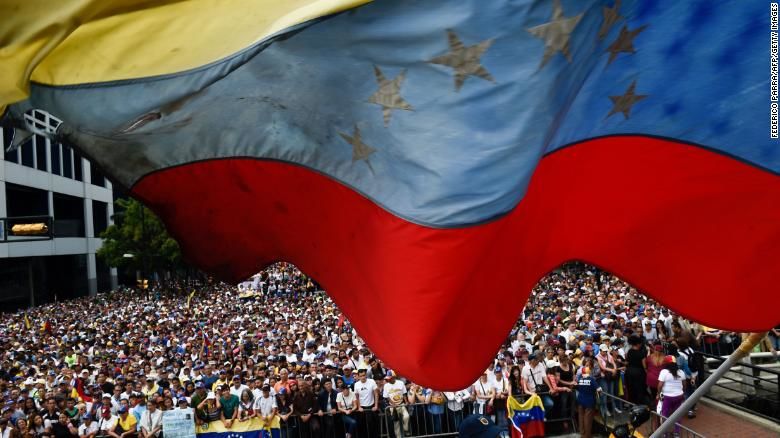 A Venezuelan national flag flutters during a mass opposition rally
against President Nicolas Maduro in which Venezuela's National Assembly
head Juan Guaido (out of frame) declared himself the country's "acting
president", on the anniversary of a 1958 uprising that overthrew a
military dictatorship, in Caracas on January 23, 2019.
A Venezuelan national flag flutters during a mass opposition rally
against President Nicolas Maduro in which Venezuela's National Assembly
head Juan Guaido (out of frame) declared himself the country's "acting
president", on the anniversary of a 1958 uprising that overthrew a
military dictatorship, in Caracas on January 23, 2019.
Andrés Oppenheimer wrote in the Miami Herald last week that for the past 16 years, "the EU had refused to send electoral observation missions to Venezuela, mainly because it considered, rightly, that elections there were a sham."
He concludes that on election night, "the EU mission will probably announce that there were no major irregularities, and an ecstatic Maduro will claim that he won a clean election. And several months later, when the EU mission puts out its final report looking at the entire election process and concluding that it wasn't a fair race, the election will be long forgotten."
Diplomatic sources have confirmed to CNN that this is not just the fear of a columnist, but there are very real concerns that Maduro will, whatever the EU's intentions, be able to spin this to legitimize his grip on power.
Why would the EU be willing to do this and risk the ire of its most important ally?
First, Brussels sources refute the idea that this will give the elections a de-facto EU stamp of approval. They say that their agreement rests on the fact that the Venezuelan National Electoral Council invited a delegation. Brussels then sent a mission to see if elections could be monitored "along the 2005 UN guidelines," an EU official said, pointing out that the bloc had not recognized elections held in the country last year. "We go there not to legitimize the regime, but to see what is happening."

Second, the official says that "there is no difference in how we monitor Iraq, Peru, Pakistan or Mali. This is one of the most recognized election monitors in the world and if our partners ask us, we will explain our logic. We don't have to justify ourselves to anyone."
It is certainly true that electoral monitoring groups frequently operate in and report on polls that are far from free or fair. For example, in 2017, Organization for Security and Cooperation in Europe Office for Democratic Institutions and Human Rights, a highly respected organization, delivered a scathing report on the Turkish independence referendum.
However, critics might argue that the context here is different. Turkey is a NATO ally whose democratic standards had been sliding for years. This was a documentation of that decline -- which enraged President Recep Tayyip Erdogan.
What's different is Venezuela's comparative isolation from the West. It is arguable that even if the EU returns a highly critical report, its mere engagement in the process could be used as propaganda by Maduro.
A State Department spokesperson said to CNN that the US "considers free and fair local, National Assembly, and presidential elections essential for Venezuelans to reach a peaceful and democratic solution to the crises their country faces. In statements made jointly with the United States on June 25 and August 14, the European Union and Canada made clear they share our views ... For further questions about the EU's planned election observation mission, we refer you to EU officials."
These sort of tensions between the Brussels and Washington are to some extent inevitable as the EU tries to grow its influence as a distinct global power and defender of Western values, rather than an extension of US influence.
However, the bloc must remember that each time it diverges from American policy -- be it on China, Russia or Venezuela -- it will be noticed by the leadership of the nation that still towers above all else on the world stage.