Arab Press

بالشعب و للشعب
Tuesday, Mar 17, 2026

Europe's space sector seeks to boost commercialisation

Europe's space sector seeks to boost commercialisation

As Europe's space leaders meet virtually in Brussels at the new European Space Forum, Euronews explores how the sector is making a big push to become more business-minded.

“Supporting startups is a huge priority” for the European Space Agency (ESA), according to its Director General Josef Aschbacher, as the agency seeks to compete in an increasingly crowded and dynamic sector where Europe has been accused of lagging behind.

Speaking to Euronews, Aschbacher explained how ESA has created a new directorate for commercialisation, industrial policy and procurement, headed by space strategy specialist Géraldine Naja.

The goal is to make Europe fertile ground for what is termed 'New Space' operators, a catch-all phrase for companies taking advantage of existing and emerging space technologies to build wholly commercial businesses.

For Aschbacher, there is no time to lose, as he sees the commercial space sector in the United States taking the lead in launch services, but also areas which are traditionally strong for Europe, such as Earth observation.

He says a priority for his tenure is to “encourage people to take more risks, be faster in implementing projects, and to help them both through faster action on the side of ESA”.

Although the move is welcomed by the space sector, Olivier Lemaitre, Secretary General of industry body ASD-Eurospace, warns that we're not going to see a 'European SpaceX' anytime soon.

Space budgets in Europe are fragmented across countries and six times smaller than in the US, he tells Euronews. "Some public powers forget this reality, thinking we can do as well as the USA with six times less money," he says.

The pro-business messages from ESA come as the European Commission's own space operation, called the European Union Agency for the Space Programme, begins to spread its wings.

The recently-created EUSPA is tasked with maximising the benefits of the European Commission-funded space projects such as the Galileo navigation system, the Copernicus earth observation network, and the EGNOS positioning and navigation tool.

These two organisations, ESA, and EUSPA, both say they are focused on encouraging a 'globally competitive' European space sector. Which begs the question - do we actually really need both of them in parallel?

"It's a good question," replies Aschbacher, "But today they are working certainly in a very complex and complementary manner". He stresses that the role of ESA is to develop the technical side of new satellite technologies and launchers, while the European Commission has the political clout to get big projects like Galileo off the ground.

What remains an open question however, is whether Europe, with ESA and EUSPA, can create the kind of innovative and flexible environment that can foster the emergence of major new commercial players.

What's the future for Coperncius?


Another key topic of debate at the European Space Forum will be the future of Copernicus. Established in 2014, 'Copernicus provides Europe with a continuous, independent and reliable access to satellite Earth Observation data and information.

Simonetta Cheli, soon to become director of Earth Observation at ESA, sings the praises of this constellation of satellites, telling Euronews: "We have eight satellites working flawlessly, we have 400,000 users registered and 250 terabytes of data are downloaded every day."

However she admits that the programme is facing funding difficulties as a result of “high level political considerations” related to Brexit (the UK is an active ESA member, but no longer in the EU), with a €750 million shortfall in funding that she is confident will be overcome soon. Lemaitre from ASD-Eurospace also believes that the financing issue can be overcome. "We need to see goodwill on both sides and if we give each other enough time then it could move forwards," he says.
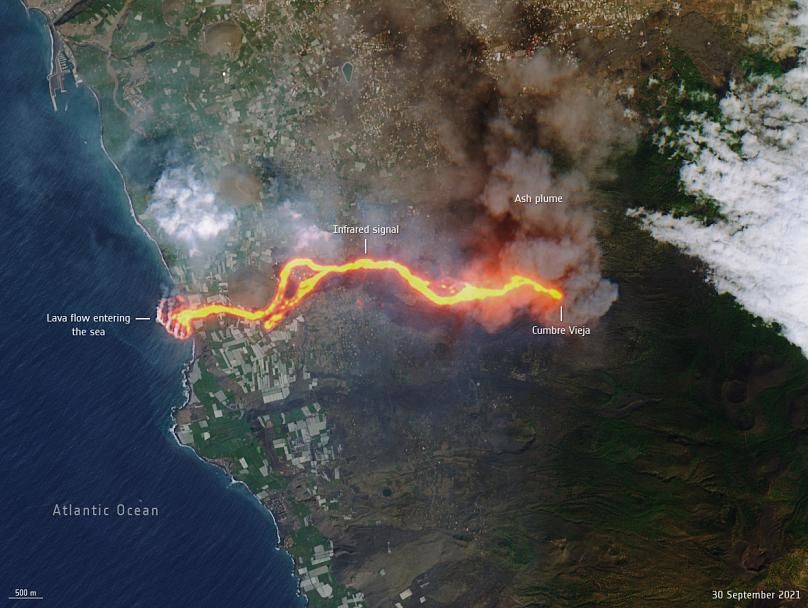
A Copernicus image shows lava flowing from a volcano on La Palma in September this year


Looking ahead, Cheli explains that the Copernicus programme will be focused on issues such as Arctic monitoring and CO2 emissions observations, both crucial in a post-COP26 political environment.

However private companies are competing with Copernicus in high-resolution Earth imaging, and Cheli says that current thinking inside ESA suggests that finding ways to integrate these commercial initiatives into the Copernicus systems in a mutually-beneficial way is one of the favoured ways forward.

Lemaitre again flags a tendency to over-spin the business potential of Copernicus, which he says was initially designed to offer high quality data to public bodies and scientific institutions.

He believes there is strong economic potential in the Earth observation field, but that barriers exist to access the data and there is a need for powerful AI and high performance computing technologies to take best advantage of the information gathered by the Copernicus Sentinel satellite fleet.

Newsletter

Related Articles

Arab Press
0:00
0:00
Close
Saudi Arabia Targets South African Professionals in New Recruitment Drive Amid Regional Uncertainty
Formula One Faces Major Financial Hit as Bahrain and Saudi Arabian Grands Prix Cancelled Amid Middle East Conflict
U.S. and Saudi Firms Launch Local Production of Attritable Drone Systems in Saudi Arabia
Saudi Arabia and UAE Warn Rising Gulf Tensions Could Endanger Regional Security
Saudi Arabia Rejects Claims It Encouraged Prolonged War With Iran
Saudi Arabia to Host World’s Largest Single-Cell Protein Plant as Food Security Push Accelerates
Saudi Crown Prince Urges Trump to Continue Military Pressure on Iran
Iran Intensifies Drone Campaign Against Saudi Arabia as Gulf Conflict Escalates
When Is Eid al-Fitr 2026? Saudi Arabia Awaits Moon Sighting to Confirm End of Ramadan
Iranian Missile Strike Damages Five U.S. Refueling Aircraft at Saudi Air Base
Washington State Pilot Among Six U.S. Airmen Killed in Military Aircraft Crash Over Iraq
Severe Storm Threat Looms Over Washington as Tornado Risk and Damaging Winds Target Mid-Atlantic
Trump Supports FCC Warning to Broadcasters Over Iran War Reporting
Saudi Stocks Edge Lower as Tadawul All Share Index Slips Slightly at Market Close
Iranian Missile and Drone Strike Targets Saudi Arabia’s Prince Sultan Air Base Hosting US Aircraft
Saudi Air Defenses Intercept Drone Over Eastern Province as Iranian Strike Campaign Intensifies
Middle East War Reshapes Gulf Economies as Saudi Arabia and Oman Gain Strategic Leverage While UAE Faces Economic Shock
Iranian Ambassador in Riyadh Blames ‘Enemies’ for Attacks Across the Gulf
Israeli Envoy Ron Dermer Reportedly Visits Saudi Arabia for Discussions on Potential Lebanon Talks
Formula One Cancels Bahrain and Saudi Arabian Grands Prix Scheduled for April
Iran’s Ambassador in Riyadh Rejects Claims Tehran Targeted Saudi Oil Facilities
Saudi Arabia Declares 2026 ‘Year of Artificial Intelligence’ in Major Push for Data-Driven Economy
Saudi Arabia’s 2018 Budget Signals Strong Push for Non-Oil Economic Growth
Pakistan Envoy in Riyadh Says Regional Diplomacy Intensifying to Prevent Wider Middle East War
Saudi Arabia Intercepts Dozens of Drones as Regional Strikes Kill Two in Oman
Saudi Arabia Redirects Oil Exports to Red Sea Ports as Strait of Hormuz Tensions Escalate
Saudi Arabia Intercepts Missile and Drone Barrage as Regional Conflict Intensifies
Iran Expands Drone and Missile Campaign Across Gulf as Conflict With US and Israel Intensifies
Muslims Worldwide Await Saudi Moon Sighting to Confirm Eid al-Fitr 2026 Date
F1 Calendar Faces Major Disruption as Middle East Conflict Threatens Bahrain and Saudi Races
Trump Says Most US Aircraft Hit in Saudi Base Attack Suffered Minimal Damage
Strait of Hormuz Crisis Forces Saudi Arabia Into Major Oil Production Shut-In
Saudi Arabia Slashes Oil Output as Strait of Hormuz Crisis Cuts Deep Into Gulf Revenues
Saudi Arabia’s Cultural Scene Presses Ahead as Nation Navigates Regional War
Saudi-Pakistan Defence Pact Faces Real-World Constraints as Iran War Escalates
Saudi Arabia Offers Two Million Barrels of Crude From Red Sea as War Disrupts Gulf Exports
Formula One Faces Tens of Millions in Lost Revenue if Bahrain and Saudi Arabia Races Are Cancelled
Formula One Set to Cancel Bahrain and Saudi Arabian Grands Prix Amid Escalating Middle East War
Saudi Arabia Downs Dozens of Iranian Drones in Major Defensive Operation
Saudi Arabia Cuts Oil Output by About Twenty Percent as Iran War Disrupts Gulf Energy Flows
Formula One Set to Cancel Bahrain and Saudi Arabian Grands Prix Amid Escalating Iran War
Asian Energy Security Tested as Strait of Hormuz Disruption Threatens Oil Supplies
Iran Sets Three Conditions for Ending Regional War as Diplomatic Efforts Intensify
Saudi Arabia Launches Royal Institute of Anthropology to Examine Social Transformation
Pakistan’s Prime Minister Shehbaz Sharif Arrives in Saudi Arabia for High-Level Talks
×