

Federal Reserve announces biggest interest rate hike since 1994
With soaring inflation and the shadow of recession hanging over the United States, the Federal Reserve announced a 0.75 percentage-point increase in interest rates on Wednesday – the largest hike since 1994.
Until this week the Fed had been expected to announce a smaller increase. At a press conference, the Fed chair, Jerome Powell, said the central bank decided that a larger hike was needed after recent economic news, including last week’s announcement that inflation had risen to a 40-year high.
He made clear that a similarly outsized rate rise should be expected at its next meeting in July unless price rises softened. “We at the Fed understand the hardship inflation is causing,” he said. “Inflation can’t go down until it flattens out. That’s what we’re looking to see.”
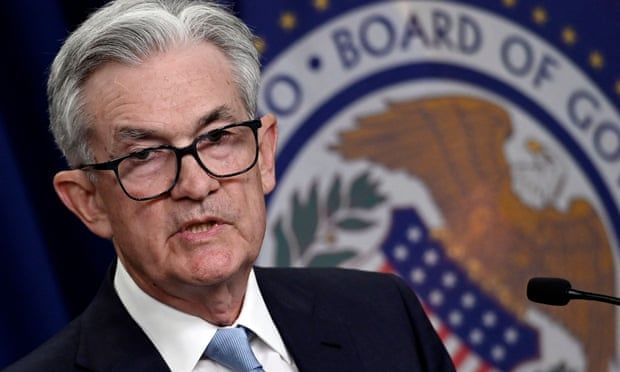 US Federal Reserve chair Jerome Powell talks to the media after the bank raised interest rates by 0.75%.
The hike will increase the Fed’s benchmark federal-funds rate to a range between 1.5% and 1.75% and officials said they expected rates to rise to at least 3% this year.
Powell acknowledged that the Fed’s attempt to cool spending is likely to lead to job losses. The Fed expects unemployment to rise to 4.1% from the current rate of 3.6% as it attempts to bring inflation back down to its target rate of 2%.
“We never seek to put people out of work,” Powell said. But, he added: “You really cannot have the kind of labor market we want without price stability.”
The rate rise came after more bad news on inflation late last week sent US stock markets into a tailspin, presenting the Fed and the Biden administration with an escalating crisis amid fears that runaway inflation has now spread through the economy.
The Fed cut rates to near zero at the start of the coronavirus pandemic, as the US and global economies effectively shut down. It increased rates for the first time since 2018 in March this year, but the increase did nothing to tamp down rising prices.
Powell initially described rising prices as “transitory”, but has changed his view and says the Fed intends to aggressively increase rates in order to bring prices back under control.
There are already signs that consumers are cutting back in the face of rising inflation. Retail spending fell for the first time this year in May, the commerce department said on Wednesday. Home sales have fallen for three consecutive months and consumer confidence hit a record low between May and June.
Last week the labor department announced consumer prices were 8.6% higher in May than they were a year ago. The increase was broad-based, with food and fuel prices rising alongside rent, airfares and car prices.
Across the country, consumers are being confronted by rising prices and shortages. Nationally, gas now costs an average of $5 per gallon, close to $2 higher than a year ago. In California, a gallon of gas now costs more than $6, up from just over $4 a year ago.
Supply chain disruptions and other issues have led to shortages of basic necessities including tampons and baby formula.
On Wednesday, Joe Biden summoned top oil executives to the White House to discuss ways they can “work with my administration to bring forward concrete, near-term solutions that address the crisis”.
Biden’s handling of the inflation issue has battered his poll numbers. With crucial midterm elections, and control of Congress, coming up in November, Biden’s approval rating is 33%, according to Quinnipiac University’s national poll, equal to the lowest rating for his administration.
Many parts of the economy remain strong and the Fed is aiming for a “soft landing” – hoping it can tame inflation by raising rates without sharply increasing the unemployment rate – but Powell acknowledged some risks, including the war in Ukraine, were beyond the influence of the Fed.
Nearly 70% of the academic economists polled by the Financial Times and the University of Chicago’s Booth School of Business now believe the US economy will tip into a recession next year.