Arab Press

بالشعب و للشعب
Sunday, Feb 08, 2026

Former Senator Bill Nelson is officially NASA's new administrator. His goals: support climate research and put astronauts on the moon.

Former Senator Bill Nelson is officially NASA's new administrator. His goals: support climate research and put astronauts on the moon.

Presidential administration transitions can give NASA whiplash, but Bill Nelson wants the US space program to have "constancy of purpose."

NASA has a new leader, but he does not plan to shake things up.

Instead, Bill Nelson is keeping his eyes on the same prizes as his predecessor, Jim Bridenstine: sending astronauts to the moon and Mars.

Nelson, a three-term US Senator from Florida who flew into orbit aboard the Space Shuttle Columbia in 1986, was sworn in as the new NASA Administrator on Monday.

His plan is mainly to keep the ball rolling. During confirmation hearings, Nelson told Congress that he wants to see NASA achieve its most ambitious goal — sending astronauts to the lunar surface and, eventually, to Mars. He also advocated a renewed focus on climate-change research, which has historically been a big part of NASA's directive but was deprioritized under the Trump administration.
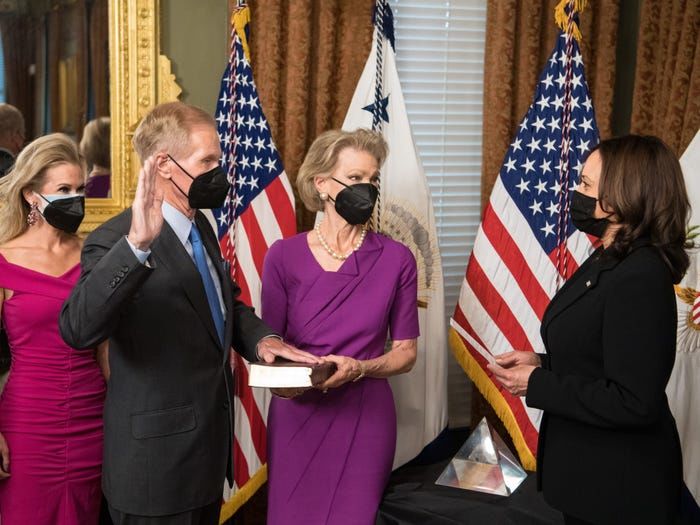
Former Senator Bill Nelson is sworn in as NASA Administrator, as his wife, Grace Nelson, holds their family Bible, and his daughter, Nan Ellen Nelson watches, May 3, 2021.


"The space program needs constancy of purpose," Nelson said in a written testimony to the Senate Committee on Commerce, Science, and Transportation. For continuity, he added, he plans to work with Bridenstine and "seek his advice."

That consistency may give NASA a break from the whiplash it often gets with new administrations. President George W. Bush first asked NASA to pursue a return to the moon in 2005. Five years later, President Barack Obama shifted the focus to Mars. The Trump administration shifted back to the moon, with a tight deadline: to return astronauts to the lunar surface by 2024. That's four years earlier than NASA was previously planning.

"If you ask me what is my vision for the future of NASA, it is to continue for us to explore the heavens with humans and with machines," Nelson told the Senate committee, of which he was previously a member, during a confirmation hearing on April 21. "There is a lot of excitement."

Sending astronauts back to the moon and on to Mars
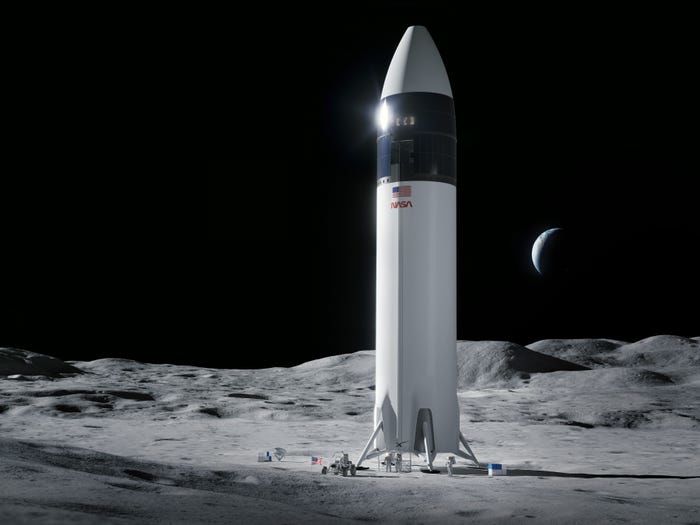
An illustration of SpaceX's Starship as a lander carrying NASA astronauts to the moon.


NASA still hopes to land astronauts on the moon by 2024 — a feat nobody has accomplished since 1972. Nelson is on board, even though the timeline may be too ambitious. NASA's Office of the Inspector General recently determined a 2024 landing is "highly unlikely."

"I think you may be pleased that we're gonna see that timetable try to be adhered to, but recognize that, with some sobering reality, that space is hard," Nelson told the Senate committee.

NASA's plan is to launch an astronaut crew inside an Orion spaceship, using the mega-rocket the agency is currently developing, called the Space Launch System. Once in lunar orbit, Orion would rendezvous with a lander. Two of the astronauts would move into that vehicle then land on the moon's surface.

NASA recently awarded the contract for that lander to SpaceX. Elon Musk's rocket company intends to convert its planned Starship mega-spaceship into a lunar lander. But NASA was expected to pick two contractors instead of one, so the decision prompted SpaceX's competitors — Dynetics and Blue Origin — to file complaints. While things are being sorted out, NASA asked SpaceX to pause work on the project.

NASA cited a lack of funding from Congress when it decided to award one single contract, and promised there would be a follow-on competition. Nelson stood by that statement, vowing that there will be competitions for contracts to send the first astronauts to Mars.

"Competition is always better than sole sourcing, because you can get the efficiencies and you get a lower price," he told the Senate committee.

NASA aims to launch its first Mars-bound astronaut mission in the 2030s.

'You can't mitigate climate change unless you can measure it'

Clouds over the Amazon rainforest, as seen from space, January 30, 2015.


During his hearing, Nelson defended a White House request to budget $2.3 billion for NASA's Earth-science programs. That would constitute a roughly 15% increase from the agency's 2020 Earth-science budget.

"It's a very important increase. You can't mitigate climate change unless you can measure it, and that's NASA's expertise," Nelson said. "Understanding our planet gives us the means to better protect it."

Nelson vocally opposed the Trump administration's decision to cancel NASA's Carbon Monitoring System — a $10-million-per-year program that gathers data on how carbon moves around the planet. Congress subsequently reinstated the program.

"When I flew on the space shuttle, any time that was not scheduled with experiments or flight activities – which was not often – I would make my way to the spacecraft window to look at our home, our planet," Nelson wrote in his testimony. "I was struck by how fragile it looked with its thin atmosphere. Combating climate change cannot succeed without robust observations, data, and research."

Newsletter

Related Articles

Arab Press
0:00
0:00
Close
Syria and Saudi Arabia Seal Multibillion-Dollar Investment Agreements to Drive Post-War Economic Reconstruction
Apple iPhone Lockdown Mode blocks FBI data access in journalist device seizure
Foreign Governments and Corporations Spend Millions with Trump-Linked Lobbying Firm in Washington
KPMG Urges Auditor to Relay AI Cost Savings
Saudi Arabia Quietly Allows Wealthy Foreign Residents to Buy Alcohol, Signalling Policy Shift
US and Iran to Begin Nuclear Talks in Oman
China unveils plans for a 'Death Star' capable of launching missile strikes from space
Investigation Launched at Winter Olympics Over Ski Jumpers Injecting Hyaluronic Acid
U.S. State Department Issues Urgent Travel Warning for Citizens to Leave Iran Immediately
Wall Street Erases All Gains of 2026; Bitcoin Plummets 14% to $63,000
Eighty-one-year-old man in the United States fatally shoots Uber driver after scam threat
German Chancellor Friedrich Merz Begins Strategic Gulf Tour with Saudi Arabia Visit
Dubai Awards Tunnel Contract for Dubai Loop as Boring Company Plans Pilot Network
Five Key Takeaways From President Erdoğan’s Strategic Visit to Saudi Arabia
AI Invented “Hot Springs” — Tourists Arrived and Were Shocked
Erdoğan’s Saudi Arabia Visit Focuses on Trade, Investment and Strategic Cooperation
Germany and Saudi Arabia Move to Deepen Energy Cooperation Amid Global Transition
Saudi Aviation Records Historic Passenger Traffic in 2025 and Sets Sights on Further Growth in 2026
Tech Market Shifts and AI Investment Surge Drive Global Innovation and Layoffs
Global Shifts in War, Trade, Energy and Security Mark Major International Developments
Tesla Ends Model S and X Production and Sends $2 Billion to xAI as 2025 Revenue Declines
The AI Hiring Doom Loop — Algorithmic Recruiting Filters Out Top Talent and Rewards Average or Fake Candidates
Federal Reserve Holds Interest Rate at 3.75% as Powell Faces DOJ Criminal Investigation During 2026 Decision
Putin’s Four-Year Ukraine Invasion Cost: Russia’s Mass Casualty Attrition and the Donbas Security-Guarantee Tradeoff
Saudi Crown Prince Tells Iranian President: Kingdom Will Not Host Attacks Against Iran
U.S. Central Command Announces Regional Air Exercise as Iran Unveils Drone Carrier Footage
Trump Defends Saudi Crown Prince in Heated Exchange After Reporter Questions Khashoggi Murder and 9/11 Links
Saudi Stocks Rally as Kingdom Prepares to Fully Open Capital Market to Global Investors
Air France and KLM Suspend Multiple Middle East Routes as Regional Tensions Disrupt Aviation
Saudi Arabia scales back Neom as The Line is redesigned and Trojena downsized
Saudi Industrial Group Completes One Point Three Billion Dollar Acquisition of South Africa’s Barloworld
Saudi-Backed LIV Golf Confirms Return to Trump National Bedminster for 2026 Season
Gold Jumps More Than 8% in a Week as the Dollar Slides Amid Greenland Tariff Dispute
Boston Dynamics Atlas humanoid robot and LG CLOiD home robot: the platform lock-in fight to control Physical AI
United States under President Donald Trump completes withdrawal from the World Health Organization: health sovereignty versus global outbreak early-warning access
Trump Administration’s Iran Military Buildup and Sanctions Campaign Puts Deterrence Credibility on the Line
Tech Brief: AI Compute, Chips, and Platform Power Moves Driving Today’s Market Narrative
NATO’s Stress Test Under Trump: Alliance Credibility, Burden-Sharing, and the Fight Over Strategic Territory
Saudi Arabia’s Careful Balancing Act in Relations with Israel Amid Regional and Domestic Pressures
Greenland, Gaza, and Global Leverage: Today’s 10 Power Stories Shaping Markets and Security
America’s Venezuela Oil Grip Meets China’s Demand: Market Power, Legal Shockwaves, and the New Rules of Energy Leverage
Trump’s Board of Peace: Breakthrough Diplomacy or a Hostile Takeover of Global Order?
Prince William to Make Official Visit to Saudi Arabia in February
Saudi Arabia Advances Ambitious Artificial River Mega-Project to Transform Water Security
Saudi Crown Prince and Syrian President Discuss Stabilisation, Reconstruction and Regional Ties in Riyadh Talks
Mohammed bin Salman Confronts the ‘Iranian Moment’ as Saudi Leadership Faces Regional Test
Cybercrime, Inc.: When Crime Becomes an Economy. How the World Accidentally Built a Twenty-Trillion-Dollar Criminal Economy
×