Arab Press

بالشعب و للشعب
Friday, Jan 30, 2026

WWI was meant to be the war that ended all wars. It wasn't.

WWI was meant to be the war that ended all wars. It wasn't.

H.G. Wells predicted in 1914 that the First World War would usher in a new world order.

It was the British author, H.G. Wells, that coined the expression: "The war that will end war" to describe World War One, which had broken out in Europe in September 1914. Wells believed the conflict would create a new world order that would make future conflict impossible.

It would do so, Wells believed, by crushing the militarism of Germany under the Kaiser and its allies, the Austro-Hungarian and Ottoman empires. The Allies - Great Britain, France, and Russia - were, Wells wrote, not only soldiers in a war but “crusaders against war”.

“There shall be no more Kaisers [...]. We are resolved. That foolery shall end! It is the last war.”

Wells’ belief was that the militarisation of Europe at the beginning of the 20th century, and particularly the manufacture of heavy armaments and modern weapons, had been pioneered by Germany and had spread outwards, forcing Europe as a whole down the same path.

He was making the argument at a time when many in Britain did not believe that the country should join France and Russia in fighting Germany and Austria-Hungary in the war, sparked by the assassination of Archduke Franz Ferdinand in Sarajevo by a Bosnian Serb nationalist.

'The opportunity for revenge'


Wells first wrote the phrase in August 1914 and within weeks it had become a mantra. But while in 1914 its sentiment was optimistic - positive, even - by 1918 it was desperate. Europe was in ruins, millions were dead. It had to be the last war because Europe could not have another.

World War One was the end of a number of things: It led to the collapse of no less than four empires. The Weimar Republic replaced the German Kaiser, the Ottoman and Austro-Hungarian empires fell, and in 1917 the Bolsheviks overthrew Tsar Nicholas II.

But the Europe that came next was certainly not the new social order that Wells had hoped to see - and it was not the end of war. Just 15 years later, Adolf Hitler became Germany’s chancellor and Europe was again on the path to a brutal and epoch-defining conflict.

Even in 1914, there were those who did not approve of Wells’ prediction. Philosopher Bertrand Russell argued, in an open letter to Wells published in a British journal, that even if Germany was defeated: “Why should Germany not wait [...] for the opportunity of revenge?”
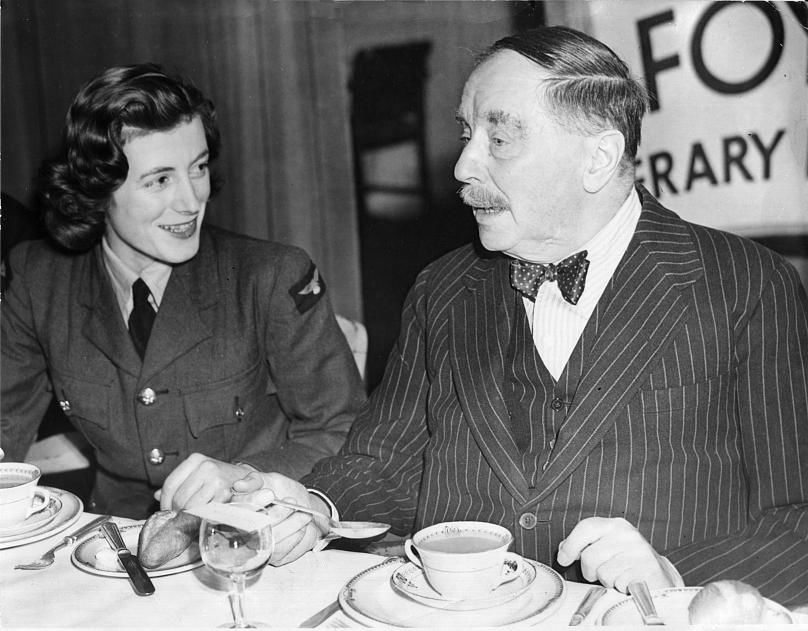
Writer H. G. Wells, right, with Sarah Churchill, Winston Churchill's daughter, at the C. B. Cochran Jubilee luncheon in the Grosvenor House, in London, Dec. 17, 1941.


Russell said that the only way to make WW1 the “war to end war” would be a new era of leaders that were quite different from those that had taken Europe into war, and - crucially, as things would turn out - the avoidance of “intolerable humiliation for the vanquished”.

While the end of WW1 brought a new era of leaders to a number of European countries, they would not be the “men with [different] traditions” that Russell foresaw, and the humiliation of the Versaille Treaty that Germany signed in 1918 would form a centrepiece to Hitler’s Nazi rhetoric.

Wells lived until 1946 and so witnessed the rise of fascism and WW2, and blamed the punitive settlement of the First World War for the onset of the second. He argued that Germans supported Hitler because they feared a repeat of the humiliation of Versailles.

He continued to advocate for a new world order, including in his 1940 book Rights of Man, which called for a world government that would protect the individual regardless of sex, colour or creed. It has been credited as the foundation of the Universal Declaration of Human Rights.

'Mind at the End of its Tether'


But the man considered the father of science fiction was not an optimist. His final book, Mind at the End of its Tether, which he wrote at the age of 78, speculated that mankind’s time on earth was over, and that it would soon be replaced by a more technologically-advanced species.

In the years since Wells’ death, war has followed war in Europe and beyond, from the Second World War to Vietnam, from Bosnia to Iraq to Afghanistan to Syria. Meanwhile, the new world order that he predicted - and lobbied for - is arguably as remote now as it was then.

Writing over a century ago, Russell wrote: “War will only end when people so realize its horrors [that] they prefer to refrain from fighting even when they believe that they have a just cause.”

“The only road to a secure peace lies through a reform in the thoughts and feelings of common men: an unwillingness to inflict humiliation on others for the sake of one’s own triumph, a more calm and equable courage which provides against reasonable risks quietly, without hostile feeling, and without the nightmare terror that makes men rush into the very calamity of which they are in dread.”

Newsletter

Related Articles

Arab Press
0:00
0:00
Close
Saudi Aviation Records Historic Passenger Traffic in 2025 and Sets Sights on Further Growth in 2026
Tech Market Shifts and AI Investment Surge Drive Global Innovation and Layoffs
Global Shifts in War, Trade, Energy and Security Mark Major International Developments
Tesla Ends Model S and X Production and Sends $2 Billion to xAI as 2025 Revenue Declines
The AI Hiring Doom Loop — Algorithmic Recruiting Filters Out Top Talent and Rewards Average or Fake Candidates
Federal Reserve Holds Interest Rate at 3.75% as Powell Faces DOJ Criminal Investigation During 2026 Decision
Putin’s Four-Year Ukraine Invasion Cost: Russia’s Mass Casualty Attrition and the Donbas Security-Guarantee Tradeoff
Saudi Crown Prince Tells Iranian President: Kingdom Will Not Host Attacks Against Iran
U.S. Central Command Announces Regional Air Exercise as Iran Unveils Drone Carrier Footage
Trump Defends Saudi Crown Prince in Heated Exchange After Reporter Questions Khashoggi Murder and 9/11 Links
Saudi Stocks Rally as Kingdom Prepares to Fully Open Capital Market to Global Investors
Air France and KLM Suspend Multiple Middle East Routes as Regional Tensions Disrupt Aviation
Saudi Arabia scales back Neom as The Line is redesigned and Trojena downsized
Saudi Industrial Group Completes One Point Three Billion Dollar Acquisition of South Africa’s Barloworld
Saudi-Backed LIV Golf Confirms Return to Trump National Bedminster for 2026 Season
Gold Jumps More Than 8% in a Week as the Dollar Slides Amid Greenland Tariff Dispute
Boston Dynamics Atlas humanoid robot and LG CLOiD home robot: the platform lock-in fight to control Physical AI
United States under President Donald Trump completes withdrawal from the World Health Organization: health sovereignty versus global outbreak early-warning access
Trump Administration’s Iran Military Buildup and Sanctions Campaign Puts Deterrence Credibility on the Line
Tech Brief: AI Compute, Chips, and Platform Power Moves Driving Today’s Market Narrative
NATO’s Stress Test Under Trump: Alliance Credibility, Burden-Sharing, and the Fight Over Strategic Territory
Saudi Arabia’s Careful Balancing Act in Relations with Israel Amid Regional and Domestic Pressures
Greenland, Gaza, and Global Leverage: Today’s 10 Power Stories Shaping Markets and Security
America’s Venezuela Oil Grip Meets China’s Demand: Market Power, Legal Shockwaves, and the New Rules of Energy Leverage
Trump’s Board of Peace: Breakthrough Diplomacy or a Hostile Takeover of Global Order?
Prince William to Make Official Visit to Saudi Arabia in February
Saudi Arabia Advances Ambitious Artificial River Mega-Project to Transform Water Security
Saudi Crown Prince and Syrian President Discuss Stabilisation, Reconstruction and Regional Ties in Riyadh Talks
Mohammed bin Salman Confronts the ‘Iranian Moment’ as Saudi Leadership Faces Regional Test
Cybercrime, Inc.: When Crime Becomes an Economy. How the World Accidentally Built a Twenty-Trillion-Dollar Criminal Economy
Strategic Restraint, Credible Force, and the Discipline of Power
Donald Trump Organization Unveils Championship Golf Course and Luxury Resort Project in Saudi Arabia
Inside Diriyah: Saudi Arabia’s $63.2 Billion Vision to Transform Its Historic Heart into a Global Tourism Powerhouse
Trump Designates Saudi Arabia a Major Non-NATO Ally, Elevating US–Riyadh Defense Partnership
Trump Organization Deepens Saudi Property Focus with $10 Billion Luxury Developments
There is no sovereign immunity for poisoning millions with drugs.
Mohammed bin Salman’s Global Standing: Strategic Partner in Transition Amid Debate Over His Role
Saudi Arabia Opens Property Market to Foreign Buyers in Landmark Reform
The U.S. State Department’s account in Persian: “President Trump is a man of action. If you didn’t know it until now, now you do—do not play games with President Trump.”
CNN’s Ranking of Israel’s Women’s Rights Sparks Debate After Misleading Global Index Comparison
Saudi Arabia’s Shifting Regional Alignment Raises Strategic Concerns in Jerusalem
OPEC+ Holds Oil Output Steady Amid Member Tensions and Market Oversupply
Iranian Protests Intensify as Another Revolutionary Guard Member Is Killed and Khamenei Blames the West
President Trump Says United States Will Administer Venezuela Until a Secure Leadership Transition
Delta Force Identified as Unit Behind U.S. Operation That Captured Venezuela’s President
Saudi-UAE Rift Adds Complexity to Middle East Diplomacy as Trump Signals Firm Leadership
OPEC+ to Keep Oil Output Policy Unchanged Despite Saudi-UAE Tensions Over Yemen
×