Arab Press

بالشعب و للشعب
Friday, Feb 06, 2026

‘The pain gets worse’: Lebanese mark second anniversary of Beirut port explosion

Further collapse of city’s grain silos, almost to the minute of blast, seen as symbol of failure to bring anyone to justice

For two years, Beirut’s crumbing grain silos had teetered over the ruins of the nearby port, a battered backdrop to a broken city that has barely stayed on its feet.

Almost to the minute of the second anniversary of the Beirut port explosion that destroyed them and pulverised nearby neighbours, a huge slither of the silos collapsed, showcasing yet again the dysfunction of Lebanon and the failed quest to bring those responsible to justice.

Crowds lined adjoining overpasses on Thursday to commemorate the deaths of more than 200 people in one of the biggest industrial disasters in modern history. And in doing so, many were also mourning the ongoing destruction of a country, the demise of which is encapsulated in Lebanon’s inability to hold its leaders to account either for the blast, or the wilful collapse of its economy.

Hailed at the time as a galvanising moment that could finally break a corrupt protectorate that had enriched Lebanon’s leaders at the expense of its citizens, the post-explosion era has instead served to reinforce the status quo. Beirut port was a microcosm of Lebanon’s failings, a place where civil war-era leaders all had a stake in various arms of its operations, and took large financial cuts under informal understandings.
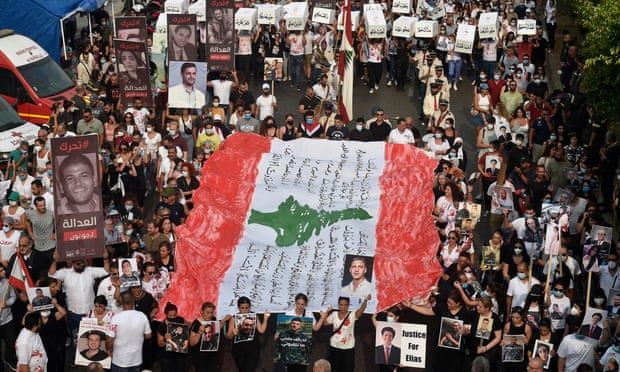
Activists hold symbolic coffins and the Lebanese flag during a march to the Beirut port to commemorate the second anniversary of the Beirut port explosion.


While the ruin of the bulk cargo terminal, a global pandemic, and a plunging economy may have put pay to that, the patronage networks that have helped Lebanon to ruin remain intact. Attempts to investigate the cause of the blast and the negligence that led 2,750 tonnes of ammonium nitrate to be stored haphazardly for seven years remain stalled, with little political will for any meaningful resumption.

Among a crowd gathered near the port, Alan Hobeika, 17, held a picture of his friend Elias Khoury, who died in the blast in his home not far away. He said he joined the commemorative march because “justice is still not achieved until now. I’m here to honour him so he doesn’t die in vain. We have to at least give him his rights so he can rest peacefully.”

“It’s been two years and until now there’s nothing we can call accountability or justice. I don’t think it’ll happen any time soon unless the international community steps in.”

“The pain [at Elias’s death] grows more and more every single day. It gets worse and worse.”

Ongoing grief is a prevalent emotion among many survivors and family members. The lament extends to many other Lebanese who have since fled the country, angered first by the economic collapse that has resulted in an almost 25-fold fall in the local currency, and collectively traumatised by an event so catastrophic, yet seemingly so inconsequential.

Ahead of the anniversary the UN secretary general, António Guterres, launched a plea for a “transparent, international investigation” into the blast. His call was poorly received by many Lebanese who cite the UN probe into the killing of the country’s former prime minister Rafiq Hariri as an example of how a 13-year investigation diluted the impact of the “justice” it delivered.

“No one can solve this except the Lebanese themselves, said Hassan Yamout, a Beirut resident. “And none of them will because they’re all involved in one way or another.”

At 6.07pm, one minute before the ammonium nitrate detonated, after workers using welders had set fire to nearby sites, sirens started blaring and an ambulance made its way through the crowd as people clapped in support.

Shortly afterwards, a helicopter carrying a water bucket flew over what remained of the grain silos, attempting to douse fires that had burned at their base for weeks.

“The rest will fall over soon,” said Samer, 26, a student. “They should too. They’re only a symbol of failure.”

#ANT 
Newsletter

Related Articles

Arab Press
0:00
0:00
Close
Foreign Governments and Corporations Spend Millions with Trump-Linked Lobbying Firm in Washington
KPMG Urges Auditor to Relay AI Cost Savings
Saudi Arabia Quietly Allows Wealthy Foreign Residents to Buy Alcohol, Signalling Policy Shift
US and Iran to Begin Nuclear Talks in Oman
China unveils plans for a 'Death Star' capable of launching missile strikes from space
Investigation Launched at Winter Olympics Over Ski Jumpers Injecting Hyaluronic Acid
U.S. State Department Issues Urgent Travel Warning for Citizens to Leave Iran Immediately
Wall Street Erases All Gains of 2026; Bitcoin Plummets 14% to $63,000
Eighty-one-year-old man in the United States fatally shoots Uber driver after scam threat
German Chancellor Friedrich Merz Begins Strategic Gulf Tour with Saudi Arabia Visit
Dubai Awards Tunnel Contract for Dubai Loop as Boring Company Plans Pilot Network
Five Key Takeaways From President Erdoğan’s Strategic Visit to Saudi Arabia
AI Invented “Hot Springs” — Tourists Arrived and Were Shocked
Erdoğan’s Saudi Arabia Visit Focuses on Trade, Investment and Strategic Cooperation
Germany and Saudi Arabia Move to Deepen Energy Cooperation Amid Global Transition
Saudi Aviation Records Historic Passenger Traffic in 2025 and Sets Sights on Further Growth in 2026
Tech Market Shifts and AI Investment Surge Drive Global Innovation and Layoffs
Global Shifts in War, Trade, Energy and Security Mark Major International Developments
Tesla Ends Model S and X Production and Sends $2 Billion to xAI as 2025 Revenue Declines
The AI Hiring Doom Loop — Algorithmic Recruiting Filters Out Top Talent and Rewards Average or Fake Candidates
Federal Reserve Holds Interest Rate at 3.75% as Powell Faces DOJ Criminal Investigation During 2026 Decision
Putin’s Four-Year Ukraine Invasion Cost: Russia’s Mass Casualty Attrition and the Donbas Security-Guarantee Tradeoff
Saudi Crown Prince Tells Iranian President: Kingdom Will Not Host Attacks Against Iran
U.S. Central Command Announces Regional Air Exercise as Iran Unveils Drone Carrier Footage
Trump Defends Saudi Crown Prince in Heated Exchange After Reporter Questions Khashoggi Murder and 9/11 Links
Saudi Stocks Rally as Kingdom Prepares to Fully Open Capital Market to Global Investors
Air France and KLM Suspend Multiple Middle East Routes as Regional Tensions Disrupt Aviation
Saudi Arabia scales back Neom as The Line is redesigned and Trojena downsized
Saudi Industrial Group Completes One Point Three Billion Dollar Acquisition of South Africa’s Barloworld
Saudi-Backed LIV Golf Confirms Return to Trump National Bedminster for 2026 Season
Gold Jumps More Than 8% in a Week as the Dollar Slides Amid Greenland Tariff Dispute
Boston Dynamics Atlas humanoid robot and LG CLOiD home robot: the platform lock-in fight to control Physical AI
United States under President Donald Trump completes withdrawal from the World Health Organization: health sovereignty versus global outbreak early-warning access
Trump Administration’s Iran Military Buildup and Sanctions Campaign Puts Deterrence Credibility on the Line
Tech Brief: AI Compute, Chips, and Platform Power Moves Driving Today’s Market Narrative
NATO’s Stress Test Under Trump: Alliance Credibility, Burden-Sharing, and the Fight Over Strategic Territory
Saudi Arabia’s Careful Balancing Act in Relations with Israel Amid Regional and Domestic Pressures
Greenland, Gaza, and Global Leverage: Today’s 10 Power Stories Shaping Markets and Security
America’s Venezuela Oil Grip Meets China’s Demand: Market Power, Legal Shockwaves, and the New Rules of Energy Leverage
Trump’s Board of Peace: Breakthrough Diplomacy or a Hostile Takeover of Global Order?
Prince William to Make Official Visit to Saudi Arabia in February
Saudi Arabia Advances Ambitious Artificial River Mega-Project to Transform Water Security
Saudi Crown Prince and Syrian President Discuss Stabilisation, Reconstruction and Regional Ties in Riyadh Talks
Mohammed bin Salman Confronts the ‘Iranian Moment’ as Saudi Leadership Faces Regional Test
Cybercrime, Inc.: When Crime Becomes an Economy. How the World Accidentally Built a Twenty-Trillion-Dollar Criminal Economy
Strategic Restraint, Credible Force, and the Discipline of Power
Donald Trump Organization Unveils Championship Golf Course and Luxury Resort Project in Saudi Arabia
×