

US must do more than talk to resolve Palestine-Israel issue: PA official
Israel’s killing of Palestinian civilians and home demolition campaign has created a “very dangerous” situation in the West Bank, Nabil Abu Rudeineh, spokesperson for the Palestinian presidency, has told Arab News.
He said: “We are facing an unprecedented extremist Israeli government. The policy that Israel is pursuing amounts to a war against the Palestinian people.
“Daily killings have increased tension in Palestine while the political relationship with Israel is nonexistent and the security coordination has stopped.”
Abu Rudeineh added: “We demand the cessation of all unilateral measures, and therefore all our options will be open, including going to the UN Security Council and moving the International Court of Justice and International Criminal Court.”
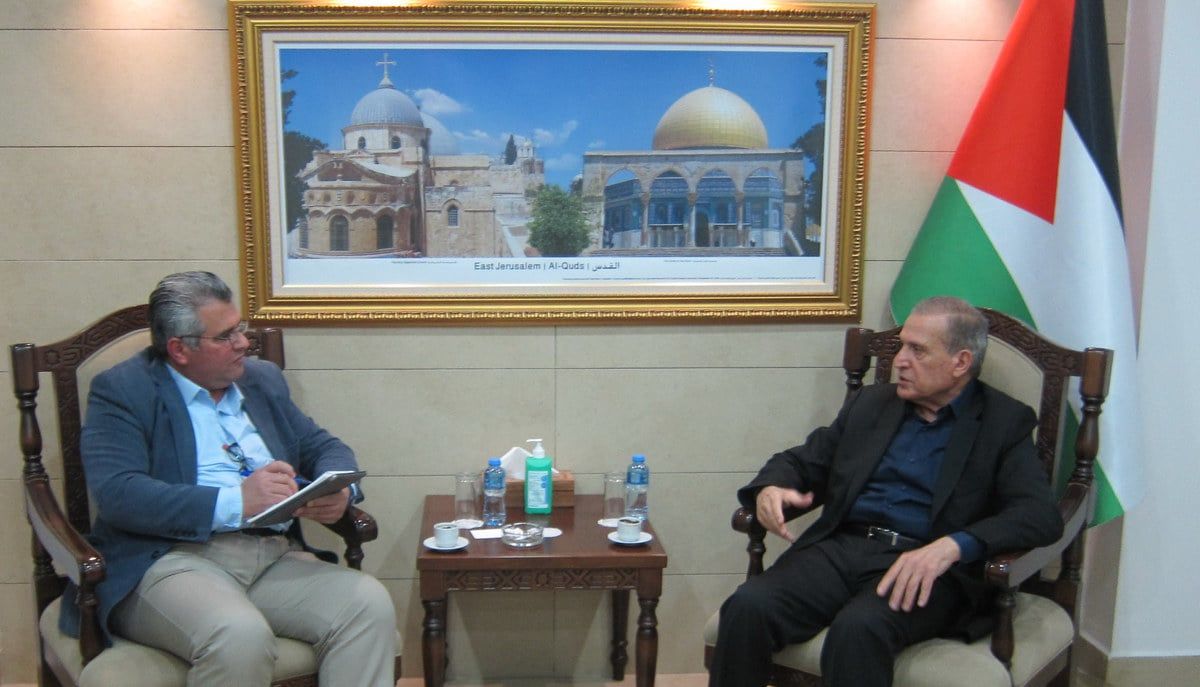 Nabil Abu Rudeineh, spokesperson for the Palestinian presidency, speaks to Arab News correspondent Mohammed Najib in Ramallah.
On Feb. 3, Israel, which collects taxes on behalf of the PA, announced that it would use 100 million shekels ($29 million) of PA funds to compensate victims of Palestinian attacks.
Israeli Finance Minister Bezalel Smotrich signed the order, claiming that the funds would normally be transferred by the PA to families of prisoners and resistance fighters.
The amount to be deducted is double the usual figure confiscated monthly — $14.7 million. It was the first move of its kind by Smotrich since he took office.
Abu Rudeineh described Israel as “a state outside the law that defies the law and the resolutions of the UN Security Council, which considers Israeli settlements illegal, including in East Jerusalem.” Israel continues to build in East Jerusalem and the West Bank despite its illegality, he said, adding that Israel has become an “existential threat to the PA as it has a government that messes with security and stability in the Palestinian and Arab arenas.”
He said: “We are facing an American administration that is unable to impose what it says publicly, the latest of which was Secretary of State Antony Blinken’s speech that talks about the two-state solution, and says that all American Democratic and Republican administrations oppose settlements, but they do nothing to stop Israeli steps against the Palestinians, their land and sanctities.
“In our existing contacts with the American side, we were completely clear that unless Israel stops its unilateral measures, we are forced to take decisions, the first of which was the cessation of security coordination.”
He added that the US has issued statements that appeared favorable to Palestine but that needed to be put into practice. “When President Joe Biden came to Bethlehem, he said he was against unilateral measures and with the status quo against settlement expansion and supported the two-state solution, and despite that, Israel continues its settlement expansion, legitimizing settlements and unilateral measures.”
The US administration must force Israel to comply with international law, he said. Statements “do not frighten Israel or discourage it from what it is doing,” he added.
“We constantly hear voices saying we want to strengthen the PA, but they strengthen Israel and Hamas more than they strengthen the PA by contributing to the delivery of money to Gaza.”
Palestinian officials in contact with US government have focused on two issues — unilateral measures and signed agreements, Abu Rudeineh said, adding that those two concerns may be raised in the UN Security Council if no progress is made.
“All American efforts are focused on calming us down, and we tell the Americans that we are not the ones carrying out the escalation. Those who are killing, settling and storming the Al-Aqsa compound are obvious.
“Stop these actions, and things will calm down. But unfortunately, the American administration is giving us the words we want, but it is not forcing Israel to implement them. Therefore, the escalation is taking place because Israel is demolishing homes in Jerusalem and killing Palestinians.”
The US is “required to force Israel to do what America wants,” Abu Rudeineh said, adding: “But the problem is that what matters to America is the security of Israel and not clashing with the Jewish communities in America and dealing with the US internal situation. These are the considerations that govern American foreign policy.”
The killing of Palestinians, home demolitions and storming of Al-Aqsa Mosque, Abu Rudeineh said, “cause the existing security tension, and it will continue before, during and after Ramadan. The Americans want calm to preserve Israel’s security and not as a prelude to resuming a political process between the Palestinians and the Israelis.”
The spokesman described the fears of the Palestinian leadership: “The only concern is the Israeli occupation and the indifference of the American side. However, it seems that the US is concerned with the continuation of instability in the Middle East because what America cares about is the security of Israel and Arab oil.”
He added: “The main problem is the theft of the PA’s funds and the suspension of donor country funds. We have had more than $2 billion stolen and seized by Israel. The US can force Israel to return our stolen money if it is serious.
“America is required to abide by international legitimacy. Is it unimaginable that all American presidents, the latest of which is Biden, visited Ramallah and the Palestinian territories while the Palestine Liberation Organization continues to be classified as a terrorist organization?”
Abu Rudeineh said: "The US administration must reconsider its dealings with the PLO and the Palestinian people. They cannot open a consulate in East Jerusalem and close the PLO office in Washington. The US administration contradicts itself and international legitimacy.”
He added that the US had ended its financial support to the PA in an effort to stop its influence in Jerusalem, “but they will not find a single Palestinian who accepts giving up Jerusalem. Jerusalem is not for sale, and the American administration must reconsider its accounts.”
Regarding the potential for a third intifada in the West Bank, Abu Rudeineh said: “The issue is not a third intifada. Rather, there are Israeli attacks and Palestinian reactions, and all we see is a reaction to Israel’s daily crimes.
“The PA is keen on the security, stability and protection of Palestinian citizens. We are not protectors of Israel, and we will not be in any case either.”
He praised the political stance of Saudi Arabia, describing the Kingdom as “unlimitedly supportive of the Palestinian cause, especially its adherence to the Arab Peace Initiative, which is the best initiative in the last 100 years to support the Palestinian cause.”
He lauded Saudi Arabia’s continuous condemnation of Israeli aggression and the Kingdom’s position on Jerusalem, “which is quite clear.”
Abu Rudeineh added: “We are keen on our relationship with Saudi Arabia and the implementation of the decisions of the Arab summits, on top of which is the Arab Peace Initiative.
“We are against the normalization of some Arab countries’ ties with Israel because it contradicts the Arab Peace Initiative that was proposed and adopted by Saudi Arabia.”
On the future of Palestine, he said: “We are not creating problems for anyone, but the occupation is the one that imposes itself on Palestine and the entire region through all these measures.
“Resolving the Palestinian issue will restore security and stability to the region, and without resolving the Palestinian issue, everyone will burn, and the most important point in the Palestinian issue is the status of Jerusalem, with its historical, national and religious values.”
He added: “Stopping security coordination was the first and weakest card of the PA and as long as Israeli atrocities continue, we will continue with these steps, and more difficult and dangerous steps will follow, including demanding UN Security Council resolutions to delegitimize Israel.
“Our political and legal battle will continue as long as Israel continues its unilateral measures. If they stop them, we will be happy to review all our steps.
“But if the unilateral measures continue, we will implement the decisions of the Palestinian leadership regarding security coordination, turning to the ICJ and the ICC, and instructions have been issued to our UN representative to develop certain political perceptions.”
Abu Rudeineh added: “We are facing American pressure not to go ahead because America wants us to remain silent in exchange for nothing.
“They tell us that they are against our moves in the international courts and UN Security Council: ‘Remain calm and do not make things worse’.”