
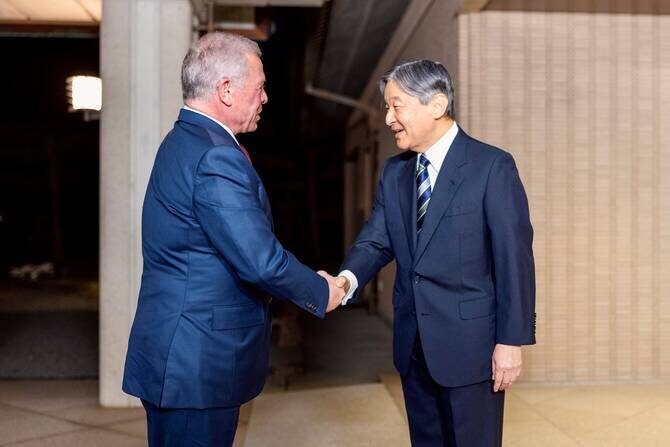
King Abdullah II of Jordan Meets Japanese Emperor and Business Leaders
The King of Jordan met with Emperor Naruhito, the Japanese Defense Minister, and business leaders in Tokyo to discuss strengthening cooperation.
King Abdullah II of Jordan visited the Imperial Palace in Tokyo on Monday, where he met with Emperor Naruhito.
The two leaders reaffirmed the longstanding ties between their nations, which have spanned 70 years.
Discussions focused on regional developments and potential military cooperation enhancements.
Additionally, they emphasized the importance of achieving peace in the Middle East through a comprehensive agreement to end the conflict in Gaza and ensure uninterrupted humanitarian aid.
The Jordanian king also met with representatives from the Japan Chamber of Commerce and Industry, as well as Japanese companies, to discuss enhancing economic and investment cooperation.
He highlighted the need for greater collaboration in technical transformation, agriculture, logistics, food processing, textiles, manufacturing, mining, chemical industries, and energy sectors.
King Abdullah emphasized the strategic location, trade relations, and industrial growth of Jordan as factors that attract Japanese businesses.
The meeting included CEOs and representatives from key businesses such as trade, energy, natural resources, artificial intelligence, textiles, and food processing.
King Abdullah II met with Akihiko Tanaka, president of the Japan International Cooperation Agency (JICA), to discuss expanding their 40-year partnership.
Their discussion centered on ongoing collaborations in water desalination projects, such as the Aqaba-Amman Water Desalination and Conveyance Project, as well as energy and tourism sectors, while exploring opportunities for growth.
In a separate meeting with Norihiko Ishiguro, chairman and CEO of the Japan External Trade Organization (JETRO), they discussed organizing Jordanian-Japanese business forums to promote private sector engagement.
The king emphasized the importance of fostering cooperation in contract manufacturing, metals, energy, agriculture, logistics sectors, and complementary industries to enhance competitiveness for both countries' products.
He also highlighted JETRO's valuable economic reports and support for Jordanian companies entering the Japanese market.
Additionally, he mentioned opportunities for Japanese firms to invest in Jordan.
The Jordanian delegation consisted of key members including Prince Ghazi bin Muhammad, Director of the Office of His Majesty Alaa Batayneh, Deputy Prime Minister and Foreign Minister Ayman Safadi, Minister of Planning and International Cooperation Zeina Toukan, and Ambassador to Japan Nasser Shraideh.
The two leaders reaffirmed the longstanding ties between their nations, which have spanned 70 years.
Discussions focused on regional developments and potential military cooperation enhancements.
Additionally, they emphasized the importance of achieving peace in the Middle East through a comprehensive agreement to end the conflict in Gaza and ensure uninterrupted humanitarian aid.
The Jordanian king also met with representatives from the Japan Chamber of Commerce and Industry, as well as Japanese companies, to discuss enhancing economic and investment cooperation.
He highlighted the need for greater collaboration in technical transformation, agriculture, logistics, food processing, textiles, manufacturing, mining, chemical industries, and energy sectors.
King Abdullah emphasized the strategic location, trade relations, and industrial growth of Jordan as factors that attract Japanese businesses.
The meeting included CEOs and representatives from key businesses such as trade, energy, natural resources, artificial intelligence, textiles, and food processing.
King Abdullah II met with Akihiko Tanaka, president of the Japan International Cooperation Agency (JICA), to discuss expanding their 40-year partnership.
Their discussion centered on ongoing collaborations in water desalination projects, such as the Aqaba-Amman Water Desalination and Conveyance Project, as well as energy and tourism sectors, while exploring opportunities for growth.
In a separate meeting with Norihiko Ishiguro, chairman and CEO of the Japan External Trade Organization (JETRO), they discussed organizing Jordanian-Japanese business forums to promote private sector engagement.
The king emphasized the importance of fostering cooperation in contract manufacturing, metals, energy, agriculture, logistics sectors, and complementary industries to enhance competitiveness for both countries' products.
He also highlighted JETRO's valuable economic reports and support for Jordanian companies entering the Japanese market.
Additionally, he mentioned opportunities for Japanese firms to invest in Jordan.
The Jordanian delegation consisted of key members including Prince Ghazi bin Muhammad, Director of the Office of His Majesty Alaa Batayneh, Deputy Prime Minister and Foreign Minister Ayman Safadi, Minister of Planning and International Cooperation Zeina Toukan, and Ambassador to Japan Nasser Shraideh.