

Merkel says Germany faces ‘difficult months ahead’ in Covid fight
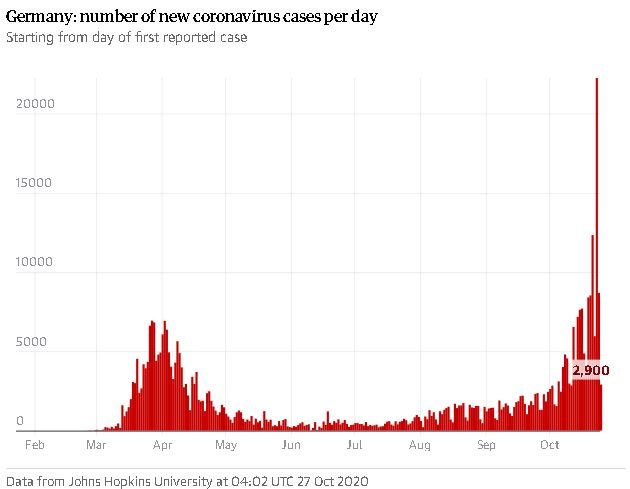
The German chancellor, Angela Merkel, has said her country is on the verge of losing control of its fight against the coronavirus pandemic, telling colleagues from her Christian Democratic Union party “the situation is threatening” and “every day counts”.
In leaked comments to an internal party meeting, she told those attending of “very, very difficult months ahead” and added that “every day [would] count” in tackling the virus’s spread.
Merkel’s bleak remarks came as countries across Europe moved quickly to reimpose what have become both unpopular and economically damaging restrictions, as governments and scientists reported record and still rising numbers of infections across the continent.
Underlining the mounting sense of alarm over the deteriorating situation in Europe, the World Health Organization pointed to a series of concerning indicators.
Speaking at a briefing on Monday, Dr Mike Ryan, the UN health body’s top emergency expert, said a lack of contact tracing capacity in Europe, in tandem with very high positivity rates for those being tested, was driving the coronavirus further into the “darkness”.
“We are seeing very, very high positivity rates and an increasing lack of capacity to do any effective form of contact tracing, which is going to further drive the disease into darkness,” Ryan said.
With officials across Europe warning of a looming shortage of hospital beds and runaway infections, the confirmed death toll on the continent surpassed 250,000, according to Johns Hopkins University, part of a global toll of more than 1.1 million.
Italy, which imposed new curfews and shut gyms, pools and cinemas, has become the latest country to have angry demonstrations – including clashes with police in Rome and Naples last weekend – prompting the government of Giuseppe Conte to promise new financial relief for businesses hit by the measures. From Turin, Milan and Trieste in the north to Rome, Naples and Catania in the south, people converged on Monday night to protest against measures that include the 6pm closure of bars and restaurants and the complete closure of gyms, swimming pools, cinemas and theatres.
In France, the head of the scientific council that advises the government, Jean-François Delfraissy, said the real number of infections in the country was probably twice the official figure and close to 100,000 a day.
“There are probably more than 50,000 cases per day. We estimate, on the scientific committee, that we are more in the region of 100,000 cases per day,” said Delfraissy.
Although France declared a state of emergency this month and has been imposing ever stricter restrictions since September, Dr Eric Caumes, the head of the infections and tropical diseases department at Paris’s Pitié Salpêtrière hospital, said the country needed to lock down again, adding that the virus was “out of control”.
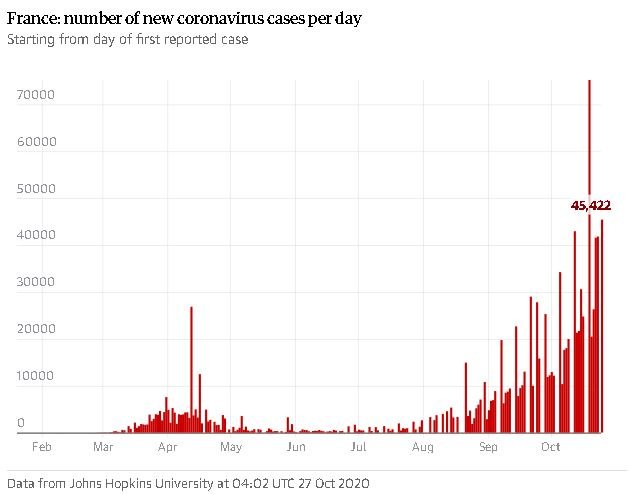
“We lost control of the epidemic but that doesn’t date from yesterday,” he told the broadcaster France Info. “We lost control of the epidemic several weeks ago already.”
Elsewhere, the picture was unrelentingly grim as a string of countries reported record increases and fears over the spread of the virus.
In Spain, which was the first country to report more than 1 million cases of the disease, the prime minister, Pedro Sánchez, said the country was facing an “extreme” situation as he announced a new state of emergency on Sunday, imposing local night-time curfews and banning travel between regions in some cases.
Belgians were also told they were facing a pivotal week in the struggle to limit the spread of the coronavirus, as a series of new restrictions entered force in one of the European countries hardest hit by the pandemic, with one official suggesting hospital beds would be completely filled within 15 days.
Pressure is building on the country’s hospitals, where 467 people are being admitted on average each day, a rise of 85%. Almost 5,000 people have been admitted, more than 750 of them in intensive care, according to the latest data.
“What we do now, what we will do in the next two weeks, will be decisive,” said Yves Van Laethem, a spokesman for Belgium’s Covid-19 crisis centre. If the figures do not change, he said, “we are likely to reach 2,000 patients in intensive care in two weeks. That is our maximum capacity.”
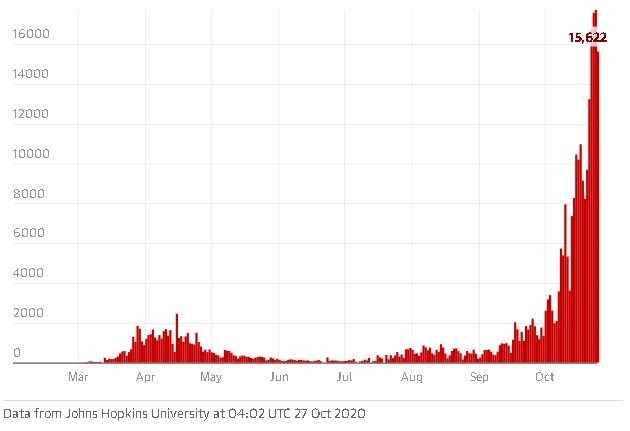
Norway also announced it would impose tougher measures to combat the coronavirus following a recent rise in the number of infections, including stricter rules on private gatherings, the prime minister, Erna Solberg, said on Monday.
Outside Europe, similar trends were in evidence in many other countries, including Iran, where there were warnings that hospitals in some provinces were in danger of being overwhelmed.
Mexican health authorities acknowledged on Sunday the country’s true death toll from the coronavirus pandemic was far higher than thought, saying there were 193,170 “excess” deaths in the year up to 26 September, with 139,153 of those judged to be attributable to Covid-19. That is about 50,000 more deaths than Mexico’s official, test-confirmed death toll of about 89,000, and about 56% higher than the previous estimate of 103,882 pandemic deaths.
Russia’s daily tally of new Covid-19 cases soared to a record high of 17,347 on Monday as the Kremlin said the pandemic was beginning to inflict a greater toll outside the capital, Moscow.
Authorities say Russia has enough hospital beds and medication to tackle the second wave of the coronavirus outbreak. But the Kremlin spokesman Dmitry Peskov said “extremely energetic” efforts from both federal and regional governments were needed to cope with rising case numbers.