

HSBC head dismisses idea China is trying to get hold of the bank's Asian operations
Ever since April, when HSBC's biggest single shareholder, Ping An, began lobbying the lender to spin off its Asian operations into a separate business, there has been speculation over what has motivated the Chinese insurer to do so.
Some, including a number of analysts covering the banking sector, have speculated that Ping An, which owns 8.29% of HSBC, has been doing so with the backing of the Chinese government.
The thinking is that, shorn of its operations outside Asia, a standalone HSBC in the region could be more easily influenced by Beijing as it seeks to extend its influence over Hong Kong's financial markets in particular. HSBC effectively controls the money supply in the former British colony.
Others wonder whether China is simply trying to get hold of the jewel in HSBC's crown - its highly profitable Asian operations - as the standalone business would more easily become a takeover target.
So it was interesting today to hear Noel Quinn, HSBC's chief executive, dismiss the conspiracy theories as stridently as he did.
Mr Quinn had previously indicated in August this year that he had not regarded Ping An's campaign as "an issue of politics".
However, participating in the Financial Times global banking summit, he expanded on the theme.
He said: "I do not believe it is politically motivated based on all the dialogue we've had with various stakeholders. Quite the contrary.
"We're viewed in Asia, in Hong Kong, in China as an important international bank. We're an international bank that has been there for 157 years, helping Hong Kong develop as an economy, helping China develop.
"Based on the conversations we've had, that is a position that is still valued and people want us to take."
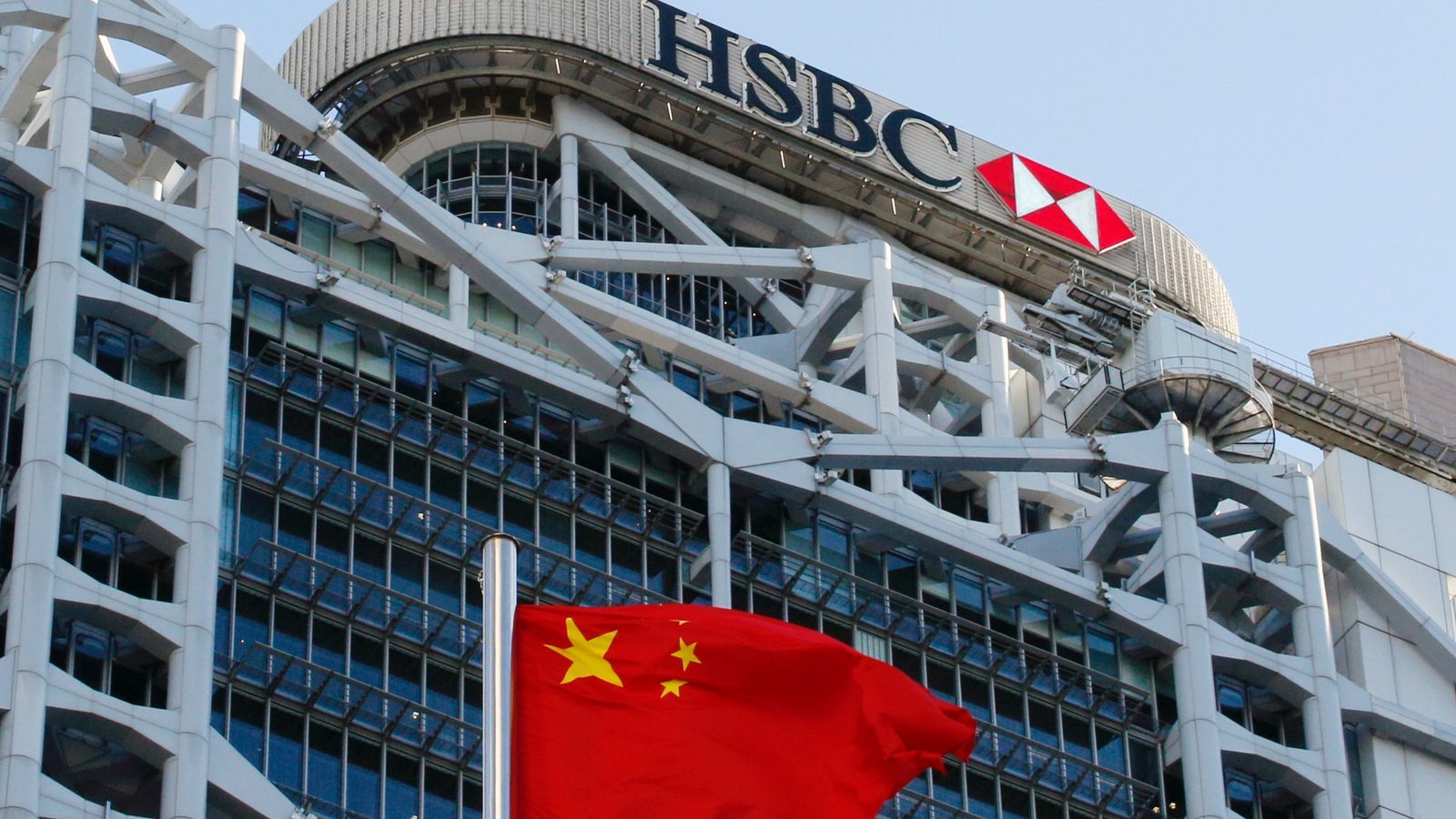 A Chinese national flag flies in front of HSBC headquarters in Hong Kong, July 28, 2020
A campaign driven by Beijing?
His comments are instructive because, even within HSBC itself, some employees have speculated that Ping An's campaign is being driven by Beijing.
A former senior executive of the bank told the FT in May this year that Ping An "would have had air cover from Beijing" in saying what it has been.
Ping An has certainly had close ties in the past to Beijing. The family of Wen Jiabao, a former Chinese premier, were at one point major shareholders in the company and profited enormously from their investment. And Dhanin Chearavanont, Thailand's richest man, was known to have close ties to China's Communist Party when, in 2012, he bought HSBC's 15.4% stake in Ping An itself.
Three of Ping An's biggest investors are investment firms which are owned by the Chinese government, And Xie Yonglin, Ping An's co-chief executive and president, is a member of the Chinese Communist Party, as are a number of senior executives at the insurer.
So it would certainly be no surprise were Beijing to be behind Ping An's calls.
But Mr Quinn clearly thinks it is simply business.
The difficulty separating politics from business
It is, however, difficult to separate politics from business when HSBC is concerned.
There was widespread unhappiness in Hong Kong when, in 2020, HSBC cancelled its dividend after the Bank of England urged lenders to conserve capital at the outset of the pandemic. HSBC has many shareholders based in the territory - both institutional and retail - who depend heavily on its dividends.
HSBC's head office in Hong Kong found itself picketed by shareholders demanding the reinstatement of pay-outs and for executives to have their pay docked.
A separation in Asian and non-Asian arms would, it was argued at the time, enable the Asian part of HSBC to avoid UK regulations that were seen as acting to the detriment of Hong Kong based shareholders.
But it would also represent an acknowledgement from HSBC that it was finding it impossible to reconcile its interests in the West, particularly the United States and the UK, with those in China - and that, in turn, would have undermined the lender's entire raison d'etre of enabling Western customers to do business in Asia and Asian customers to do business in the West.
HSBC's rebuttal of Ping An's arguments, which have so far failed to gain public support from any of its other major institutional shareholders, has not dampened the insurer's determination.
Upping the ante and going public
Having lobbied behind closed doors for most of the year, Ping An last month went public, upping the ante in the process.
Michael Huang, chairman of Ping An's asset management business, said: "The global finance model that once dominated and shaped the global financial industry in the last century is no longer competitive."
He also said that HSBC needed to be "much more aggressive" in terms of cutting costs.
He added: "This is the most important, urgent and absolutely needed action for HSBC to improve its business performance, reducing costs and increasing efficiency, particularly amid slowing growth in the global financial industry."
A programme of cuts
In fairness to Mr Quinn, he has been doing just that, committing back in October to making $1bn worth of extra cost savings next year and pledging to keep cost increases to just 2%. In many ways, even before Mr Quinn was handed the role on a permanent basis, he seems to have spent most of his time cost-cutting.
He did, however, also produce a major rabbit from the hat on Wednesday with the sale of HSBC's Canadian business for $10bn and at a highly attractive valuation. Much of this is likely to find its way back to investors in a move that the lender will hope assuages some of the disappointment lingering from the dividend suspension two years ago.
If he could pull off a few more asset sales like that, at a similarly compelling valuation, Mr Quinn will certainly find it easier to live with his Shenzhen-based headache.