Arab Press

بالشعب و للشعب
Tuesday, Feb 24, 2026

Huawei Mate X2 folding phone unveiled despite chip supply worries

Huawei Mate X2 folding phone unveiled despite chip supply worries

Huawei has unveiled a revamped foldable smartphone, which it says has a much smaller internal gap when closed than that of its main rival Samsung.

The Mate X2 marks a major redesign for the Chinese firm. When shut, the large display is now hidden inside the device rather than exposed over its exterior, as was the case with past generations.

But its price - about £2,000 ($2,800) - is likely to limit demand.

And US trade bans also threaten the firm's ability to produce them.

The company's consumer devices chief acknowledged the challenges it faced in his opening remarks about the new phone.

"US sanctions have posed great difficulties to our business operations and day-to-day work," Richard Yu said in a video recorded at the firm's headquarters near Shenzhen.

"However, thanks to the solid support of our partners, suppliers and in particular consumers around the world, we survived 2020."
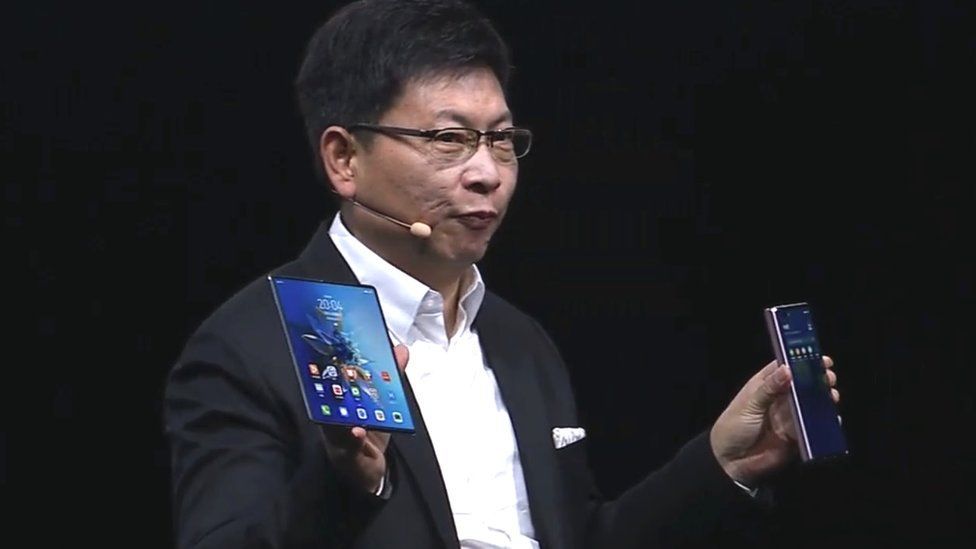
Consumer devices chief Richard Yu hosted the launch event

Unlike many of Huawei's past high-profile launches, this event was hosted in Mandarin Chinese rather than English, reflecting the fact that its sales are still growing in its home market and falling elsewhere.

But the firm has posted a subtitled version on YouTube.

Water drop cavity


Huawei says it developed a new robust hinge mechanism to safeguard its tablet-like display.

When closed, part of the flexible screen folds into a "water drop-shaped" cavity to prevent it coming under strain at the crease.
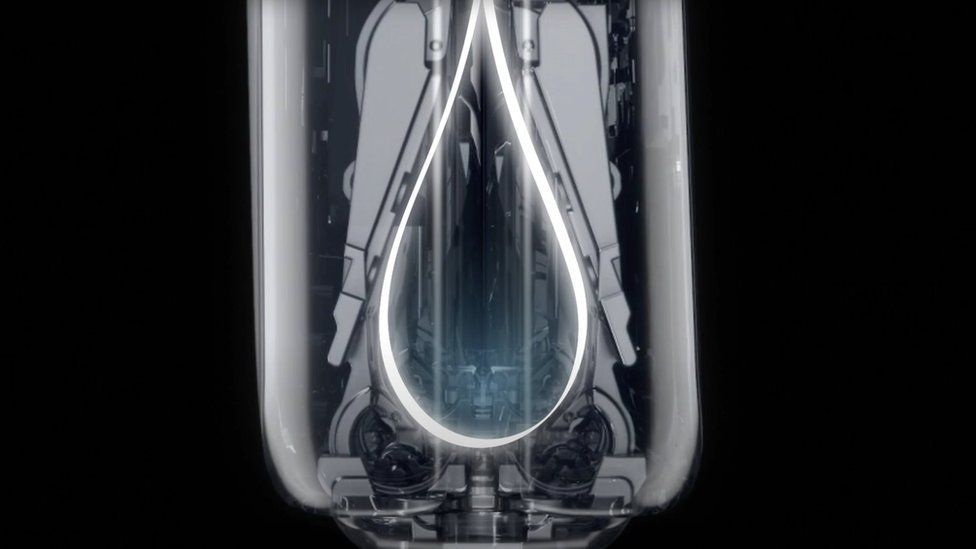
Huawei says its design incorporates high-intensity steel and a carbon fibre support

Mr Yu said an added benefit of the patented innovation was that the crease was also less visible when the screen was opened.

By contrast, the Samsung's Z Fold 2 angles its two halves to create an intentional gap along its spine.

Mr Yu also highlighted that Mate X2's 8-in (20.3cm) main screen was larger than its rival's 7.6-inch (19.3cm) equivalent, and claimed the dimensions of its exterior display - for when the phone is closed - was better suited for apps than its competitor.

In addition, he claimed the use of a new "nano-optical layer" meant the display was much less reflective.
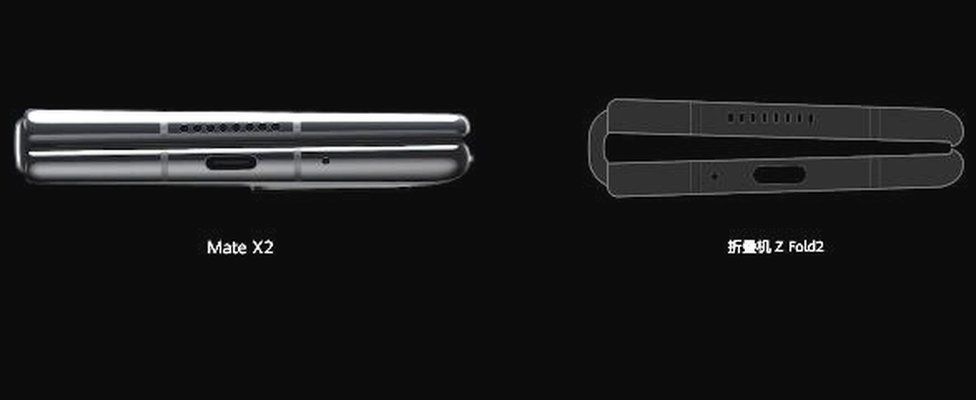
Huawei's design reduces the risk of objects sliding inside the closed flexible screen

But one company watcher said it was an unavoidable fact that Huawei had followed its rival's design lead.

"The original Mate X looked phenomenal with its soft flexible screen wrapped around the outside of the device, but it was instantly apparent that it was going to be extremely vulnerable," commented Ben Wood from CCS Insight.

"And all the ones that I saw failed early in their life."

He added, however, that the high cost of both companies' foldables meant neither would be bestsellers.

"This is more about technology bragging rights, but it signals a real desire to find a new disruptive form factor."

Sales slump


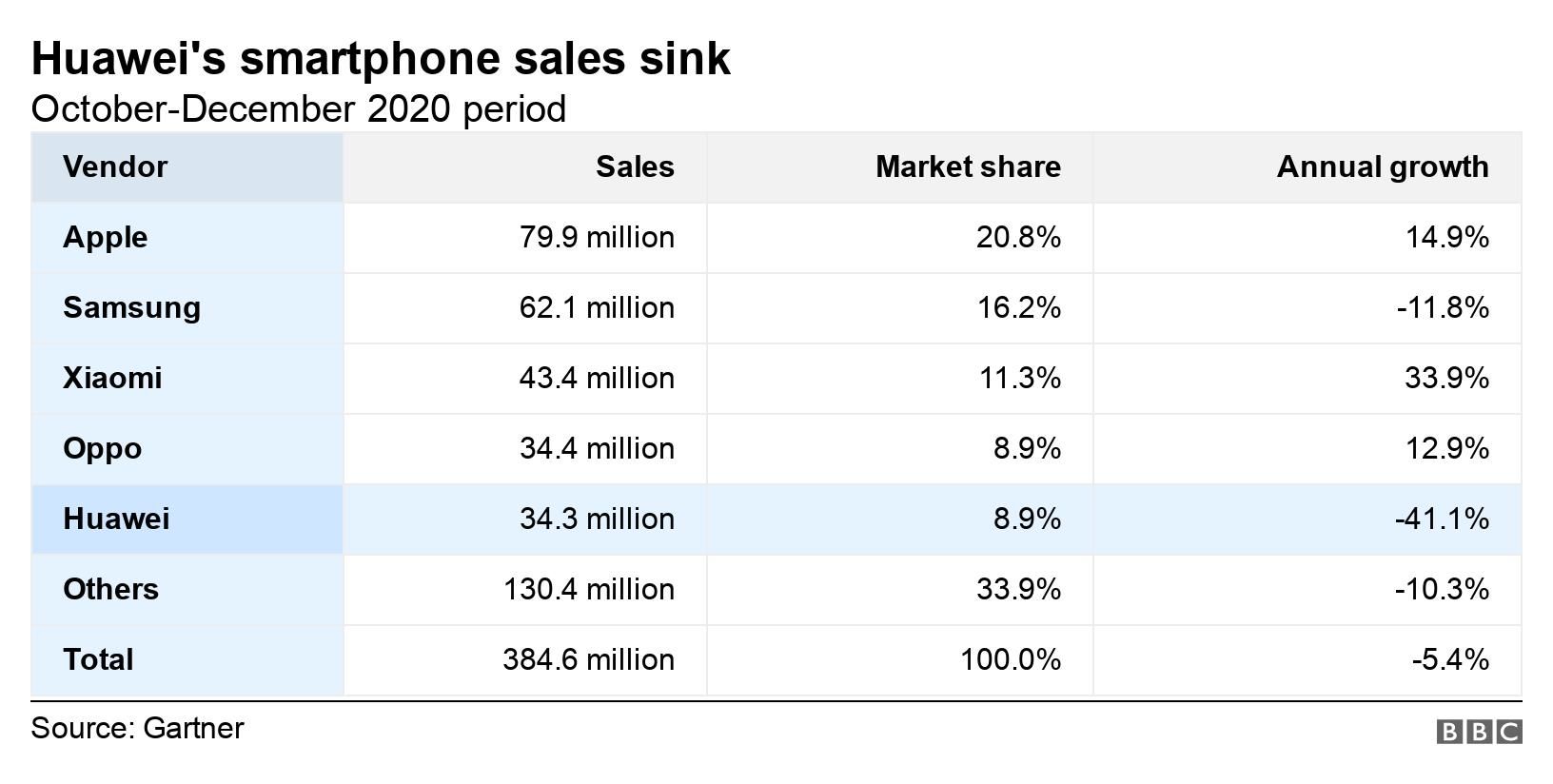
The launch coincides with a report from market research firm Gartner that indicates Huawei sold 41% fewer handsets in final three months of 2020 than the same quarter of the previous year.

This is, in large part, down to it being unable to offer either the Play store or several of Google's other apps - including YouTube, Maps and the Chrome browser - as a result of US trade sanctions.

Huawei offers similar software of its own, as well as the means to "side load" third-party products not listed in its App Gallery marketplace.

Even so, it has seen consumers switch to rival Android handsets, including those of Xiaomi.

"Outside of China, Google services are crucial to end users, and offering alternatives is not really going to work," explained Gartner analyst Anshul Gupta.

"But in China, people don't use Google services, and Huawei has a much stronger distribution network and brand there.

"And it's been able to take share from competitors in its home market."
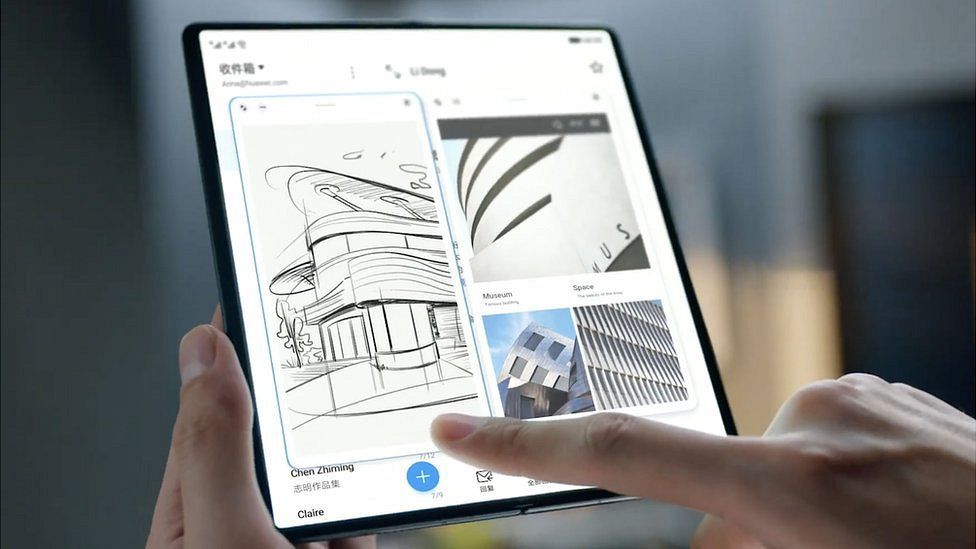
Huawei claims the dimensions of its large and small screens are superior to Samsung's

But even in China, Huawei faces a problem - it only has a dwindling number of its Kirin processors left to power its phones.

Huawei designs its own chips, but had been reliant on a Taiwanese firm, TSMC, to manufacture them.

Only TSMC and Samsung have the expertise and equipment to manufacture the microprocessors involved.

But the US has banned both from doing so on the grounds that Huawei poses a national security risk - something the Chinese firm denies.

Last week, Nikkei Asia reported that Huawei had notified its suppliers that its orders of other smartphone components would be more than 60% lower in 2021 than last year.
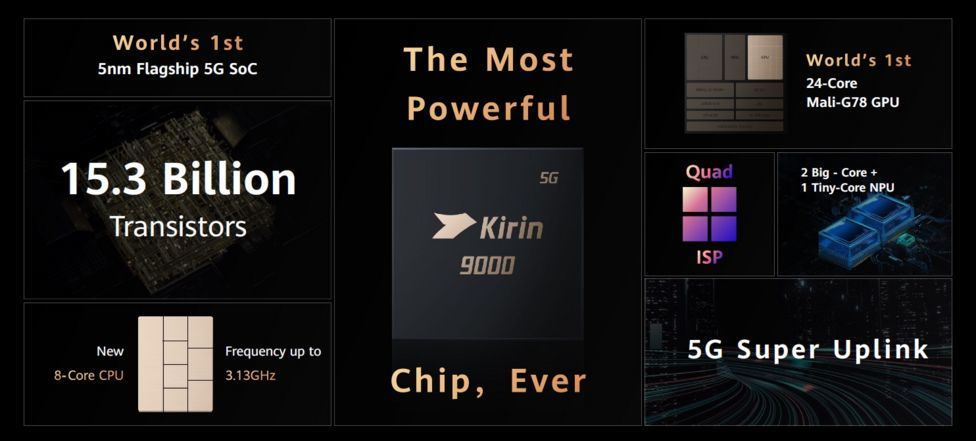
Huawei's press materials boast of its chip's prowess, but it cannot currently produce more of them

Huawei has already sold off its Honor brand.

But the company has denied reports that it is considering a similar move for its flagship brand, with its founder and chief executive Ren Zhengfei telling the press he would "never" sell the division.

"Unless the restrictions are lifted or loosened, or Qualcomm and other chip-makers are given permission to supply Huawei, then I think it will run out of processors in a quarter or two," said Mr Gupta.

Mr Yu said during the launch the firm had enough production capacity to meet demand for the Mate X2.

And when pressed about its wider smartphone business, a spokesman said: "We remain confident about the future."


WATCH: Huawei's earlier folding phones closed "face-out"


Newsletter

Related Articles

Arab Press
0:00
0:00
Close
GCC Secretary-General Holds Talks with EU Ambassador in Riyadh
Gulf States’ AI Investment Drive Seen as Strategic Bet on Technology and U.S. Security Ties
African Union Commission Chair Meets Saudi Vice Foreign Minister to Deepen Strategic Cooperation
President El-Sisi Holds Strategic Talks with Saudi Crown Prince in Riyadh
Lucid Unveils Up to $12,000 Incentive for Air and Gravity Models in Saudi Arabia
Saudi Arabia Enters Global AI Partnership, Expanding Its Role in International Technology Governance
Saudi Arabia’s Landmark U.S. LNG Agreement Signals Major Strategic Shift
Saudi Arabia Accelerates Global Gaming Push with Billion-Dollar Deals and Expanded PIF Mandate
Saudi Arabia Reports $25.28 Billion Budget Deficit in Fourth Quarter of 2025
Alvarez & Marsal Tax Establishes Dedicated Pillar Two and Transfer Pricing Team in Saudi Arabia
United States Approves Over Fifteen Billion Dollars in Major Arms Sales to Israel and Saudi Arabia
Pre-Iftar Walks Gain Momentum as Ramadan Wellness Trend Spreads
Middle East Jackup Rig Fleet Contracts Further After Saudi Drilling Suspensions
Türkiye and Saudi Arabia Prepare to Sign Five Gigawatt Renewable Energy Deal at COP31
King Mohammed VI Congratulates Saudi Leadership on Founding Day, Reaffirming Strategic Ties
US Envoy Huckabee Clarifies Remarks on Israel After Expansionism Controversy
Saudi Arabia Introduces Limited Exceptions to Regional Headquarters Requirement for Foreign Firms
Saudi Arabia Joins Global Partnership on Artificial Intelligence, Elevating Its Role in Shaping AI Governance
Saudi Arabia and Arab States Mobilise Diplomatically After U.S. Envoy’s Israel Remarks
Cristiano Ronaldo Reaffirms His Commitment to Saudi Arabia Amid Transfer Speculation
Proposed US-Saudi Nuclear Deal Raises Questions Over Uranium Enrichment Provisions
Saudi Arabia Sends 81st Aid Flight to Gaza as Humanitarian Air Bridge Continues
Global Games Show Riyadh 2026 Positioned as Catalyst for Saudi Arabia’s Vision 2030
Saudi Arabia Eases Procurement Rules, Allowing Foreign Firms Greater Access to Government Contracts
Türkiye and Saudi Arabia Seal Two Billion Dollar Solar Energy Agreement
Saudi Crown Prince Reportedly Sends Letter to UAE Leader Over Yemen and Sudan Policies
Saudi Arabia Voices Concerns to UAE Over Sudan Conflict and Yemen Strategy
Saudi Arabia Joins Global Artificial Intelligence Alliance to Strengthen International Collaboration
Shura Island Positioned as Flagship of Saudi Arabia’s Ambitious Red Sea Tourism Drive
Saudi Arabia Rebukes Mike Huckabee Over Remarks in Tucker Carlson Interview
OpenAI CEO Sam Altman praises the rapid progress of Chinese tech companies.
Concerns Mount Over Potential Saudi Uranium Enrichment in Prospective US Nuclear Accord
Trump Directs Government to Release UFO and Alien Information
Trump Signs Global 10% Tariffs on Imports
Investability Emerges as the Defining Test of Saudi Arabia’s Next Market Phase
Saudi Arabia’s Packaging Market Accelerates as Sustainability and E-Commerce Drive Transformation
Saudi Arabia Unveils $32 Billion Push Into Theme Parks and Global Entertainment
Saudi Crude Exports to India Climb Sharply, Closing Gap With Russia
Saudi Arabia’s Halal Cosmetics Market Expands as Faith and Ethical Beauty Drive Growth
ImmunityBio Secures Saudi Partnerships to Launch Flagship Cancer Therapy
United Kingdom Denies U.S. Access to Military Base for Potential Iran Strike
Türkiye and Saudi Arabia Launch Expanded Renewable Energy Partnership
US Supreme Court Voids Trump’s Emergency Tariff Plan, Reshaping Trade Power and Fiscal Risk
Mongolian Mining Family’s HK$247 Million Stanley Home Purchase Highlights Resilient Luxury Market
UK Intensifies Efforts to Secure Saudi Investment in Next-Generation Fighter Jet Programme
Saudi Arabia Tops Middle East Green Building Rankings with Record Growth in 2025
Qatar and Saudi Arabia Each Commit One Billion Dollars to President Trump’s ‘Board of Peace’ Initiative
Ramadan 2026 Prayer Times Set as Fasting Begins in Saudi Arabia and Egypt Announces Dates
Saudi Arabia Launches Ramadan 2026 Hotel Campaign to Boost Religious and Leisure Tourism
Saudi Arabia Seeks Reroute of Greece-Bound Fibre-Optic Cable Through Syria Instead of Israel
×