Arab Press

بالشعب و للشعب
Monday, Mar 23, 2026

Huge scale and impact of Israeli incursions over Lebanon skies revealed

Huge scale and impact of Israeli incursions over Lebanon skies revealed

Study documents at least 22,000 overflights in past 15 years as well as psychological effect on country

For decades, the roar of Israeli jets, and the hum of surveillance drones have been regular features in the skies above Lebanon, buzzing towns and cities at will – and acting as constant reminders that war is never far away.

Research, which was published on Thursday, demonstrates just how pervasive that presence has been, with at least 22,000 overflights being documented in the past 15 years alone. Those numbers have made warplanes an abiding soundtrack to Lebanese life and the ever present threat of violence a part of the country’s collective psychology.

Produced by a new organisation, AirPressure.info, the research shows Israeli planes have occupied the skies of Lebanon for a total of eight and a half of the past 15 years. Few of the incursions are brief, with many lasting an average of four hours and 35 minutes. And most involve the most technically advanced fighter planes or surveillance aircraft in the world that basic Lebanese ground defences offer no match for.

Maps of the flight routes taken by the jets and drones reveal a spaghetti bowl of loops over most areas of Lebanon. The flights are concentrated in the south, where they appear to follow set routes. But Beirut is also a frequent destination, as are areas north of the capital and closer to the Syrian border.
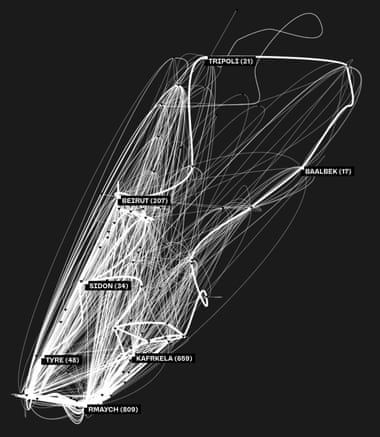
Some of the flight routes taken by the jets and drones.


Lawrence Abu Hamdan, who assembled the research, which is the most comprehensive of its kind, said studies had shown regular exposure to overflights by warplanes had taken a toll on those living below. AirPressure.info has compiled 11 peer-reviewed papers from scientific journals that detail the acute physiological effects of aircraft noise, with symptoms ranging from hypertension to diminished blood circulation and psychosomatic pains.

Perhaps less understood is the psychological effect of foreign warplanes dominating the skies above a civilian population. They often fly at low altitudes that cause alarm and panic.

“While in Lebanon, each one of these acts is felt as a briefly passing moment and no two residents may hear jets in the same way or at the same time,” said Abu Hamdan. “What I aim to present is an accumulated event, one extended crime that has taken place over the past 15 years.

“But really this should be seen as an atmosphere of violence. It takes its toll over time, and that’s why it has the potential to be ignored, but it shouldn’t be ignored any longer. Why should a population live under mass indiscriminate surveillance and live under a hostile sky … to the extent that it’s embodied into everyday life.”

The numbers have been compiled from 243 letters addressed by Lebanon to the UN security council, which were often informed by data supplied by the UN interim force in Lebanon, a peacekeeping mission, and by the Lebanese army.

In addition, over the past two years researchers were hired to survey the skies and chronicle images of Israeli aircraft. “These videos capture the threatening sounds and sights of Israeli military aircraft, as well as the discussion among citizens and residents speaking about what’s happening above them,” said Abu Hamdan.

Israel has long maintained that its intrusions over Lebanon are necessary to gain intelligence of Hezbollah, the militia-cum political bloc that holds sway over most political decisions in the country and outguns the national army. It has also used Lebanese skies to bomb targets in Syria linked to Iran, the key backer of Hezbollah.

The Israeli air force has some of the most powerful surveillance capabilities in the world, and fears that civilian communications are regularly intercepted by Israel’s eavesdropping planes have been regularly raised.

Lebanon and Israel have technically remained at war since the end of decades of civil war and the Israeli withdrawal from south Lebanon in 2000. The last protracted spate of violence was a month-long war between Hezbollah and Israel in the summer of 2006.

Newsletter

Related Articles

Arab Press
0:00
0:00
Close
Egypt Reaffirms Strong Support for Saudi Arabia as Sisi Condemns Iran’s Gulf Attacks
Saudi Stocks Close Higher as Tadawul Index Gains 0.55% on Broad Sector Strength
Iran Fires Ballistic Missiles Toward Riyadh as Gulf Conflict Intensifies
Barcelona Midfielder Marc Casadó Attracts €40 Million Interest from Saudi Clubs
Strait of Hormuz Tensions Rise as Saudi Arabia Opens Key Air Base to US Forces
Saudi Arabia Confronts Strategic Turning Point as Iran Conflict Redefines Regional Alliances
Saudi Arabia Intercepts Missile as Two Others Land in Remote Area Without Casualties
Saudi Expulsion of Iranian Military Attaché Raises Doubts Over Fragile Riyadh–Tehran Rapprochement
Saudi Arabia’s Strategic East–West Pipeline Gains Global Attention as Energy Routes Face Growing Risks
Iran Reportedly Reduces Strikes on Saudi Arabia Amid Concerns Over Strong Retaliation
Saudi Arabia Criticises Israeli Strikes in Southern Syria Amid Rising Regional Tensions
Egypt and Saudi Arabia Warn Iran’s Actions Threaten Stability Across the Gulf
Saudi Arabia Unveils Comprehensive 2026 Roadmap to Streamline Company Formation
Saudi-UAE Tensions Reveal Emerging Rivalry at the Heart of Gulf Power Dynamics
Saudi Arabia Launches Gulf Maritime Support Initiative to Safeguard Shipping
Saudi Arabia Expands US Military Access as UAE Braces for Prolonged Iran Conflict
Saudi Arabia Expels Iranian Diplomats Amid Escalating Regional Tensions
Saudi Arabia’s Edarat Wins Major Data Centre Deal with Regional Bank
Iran Intensifies Gulf Offensive as Saudi Arabia Intercepts Dozens of Drones
Regional Powers Hold Security Talks as Turkey Seeks New Strategic Pact
Asian Refiners Urge Saudi Arabia to Revise Oil Pricing Mechanism Amid War-Driven Volatility
Gulf States Weigh US Base Access and Military Alignment as Iran War Intensifies
IRGC Claims Strikes on Israel, Kuwait and Saudi Arabia as Conflict Widens
Saudi Arabia Intercepts Multiple Drones Amid Continued Iranian-Linked Attacks
Remains of Fallen Soldier Repatriated Following Death in Saudi Arabia
Iran Tensions Challenge Saudi Arabia’s Strategic Shift to Red Sea Oil Exports
Saudi Arabia Turns to Alternative Export Routes as Hormuz Disruption Strains Oil Flows
Saudi Arabia and UAE Move Closer to Backing US-Israeli Campaign Against Iran
Saudi Arabia Signals Readiness for Military Response as Iran Tensions Escalate
Saudi Arabia Warns Oil Could Surge Beyond $180 as Iran Conflict Disrupts Global Supply
Saudi Arabia Reports Drone Strike on Key Red Sea Refinery in Yanbu
United States Urges Citizens to Leave Saudi Arabia Amid Escalating Regional Conflict
Former Media Executive Chronicles Rise of Saudi Crown Prince in New Book
Saudi Aramco–Exxon Refinery in Yanbu Targeted in Latest Wave of Iranian Attacks
Greek-Operated Patriot System Intercepts Iranian Missiles Over Saudi Arabia
Asian Refiners Urge Saudi Arabia to Revise Oil Pricing as War Upends Markets
Arab and Muslim Ministers Convene in Riyadh to Coordinate Response to Iran Crisis
Saudi Arabia Expands Global Partnerships to Accelerate Vision 2030 Transformation
Europe and Japan Signal Readiness to Help Secure Strait of Hormuz Amid Escalating Crisis
Saudi Arabia Signals Firm Stance as Iranian-Linked Attacks Intensify
U.S. Lawmakers Press Rubio to Enforce Strong Safeguards in Saudi Nuclear Deal
Iran Issues Evacuation Warning to Gulf States After Strike on Major Gas Field
Saudi Arabia to Convene Arab and Islamic Ministers for Urgent Talks on Regional Conflict
Saudi Arabia Confirms Eid al-Fitr as Moon Sighting Determines End of Ramadan
Saudi Arabia Boosts Crude Exports to Highest Levels Since 2023, Data Shows
Iran Issues Warning to Gulf Energy Infrastructure Following Strike on Major Gas Field
Saudi Arabia Restarts Ras Tanura Refinery Following Drone Strike, Reinforcing Energy Resilience
Saudi Arabia Intercepts Ballistic Missiles Targeting Riyadh Amid Escalating Regional Tensions
×